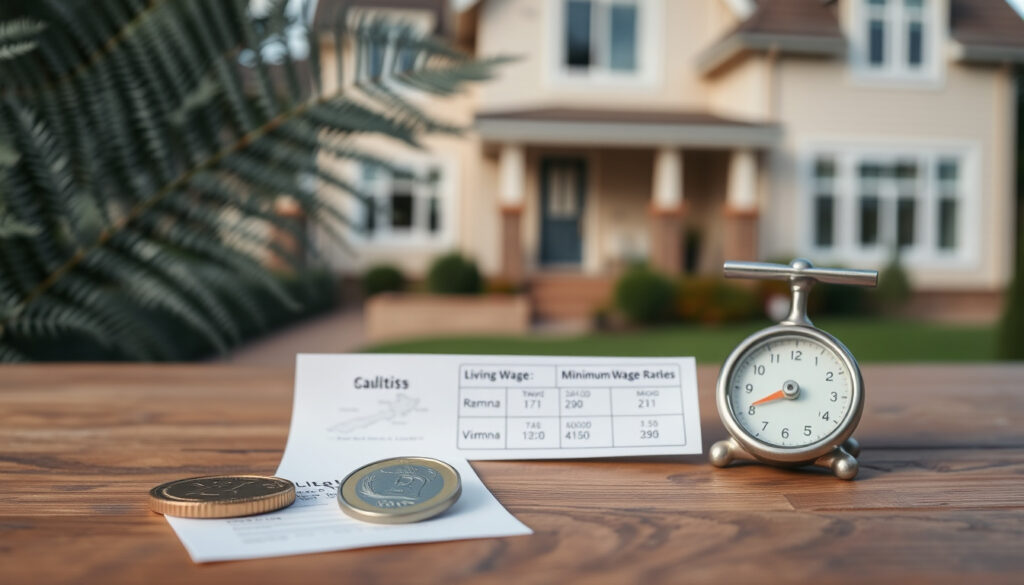
What Is the Living Wage in NZ? Current Rates & Key Differences
It’s easy to assume that a “living wage” is just a nicer name for the minimum wage. In New Zealand, the two standards are very different — one is a legal floor, the other a voluntary benchmark set by a community movement.
Current Living Wage (2025/26): $28.95 per hour ·
Upcoming Living Wage (2026/27): $29.90 per hour ·
Current Minimum Wage (adult): $23.50 per hour ·
Median Annual Salary (NZ): ~$70,000
Quick snapshot
- Living Wage 2025/26: $28.95/hour (Living Wage Movement Aotearoa New Zealand)
- Adult minimum wage: $23.50/hour (Employment New Zealand / MBIE)
- Living Wage is voluntary, not legally required (Living Wage Movement Aotearoa New Zealand)
- Exact after-tax take-home pay depends on individual tax codes and deductions
- The number of accredited employers changes over time
- 2012: Movement founded
- 1 Sept 2025: $28.95 rate takes effect
- 1 Sept 2026: $29.90 rate begins
- Annual review in 2026 sets the 2027/28 rate
- More employers may adopt accreditation
Five key facts side by side: the Living Wage movement’s numbers against the legal minimum and the national median.
| Label | Value | Source |
|---|---|---|
| Current Living Wage (hourly) | $28.95 (until 31 Aug 2026) | Living Wage Movement Aotearoa New Zealand |
| Next Living Wage (hourly) | $29.90 (from 1 Sept 2026) | Living Wage Movement Aotearoa New Zealand |
| Current Minimum Wage (adult, hourly) | $23.50 | Employment New Zealand / MBIE |
| Median Annual Salary | ~$70,000 | Employment New Zealand / MBIE |
| Living Wage Movement Founded | 2012 | Living Wage Movement Aotearoa New Zealand |
What is the living wage per hour in NZ?
Living Wage rate for 2025/26
- The current Living Wage is $28.95 per hour for the year from 1 September 2025 to 31 August 2026 (Living Wage Movement Aotearoa New Zealand).
- This is a $1.15 increase from the 2024/25 rate of $27.80, a 4.2% rise in line with New Zealand’s average ordinary time hourly rate (Living Wage Movement Aotearoa New Zealand).
Living Wage rate for 2026/27
- From 1 September 2026, the rate will rise to $29.90 per hour for the 2026/27 year (Living Wage Movement Aotearoa New Zealand).
- This is the next announced rate, set to keep pace with cost-of-living changes.
How the rate is set
- The Living Wage Movement Aotearoa New Zealand calculates the rate annually based on actual household costs: food, housing, transport, child care, and modest savings (Living Wage Movement Aotearoa New Zealand).
- It is not a government mandate — it’s a voluntary standard that accredited employers choose to follow.
The Living Wage is pegged to real expenses, not a political bargaining chip. For a worker earning $28.95/hour, the difference vs the minimum wage of $23.50 means an extra $218 per 40-hour week — enough to cover weekly groceries for a family of four.
The implication: the Living Wage is a living document, not a static number. It moves with the economy, and every year employers who sign up commit to paying that higher floor.
What is the difference between minimum wage and living wage in NZ?
Current NZ minimum wage (2025)
- The adult minimum wage is $23.50 per hour as set by the Ministry of Business, Innovation and Employment (Employment New Zealand / MBIE).
- For an 8-hour day: $188.00; a 40-hour week: $940.00; an 80-hour fortnight: $1,880.00 (Employment New Zealand / MBIE).
Legal vs voluntary wage standards
- The minimum wage is legally binding — every employer must pay at least this amount.
- The Living Wage is voluntary — only employers accredited by the Living Wage Movement are required to pay it (Living Wage Movement Aotearoa New Zealand).
- Think of the minimum wage as the floor of a building and the Living Wage as the level where a family can actually live without constant financial stress.
Who must pay each
- All employers in New Zealand must pay the minimum wage.
- Only Living Wage-accredited employers pay the Living Wage. They also commit to paying it to contractors and outsourced workers in many cases (CATAS (employer advisory)).
Two rates, one comparison: the gap of $5.45 per hour adds up to $11,336 a year for a full-time worker.
| Metric | Minimum Wage (adult) | Living Wage (2025/26) |
|---|---|---|
| Hourly rate | $23.50 | $28.95 |
| Weekly (40 hrs) | $940.00 | $1,158.00 |
| Annual (52 weeks) | $48,880 | $60,216 |
| Legal requirement | Mandatory | Voluntary (accredited employers) |
| Set by | Government (MBIE) | Living Wage Movement Aotearoa NZ |
A worker on the Living Wage takes home about $218 more per week than a minimum-wage worker. But because it’s voluntary, only a fraction of employers offer it — meaning many workers don’t have access to that higher rate.
What is the minimum wage in New Zealand after tax?
Estimated take-home pay at minimum wage
- After PAYE and ACC deductions, a minimum-wage worker on the standard “M” tax code takes home approximately 79–82% of gross (New Zealand Finance (third-party calculator)).
- That translates to roughly $19.50 per hour after tax for a full-time worker with no special deductions.
PAYE and ACC deductions explained
- PAYE (Pay As You Earn) income tax is deducted at source based on your tax code.
- ACC (Accident Compensation Corporation) levies are also deducted — about 1.46% of gross earnings.
- Actual after-tax amounts vary by tax code, student loan repayments, and KiwiSaver contributions.
The after-tax estimate is a rough guide. A worker on the Living Wage ($28.95/hour) after tax might take home about $23.70/hour — still a significant step up from minimum wage, but the exact figure depends on their personal deductions.
The pattern: the tax system is progressive, so the gap between gross and net narrows slightly as income rises, but the Living Wage still leaves workers with a noticeably larger slice.
Who is eligible for living wage in NZ?
Employer accreditation requirements
- Only employers who have been accredited by the Living Wage Movement Aotearoa New Zealand must pay the Living Wage (Living Wage Movement Aotearoa New Zealand).
- Accreditation involves a commitment to pay the Living Wage to all directly employed staff and to work towards extending it to contractors.
Employee eligibility
- If you work for an accredited employer, you are covered — regardless of your role, as long as you are a direct employee.
- Part-time, full-time, and casual employees of accredited employers all qualify.
Contractor and outsourced worker coverage
- Some accredited employers require their contractors to also pay the Living Wage to their own staff, but this is not universal (CATAS (employer advisory)).
- If you are a contractor, check your client’s accreditation policy — you may still be on the minimum wage.
Why this matters: eligibility is tied to the employer, not the job. A cleaner at an accredited university earns the Living Wage; the same role at a non-accredited company does not.
Is $70,000 a good salary in NZ?
Median salary context
- The median annual salary in New Zealand is approximately $70,000 (Employment New Zealand / MBIE).
- That means half of full-time workers earn less, half earn more.
Cost of living by region
- A $70,000 salary goes further in regions like Southland or Manawatū than in Auckland or Wellington, where housing costs are significantly higher.
- In Auckland, the median rent for a two-bedroom apartment is over $600 per week, eating more than 40% of a $70,000 after-tax income.
Individual vs household income
- For a single person, $70,000 is generally comfortable — it’s well above the Living Wage equivalent of about $60,200 annually.
- For a family with children, $70,000 can be tight, especially if housing costs are high.
$70,000 is the median, not a benchmark of comfort. A worker earning that amount is in the middle of the pack, but location and household size determine whether it feels like enough.
The trade-off: earning the Living Wage ($28.95/hour) gives you about $60,200 a year — still $10,000 below the median. So $70,000 is a step up, but not a leap into affluence.
Timeline
- 2012 — Living Wage Movement Aotearoa New Zealand is founded (Living Wage Movement Aotearoa New Zealand).
- 1 September 2025 — Living Wage rate set at $28.95 per hour for 2025/26 (Living Wage Movement Aotearoa New Zealand).
- 1 September 2026 — Living Wage rate increases to $29.90 per hour for 2026/27 (Living Wage Movement Aotearoa New Zealand).
- Ongoing — Rate reviewed annually based on cost-of-living changes.
The pattern: the Living Wage has risen steadily, reflecting real inflation. The 4.2% increase in 2025/26 matched the average wage growth in the economy.
Clarity
Confirmed facts
- Living Wage is $28.95/hour for 2025/26 (Living Wage Movement Aotearoa New Zealand).
- Living Wage will increase to $29.90/hour from 1 September 2026 (Living Wage Movement Aotearoa New Zealand).
- Adult minimum wage is $23.50/hour as of 2025 (Employment New Zealand / MBIE).
- Median annual salary in NZ is approximately $70,000 (Employment New Zealand / MBIE).
What’s unclear
- Exact after-tax amounts depend on individual tax codes and deductions.
- Number of Living Wage accredited employers may change over time.
Expert perspectives
The Living Wage is an hourly rate. Set apart from the minimum wage, it’s worker and whānau focused.
— Living Wage Movement Aotearoa New Zealand, official website
The minimum wage is the minimum amount an employer must pay an employee — it’s a legal floor, not a living standard.
— Employment New Zealand / MBIE, minimum wage rates page
For a minimum-wage worker in New Zealand, the choice is clear: if you can find an accredited employer, the Living Wage adds over $11,000 a year to your pay. If not, you’re left with the legal floor — and the gap between $23.50 and $28.95 is the difference between scraping by and having a buffer.
Related reading: **Living Wage Movement Aotearoa New Zealand – 2025/26 Living Wage rate** · **Employment New Zealand – Minimum wage rates and types (adult minimum wage)**
nzreview.org, bh-accounting.co.nz, salaries.co.nz, instagram.com, nz.icalculator.com, facebook.com, livingwage.org.nz, moneyhub.co.nz
Frequently asked questions
What is the living wage for 2025/26 in NZ?
The Living Wage is $28.95 per hour, effective from 1 September 2025 to 31 August 2026 (Living Wage Movement Aotearoa New Zealand).
How often does the NZ living wage change?
It is reviewed annually, with a new rate announced each year before 1 September.
Is the living wage the same as minimum wage?
No. The minimum wage is legally required ($23.50/hour); the living wage is a voluntary, higher standard ($28.95/hour).
How is the living wage calculated?
The Living Wage Movement calculates it based on the actual costs of housing, food, transport, child care, and other essentials for a basic but decent life (Living Wage Movement Aotearoa New Zealand).
Do all employers in NZ have to pay the living wage?
No. Only employers accredited by the Living Wage Movement are required to pay it.
What is the after-tax amount of the living wage in NZ?
After typical PAYE and ACC deductions, a worker on the Living Wage (tax code M) takes home roughly $23.70 per hour, but this varies by individual circumstances.
Can I use a living wage calculator for NZ?
Yes, third-party salary calculators exist, but for official information check the Living Wage Movement website.
Is $70,000 a good salary compared to the living wage?
$70,000 is the median salary. It is about $10,000 above the annual equivalent of the Living Wage ($60,216), so it is a comfortable income for a single person but may be tight for a family in high-cost areas.
More related posts
 BNZ KiwiSaver Withdrawal Form: Step-by-Step Guide
 Sydney Sweeney Movies and TV Shows: Full List
 Thing 1 and Thing 2: Origins, Appearance, and Cultural Impact
 Cheap Dinner Ideas NZ: 10 Budget-Friendly Meals for Families
 What Does BV Discharge Look Like? Color, Odor & Symptoms
 Phantasmal Flames Card List: Complete 94-Card Checklist
 Evelyn Page Retirement Village: Costs, Reviews & FAQ | Orewa NZ
 What is Lyme Disease? Symptoms, Causes, Treatment, and Prevention