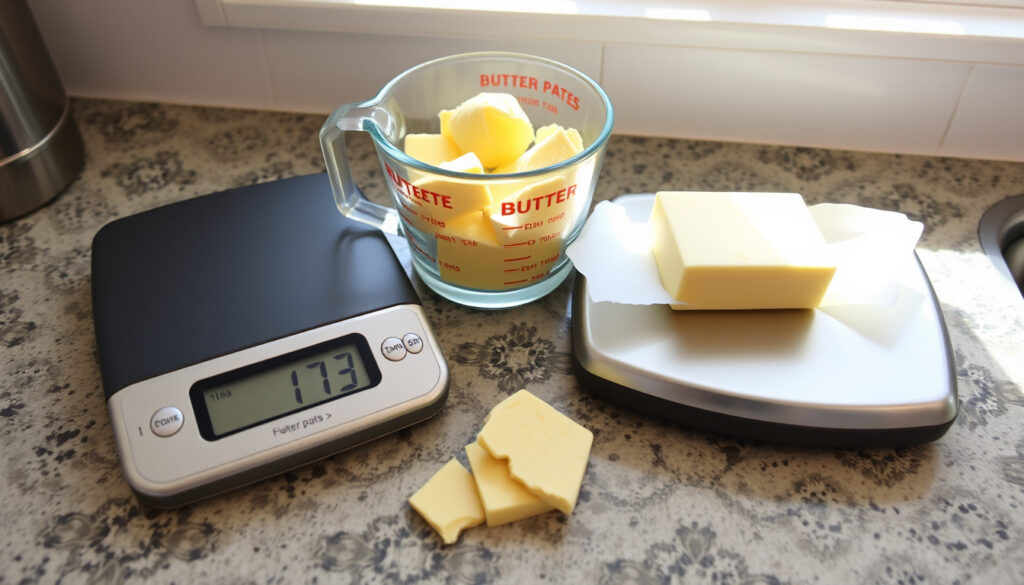
1/2 Cup of Butter in Grams: 113g, 8 Tbsp, 1 Stick (Exact)
It starts with a familiar kitchen moment: the recipe calls for half a cup of butter, but the block on the counter is marked in tablespoons, not cups — the quick answer, 113 g (8 tablespoons or one standard US stick), comes straight from King Arthur Baking’s ingredient weight chart. The catch is rounding: charts split between 113 g and slightly higher values, so it helps to know which number a recipe really means.
1/2 cup butter (exact): 113.4 g · US recipe rounding: 113 g · Tablespoons: 8 tbsp · US sticks: 1 stick · 1 cup butter: 226.8 g
Quick snapshot
- 1/2 cup butter = 113 g · 8 tbsp · 1 stick (King Arthur Baking)
- Converters that start from 227 g per cup get 113.5 g (Cup Gram Converter)
- A 250 g block is about 1.1 cups, not half a cup (CookingCalculator)
- Next bake, follow the stick wrapper’s 8-tablespoon mark, or weigh 113 g (CookCalcs)
Six measurements, one pattern: every value below traces back to the same 4-ounce US stick, which is why the cup-to-gram conversions stay consistent instead of random.
| Measurement | Grams | Also equals | Reference |
|---|---|---|---|
| 1/2 cup, exact | 113.4 g | 4 oz · 1 stick | Southern Living |
| 1/2 cup, recipe charts | 113 g | 8 tbsp · 1 stick | Land O’Lakes |
| 1/2 cup, converter basis | 113.5 g | 227 g ÷ 2 | Cup Gram Converter |
| 1 cup, recipe charts | 227 g | 16 tbsp · 2 sticks | Land O’Lakes |
| 1/4 cup (half stick) | 56.5 g | 4 tbsp | Texas Real Food |
| 250 g block (metric) | 250 g | ≈ 1.1 cups | CookingCalculator |
How many grams is 1/2 cup of butter?
Half a US cup of butter is 8 tablespoons, one standard US stick, and 113.4 g in exact weight — the 4-ounce stick value in the table above. The number that actually shows up in recipes is 113 g, which is the same stick measured on a chart that rounds for practical baking.
Why the decimal gap? US sticks are cut to 4 ounces, and 4 ounces converts to 113.4 g at the standard 28.35 g per ounce. Charts that start from a rounded 227 g per cup divide to 113.5 g instead — the difference is rounding policy, not different butter.
For metric-scale bakers, the rule to memorize is 1 cup = 226.8 g. Half a cup is therefore 113.4 g, and a scale settles the 113-versus-113.5 debate before the butter hits the bowl.
- 1/2 cup of butter = 8 tablespoons = 1 standard US stick, and the stick’s wrapper marks show both lines. (Land O’Lakes)
- The same half cup weighs 4 ounces — 1/4 pound — on any US kitchen scale. (Southern Living)
The catch: if a recipe says “half a cup” and your butter arrives in a 250 g block, the wrapper logic disappears. That’s where the gram value matters — 113 g, not “about half the block.”
The pattern: every US conversion hangs off the same 4-ounce stick, so half a cup, 8 tablespoons, and 113 g are different labels for the same point on the wrapper.
How many grams are in 1 cup of butter?
One US cup of butter is 226.8 g in exact weight, or 227 g on most recipe charts. The reason the numbers come out so clean is the stick: Southern Living confirms that 1 US cup equals two standard sticks, and the Land O’Lakes reference above rounds the full cup to 227 g.
- A 1-pound block of butter = 4 sticks = 2 cups. (Southern Living)
- 1 cup = 2 sticks = 8 ounces = 226.8 g exact. (Land O’Lakes)
Three rounding conventions, one pattern: the charts diverge only after the decimal point, and the whole spread is smaller than a pat of butter.
| Rounding basis | 1/2 cup result | Where you see it |
|---|---|---|
| Exact stick math | 113.4 g | US stick at 4 oz (Southern Living) |
| Recipe-standard rounding | 113 g | Baking charts such as Baking Like a Chef |
| 227 g-per-cup converters | 113.5 g | Utilities such as Cup Gram Converter |
The trade-off: recipe charts round for speed, and converters round for symmetry, so the same half cup can be printed three different ways. None of those numbers will ruin a batch; only reaching for 100 g or 250 g will.
Is 250g of butter half a cup?
No — and this is the mistake that trips metric-scale bakers most often. As noted in the table above, a 250 g butter block is roughly 1 US cup plus 1 tablespoon when measured against a 227 g-per-cup reference. That puts 250 g at about 1.1 cups — more than double the 113 g half-cup target.
Is 100g of butter 1/2 cup?
- 100 g ÷ 227 g per cup (the rounded chart base from above) lands at about 0.44 cups — just under half. (Land O’Lakes)
- That’s roughly 13 g short of the 113 g target, which is close to a whole tablespoon of butter missing from the batch.
For a biscuit dough, that missing tablespoon is the difference between flaky and dry; for a sauce, it disappears. The “about 100 g” habit is a fast shortcut, but it doesn’t survive contact with pastry.
Is 113g of butter half a cup?
- Yes — Baking Like a Chef’s chart treats 113 g as the appropriate rounded conversion for 1/2 cup of US-style butter.
- Yes — and the 113.5 g converter value is the same half cup measured from a 227 g base, so either number works when a recipe calls for 113 g. (Cup Gram Converter)
The other variable is the cup itself: US recipes measure with the US legal cup (236.6 ml), while some metric recipes use a 250 ml cup. The same “cup” then points at a slightly different gram target.
Halving a 250 g block to get “half a cup” gives you about 125 g — roughly 12 g, or nearly a full tablespoon, over the 113 g target. Repeat that across a baking day and the yield drifts batch to batch.
The catch: “half a cup” is a US legal measure, not a metric truth. On a scale, the target is 113 g, and a 250 g block is more than a full cup by a tablespoon — not a half-cup stand-in.
How many tablespoons is 1/2 cup of butter?
Eight tablespoons — the same number that appears on US butter wrappers as the half-cup mark. Land O’Lakes’ kitchen reference lists 1/2 cup of butter as 8 tablespoons and 1 stick, which is why a wrapper is the fastest measuring tool in the drawer.
- 8 tablespoons of butter weigh 113 g (113.4 g exact). (King Arthur Baking)
- 1 stick = 8 tbsp = 1/2 cup = 4 oz. (Southern Living)
- US sticks print tablespoon divisions on the paper, so the 8-tablespoon point is visible without any measuring cup. (CookCalcs)
Why this matters: the 8-tablespoon line is repeatable — no melting, no packing, no guesswork. Volume measures change with temperature; the stick’s printed line does not.
What does 1/2 cup of butter look like?
In a US store, half a cup of butter is one standard stick — the quarter-section of the familiar 1-pound box, with each stick weighing 1/4 pound (Southern Living).
If your butter has wrapper marks, follow those marks instead of packing soft butter into a measuring cup. If it doesn’t, the 1-pound block method below gives you the same half-cup point without a scale.
How to measure 1/2 cup of butter without a scale
- Read the wrapper. US sticks carry tablespoon divisions, so the 8-tablespoon mark is the half-cup line (CookCalcs notes the wrapper markings).
- Cut the 1-pound block into four equal quarters. Each quarter is one stick and one half cup; the How Many Sticks of Butter guide walks through the same visual.
- Weigh it when the paper is featureless. Target 113 g on a scale; a 250 g block is not a half-cup portion. (Baking Like a Chef)
The takeaway: a US stick is a built-in measuring device — the quarter-point of a pound block is half a cup, even when no cup measure is anywhere near the counter.
What’s confirmed vs what’s still unclear
Confirmed facts
- 1/2 US cup of butter is 113 g in the rounded conversion most recipes expect (Baking Like a Chef).
- The exact half-cup weight is 113.4 g, because one standard US stick is exactly 4 ounces (Southern Living).
- 250 g of butter works out to about 1.1 cups — not the half-cup some metric shortcuts assume. (CookingCalculator)
What’s unclear
- Whether a given recipe is written with 113 g, 113.5 g, or 115 g rounding in mind.
- Whether the recipe means a US cup or a metric cup — the target gram weight changes with the cup standard.
- Whether butterfat and moisture variation shifts the printed weight enough to matter in that particular bake.
The pattern: ounces and sticks behave predictably, but rounding and cup standards do not. The scale removes both doubts at once.
What the conversion guides actually say
American butter sticks carry tablespoon division marks on the wrapper, so the 8-tablespoon line is the half-cup point printed right on the parchment.
European butter is often sold in 250 g blocks rather than US-style sticks, and one 250 g block comes out to roughly 1 US cup plus 1 tablespoon.
What this means: the wrapper answers in tablespoons, the scale answers in grams, and a 250 g block answers in “more than a cup.” Pick the unit that matches your recipe and ignore the rest.
The conversion that survives every chart is 113 g for half a cup, because it lands closest to the exact 113.4 g stick weight without pretending a recipe needs that precision. The rounding debate — 113, 113.5, or 115 — is real but small: the entire spread is a fraction of a tablespoon at butter’s normal density. For a metric-scale baker, the consequence is clear: weigh 113 g per half cup, let the wrapper marks handle US sticks, and treat any 250 g or 100 g block as the different quantity it actually is — the scale never rounds against you.
Related reading: How Many Sticks of Butter · How to Measure Butter for Baking
Frequently asked questions
What is 1/4 cup of butter in grams?
About 56.5 g, which is 4 tablespoons or half a US stick — the half-stick value in the conversion table above. (Texas Real Food)
What is 1/3 cup of butter in grams?
About 75.6 g — one-third of the exact 226.8 g cup weight.
What is 2/3 cup of butter in grams?
About 151 g — double the third-cup weight, or about 10 2/3 tablespoons.
What is 3/4 cup of butter in grams?
About 170 g — triple the quarter-cup value in the table above, or 12 tablespoons.
How much does one tablespoon of butter weigh?
About 14 g, the rounded value on King Arthur Baking’s ingredient weight chart.
Whatever the fraction, the arithmetic starts from one fixed point: a US cup of butter is 226.8 g, so half is 113.4 g and the recipe-safe round number is 113 g.
More related posts
 Cast of Bridge to Terabithia: Full 2007 Movie Actors List
 New Zealand Winter Mortgage Rates 2025: Forecast & Savings
 Original 7 Wonders of the World: Complete Guide & List
 Benfica vs Real Madrid: Head-to-Head History & 2026 Results
 What Would My Repayments Be? Mortgage Calculator Guide 2025
 AA Car Insurance Login: How to Access Your Policy in Ireland
 Star Wars Battlefront 3: Cancellation, Status, and Fan Hopes
 Loui e Penny Book in Order with Summarie