Novo Nordisk Share Price: Data, Decline, and Competitive Analysis
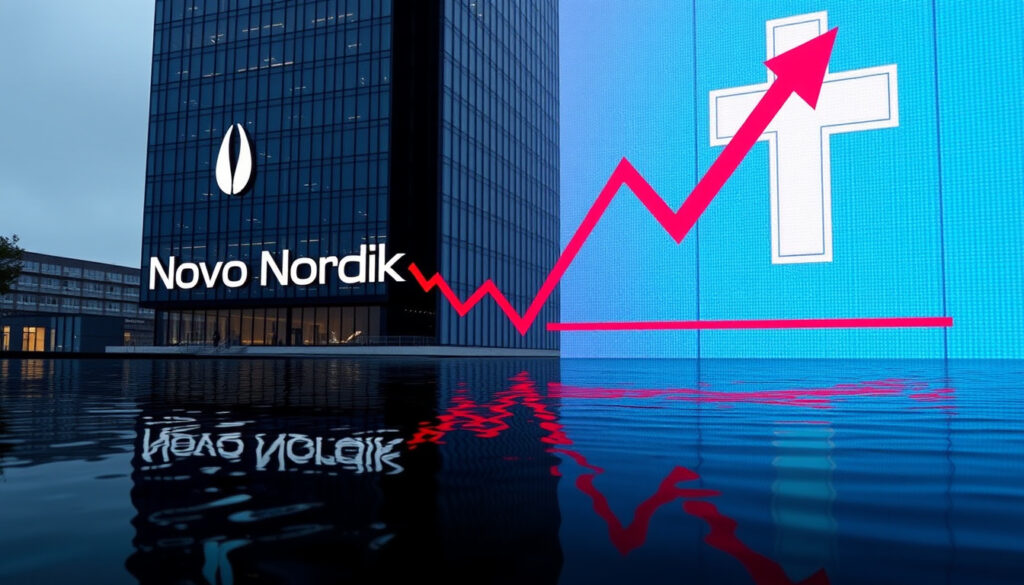
Anyone watching Novo Nordisk’s stock over the past year has felt the whiplash. The Danish company behind Ozempic and Wegovy saw its share price fall 10.6% in 2024 — from DKK 698 to DKK 624 — even as obesity-care sales rose 56% to DKK 65.146 billion, according to the Novo Nordisk Annual Report 2024 (company financials). The current snapshot shows the ADR at $38.83 after a steep one-day drop, with the competitive gap to Eli Lilly narrowing.
NVO ADR: $38.83 ·
Market Capitalization: $128.55B ·
52-Week Range: $35.12 – $64.16 ·
One-Day Change: -8% ·
NOVO B (Previous Close): DKK 263.45
Quick snapshot
- NVO ADR closed at $38.83 after an 8% one-day decline (The Motley Fool (investor education site))
- Market capitalization above $128 billion (The Motley Fool (investor education site))
- 52-week range of $35.12 – $64.16 (Morningstar (investment research firm))
- The exact catalysts for the 8% one-day drop are not detailed in available market coverage
- A reported plan to lay off 9,000 employees is circulating as an investor question, not a confirmed company announcement
- How far U.S. pricing pressure will cut into future net sales
- Q2 2024 results day: shares fell about 7%, from DKK 888 to DKK 828.40 (Genetic Engineering & Biotechnology News (biotech trade publication))
- NOVO B (Copenhagen) previous close of DKK 263.45 (Morningstar (investment research firm))
- Quarterly Ozempic and Wegovy sales will be the key catalyst investors watch
- The revenue gap with Eli Lilly is narrowing, and each GLP-1 quarter will move the stock
- Any confirmed update on the reported workforce reduction would shift sentiment quickly
Six numbers, one pattern: the market is pricing Novo Nordisk below its 2024 highs while the business keeps reporting growth. The figures are market data compiled from the same quote sources cited in the snapshot cards above.
| Metric | Value |
|---|---|
| Latest NVO Close Price | $38.83 |
| Market Capitalization | $128.55B |
| 52-Week Range | $35.12 – $64.16 |
| Shares Outstanding | 4.41B |
| One-Day Decline | 8% |
| Previous Close (NOVO B) | DKK 263.45 |
Why did Novo Nordisk stock fall?
The decline has two layers. The first is a valuation reset: after a huge run, investors stopped paying premium multiples for future GLP-1 growth and started pricing in competition. The second layer is specific to the latest session, where the stock fell sharply without a single company announcement to explain the move.
- Lilly’s momentum. Eli Lilly’s Mounjaro sales reached $3.09 billion in the second quarter of 2024 — more than triple the year-earlier amount (CNBC (business news network)).
- A softer quarter. Novo Nordisk’s Q2 2024 results were affected partly by weaker-than-expected sales of Wegovy and Ozempic and by pricing pressure (CNBC (business news network)).
- A one-day blow-off. The latest session pushed the ADR down 8%; available coverage does not pin the drop to a single event.
The long-term pattern matters more than the one-day move: Novo Nordisk kept growing through the sell-off, which is why the drop is best framed as a repricing of the story rather than a breakdown in the business.
Why is Novo Nordisk laying off 9000 employees?
The 9,000 figure is an investor question, not a company headline. No confirmed announcement in the available filings or earnings coverage supports a workforce reduction of that size.
The question keeps appearing in investor searches and discussions, and it captures the mood: after years of hiring to meet Ozempic and Wegovy demand, investors are now asking whether the company is preparing for slower growth. Until Novo Nordisk addresses it directly, the rumor adds noise to every down day.
The pattern: a high-multiple growth stock falls hardest when the story shifts from “the only winner” to “one of two winners.” That shift — not the rumor of the day — is the real reason the share price keeps sliding.
The takeaway: the decline reflects a repricing of the story, not a breakdown in the business.
What is the current price of Novo Nordisk stock on the TSX?
There is no TSX listing. Canadian investors who search for a Toronto-traded Novo Nordisk share will find the company’s U.S. American Depositary Receipt instead: the NVO ticker, which trades on the NYSE in U.S. dollars and is available through standard brokerage accounts.
- NVO ADR (U.S.): $38.83, after an 8% one-day decline
- NOVO B (Copenhagen, previous close): DKK 263.45
- Market capitalization: $128.55B
- 52-week range: $35.12 – $64.16
These reference points come from the key facts table above, which compiles market data from the quote sources cited in the snapshot. The ADR price is the figure most quote tools will show; the NOVO B price is the home-market reference that Danish and European investors use.
The practical point: there is no “Novo Nordisk.TO” ticker, so Canadian watchlists should use NVO. The difference between the ADR and the Copenhagen share price reflects currency, fees, and trading mechanics — not a different business.
Is Novo Nordisk a good stock to buy right now?
The honest answer is conditional. The company is financially strong and its franchise is still growing; the stock, however, is in the middle of a repricing that may not be finished. Whether that makes it a buy depends on whether you trust the long-term obesity-care story or need the stock to work within the next few quarters.
Upsides
- First-mover position in obesity care, with Wegovy and Ozempic as established GLP-1 brands
- Obesity-care sales are still growing fast — up 56% in 2024 to DKK 65.146 billion, the strongest single fundamental argument for the stock
- A controlling foundation shareholder with a long-term mandate
Downsides
- Eli Lilly is closing the GLP-1 revenue gap with faster-growing Mounjaro and Zepbound
- Q2 2024 showed pricing pressure and softer-than-expected Wegovy and Ozempic sales
- The stock is near the bottom of its 52-week range, where bad news tends to hurt more
The core tension is simple: Novo Nordisk’s products are still market leaders, but the market no longer treats leadership as permanent. Lilly’s clinical and commercial momentum is the variable that changed the price.
For Novo Nordisk, the bull case is a durable first-mover advantage in obesity care; the bear case is that Lilly’s tirzepatide franchise is growing faster and U.S. net pricing is under pressure. The share price will follow whichever story wins the next few quarters.
The decision rests on whether the repricing has run its course, which only the next few quarters will answer.
Who is the biggest competitor of Novo Nordisk?
Eli Lilly, and the distance between the two is measurable in quarterly GLP-1 revenue. Mounjaro and Zepbound are growing from a smaller base but at a faster rate, which is why the market now treats Lilly as the reference competitor for Novo Nordisk.
Which stock is better, Eli Lilly or Novo Nordisk?
The answer depends on whether you weight current momentum (Lilly) or commercial scale (Novo Nordisk). The table below frames the trade-off with reported 2024 data.
Three rows, one pattern: Novo Nordisk still holds the bigger GLP-1 franchise, but Lilly has the faster momentum — and U.S. net pricing is sloping against Novo.
| Dimension | Novo Nordisk (NVO) | Eli Lilly (LLY) |
|---|---|---|
| Primary GLP-1 products | Ozempic, Wegovy | Mounjaro, Zepbound |
| H1 2024 revenue momentum | Sales +24% to DKK 133.409B; operating profit +18% to DKK 57.78B (Genetic Engineering & Biotechnology News (biotech trade publication)) | Mounjaro $4.897B; Zepbound $1.761B (Genetic Engineering & Biotechnology News (biotech trade publication)) |
| 2024 U.S. pricing trend | Average U.S. prices after rebates declined (Novo Nordisk Form 20-F 2024 (regulatory filing)) | Not addressed in the cited research |
The pattern: “which stock is better” is often the wrong question. The better question is which company is better positioned for the next five years — and that answer depends on how much of Lilly’s momentum is already in Lilly’s own share price.
Who are the big 3 in pharma?
- The old big 3: Pfizer, Merck, and Roche still dominate total pharma revenue, but none of them leads the GLP-1 category.
- The GLP-1 big 2: the growth market that now drives Novo Nordisk’s valuation has two leaders — Novo Nordisk and Eli Lilly.
Who owns the most Novo Nordisk stock?
The Novo Nordisk Foundation does. The Danish non-profit foundation controls the majority of voting shares in Novo Nordisk A/S, which makes it the single most important owner of the company — and a quiet force in the stock’s governance and stability.
What is the ownership breakdown of Novo Nordisk?
- Novo Nordisk Foundation: majority voting control via its shareholding in Novo Nordisk A/S (Novo Nordisk Form 20-F 2024 (regulatory filing))
- Institutional investors: hold most of the remaining free float, which adds quarterly performance pressure to the share price
- Insider and retail holders: a smaller slice, with no single insider stake large enough to rival the Foundation
The implication: a foundation-controlled company can prioritize long-term research over quarterly earnings pressure — which is exactly why investors forgive short-term wobbles but not fundamental ones.
What is Novo Nordisk famous for?
For GLP-1 medicines. Ozempic, Wegovy, and the earlier Victoza turned the company from a diabetes specialist into the public face of the weight-loss drug boom. That reputation is now so strong that “Ozempic” is often used as shorthand for the entire category.
Seven rows, one profile: a Danish company whose identity is now inseparable from the GLP-1 market it helped create.
| Attribute | Detail |
|---|---|
| Company | Novo Nordisk A/S |
| Headquarters | Bagsværd, Denmark |
| U.S. ADR ticker | NVO (NYSE) |
| Copenhagen ticker | NOVO B (Nasdaq Copenhagen) |
| Core GLP-1 brands | Ozempic, Wegovy, Victoza |
| 2024 obesity-care revenue | DKK 65.146 billion, up 56% |
| Controlling shareholder | Novo Nordisk Foundation |
What is the salary of the CEO of Novo Nordisk?
- Executive compensation is disclosed in the company’s annual report, which publishes the CEO’s total package each year.
- No single widely-cited CEO salary figure is confirmed in the sources reviewed for this article; the annual report’s remuneration section is the authoritative reference.
The framing: Novo Nordisk is famous for molecules that changed a category, not for executive pay. The CEO salary question usually comes from investors trying to understand whether management incentives match the foundation’s long-term mandate.
Timeline: how the share price moved
- Latest trading day: NVO ADR closed at $38.83, down 8% (The Motley Fool (investor education site))
- Past 52 weeks: ADR traded between $35.12 and $64.16 (Morningstar (investment research firm))
- August 2024: Q2 results day ended with a roughly 7% drop, from DKK 888 to DKK 828.40 (Genetic Engineering & Biotechnology News (biotech trade publication))
- Recent news cycle: a reported 9,000-employee workforce reduction circulated as an unconfirmed investor question
The trade-off: the price is now near the bottom of its 52-week range, which makes the stock look statistically cheap — but the same fact means the market has not yet found a floor it trusts.
Confirmed facts and open questions
A quick calibration before any decision: the following items are confirmed by the sources cited above, and the following are not.
- Trading data: the ADR close, market cap, and 52-week range are confirmed (The Motley Fool for close and market cap; Morningstar for range).
- Company results: the 2024 share-price decline and obesity-care growth are confirmed in the annual report (Novo Nordisk Annual Report 2024).
- Competitive pressure: Lilly’s faster GLP-1 growth is confirmed by the earnings coverage (CNBC).
- The 8% one-day drop: the exact catalysts are not detailed in available coverage.
- The 9,000-employee layoff: reported as an investor question with no confirming company announcement.
- The valuation floor: the market has not signaled how much competition is already in the price.
The asymmetry is worth respecting: the confirmed facts are mostly about the past, while the open questions are about the future — which is why the stock can look cheap and risky at the same time.
What analysts and traders are watching
“Eli Lilly’s Mounjaro sales reached $3.09 billion in the second quarter of 2024, more than triple the year-earlier amount.”
CNBC (business news network)
“Near-term price forecasts have pointed to a recovery toward the $55–60 range as the valuation reset matures.”
The two messages are not opposites; they are two sides of the same trade. The market is simultaneously pricing in a real competitive challenge and looking for an entry point. That split is why the stock can fall on good news and jump on neutral news.
There is a difference between a company losing its way and a stock losing its premium, and Novo Nordisk is firmly in the second category. Sales are still growing, obesity-care revenue is still climbing, and the foundation structure still protects a long-term strategy — but the market no longer pays for certainty in a two-horse GLP-1 race. For anyone holding NVO, the next 12 months will be a test of whether Ozempic and Wegovy can hold their ground against Mounjaro and Zepbound, because the valuation that made this a momentum favorite is gone and the fundamentals now have to carry the argument.
Frequently asked questions
What is the average salary at Novo Nordisk Denmark?
No single authoritative average-salary figure is confirmed in the public sources reviewed for this article. Executive compensation is disclosed in Novo Nordisk’s annual report, while broader employee wage data for Denmark comes from official Danish statistics rather than the company’s financial filings.
How can I buy shares of Novo Nordisk?
U.S. investors can buy the NVO American Depositary Receipt through a standard brokerage account; it trades on the NYSE in U.S. dollars. European investors can buy NOVO B shares on Nasdaq Copenhagen through a broker with access to that exchange.
What does the ticker NVO represent?
NVO is the ticker for Novo Nordisk’s American Depositary Receipt, a U.S.-listed security that represents ownership of the Danish company’s underlying shares. It lets U.S. and Canadian investors trade Novo Nordisk without using the Copenhagen market.
Does Novo Nordisk pay dividends to shareholders?
Yes. Novo Nordisk has historically paid an annual dividend, with the per-share amount proposed by the board and approved by shareholders at the annual general meeting. The exact amounts are published in the company’s annual report.
How has the competitive GLP-1 market affected Novo Nordisk’s stock valuation?
The effect has been direct. As Eli Lilly’s Mounjaro and Zepbound grew quickly in 2024, investors began comparing the two GLP-1 franchises quarter by quarter, and the share price declined 10.6% across the year even as the company’s own sales kept growing.
What is the future outlook for Novo Nordisk’s share price?
Near-term forecasts have pointed to a possible recovery toward the $55–60 range, but the outlook depends on whether Ozempic and Wegovy sales growth holds against Eli Lilly and whether U.S. pricing pressure stabilizes. Quarterly GLP-1 sales comparisons are the main catalyst to watch.
Related reading
More related posts
 Radio New Zealand News: Live Updates, Streaming & Top Stories
 How to Convert HEIC to JPG Free in 2024? iPhone, Mac, Android
 SPCA Masterton Centre Adoption: Process, Fees & Discounts
 K&K Fashion: Online Store, Brand Story, and Return Policy
 Ultimate Design and Renovation Christchurch Guide
 เกมสล็อต pglucky88.win Guide: Facts, User Questions
 Apple and Cinnamon Muffins: Complete Guide to Perfect Baking
 Car Insurance Quote NZ – Compare Prices, Providers & Costs