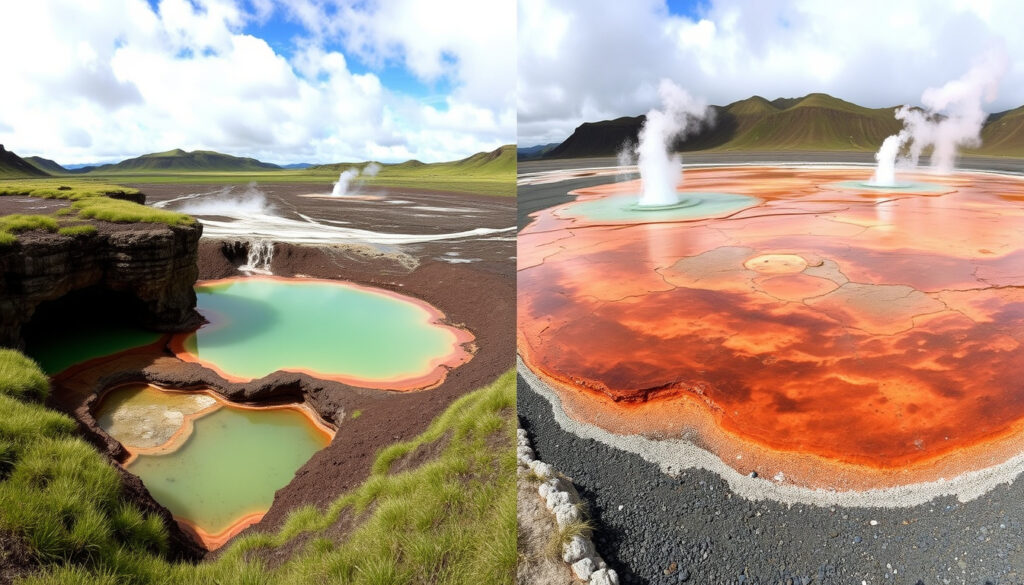
Orakei Korako Geothermal Park & Cave vs Wai-O-Tapu: Best
Two parks dominate most Rotorua geothermal itineraries, and the question travelers are really trying to answer is simple: colors or calm? Orakei Korako makes its case with a short boat ride across Lake Ohakuri, silica terraces, and New Zealand’s only geothermal cave — and the park sits about 45 minutes from Rotorua and 25 from Taupo (Drone & SLR travel guide).
Location: Between Taupo and Rotorua, New Zealand ·
Unique feature: Only geothermal cave in New Zealand (Ruatapu Cave) ·
Time required: Approx. 1.5–2 hours ·
Key attractions: Silica terraces, mud pools, hot springs
Quick snapshot
- Adult entry is listed at NZ$63, children 16 and under NZ$25, under-6s free (Orakei Korako official site)
- The park sits inside the Taupo Volcanic Zone (The Abroad Guide day-trip guide)
- Whether Ruatapu Cave is really one of only two geothermal caves on Earth — a blog-level claim that has not yet been confirmed by a geological authority (Drone & SLR travel guide)
- Seasonal opening hours and wheelchair accessibility across the whole track aren’t consistently documented in public materials
- Last ferry to the thermal area leaves at 16:00; the final return crossing is 17:00 (Orakei Korako official site)
- Wai-O-Tapu runs 08:30–16:30 daily (Aotearoa Review ticket guide)
- Last admission at Wai-O-Tapu is 15:00, so arrive with time to spare (A Teaspoon of Adventure travel notes)
Ten rows of reference, one pattern: Orakei Korako’s value sits in the bundle — ferry, valley, cave, terraces, and mud pools are all inside one ticketed visit, and the park’s adult pricing starts at NZ$63.
| Detail | Orakei Korako Geothermal Park & Cave |
|---|---|
| Park name | Orakei Korako Geothermal Park & Cave |
| Location | Between Taupo and Rotorua, near the Ohakuri Dam |
| Primary features | Ruatapu Cave, silica terraces, mud pools, hot springs |
| Recommended visit time | 1.5 to 2 hours |
| Known for | New Zealand’s only geothermal cave |
| Adult entry | NZ$63 |
| Child entry | NZ$25 (ages 16 and under); under-6s free |
| Family entry | NZ$152 (two adults and at least two children) |
| Ferry times | On demand from 8:00; last boat to the valley 16:00; last return 17:00 |
| Ticket policy | Valid up to one year from purchase; closed Christmas Day |
Which geothermal park in Rotorua is best?
Overview of Rotorua’s Geothermal Parks
- Rotorua’s geothermal field funnels into two main paid parks: Orakei Korako and Wai-O-Tapu
- Both sit inside the Taupo Volcanic Zone, the same volcanic system behind the region’s steamy reputation (The Abroad Guide day-trip guide)
- Orakei Korako still markets itself as “The Hidden Valley” (Introducing New Zealand day-trip guide)
- Wai-O-Tapu operates like a timed attraction with a geyser show; Orakei Korako operates like a working landscape with a ferry schedule
Rotorua’s thermal geography is not subtle. The volcanic zone that boils mud and throws up geysers around the city continues south toward Taupo, and the two commercial parks sit at opposite ends of that corridor. Wai-O-Tapu leans into theatrical colour; Orakei Korako leans into raw scale and a quieter pace.
Criteria for Choosing the Best Park
- Geology: cave-and-terrace rarity at Orakei Korako vs. geyser-and-pool spectacle at Wai-O-Tapu
- Crowds: a quieter valley vs. tour-bus traffic around the famous viewpoints
- Cost: Orakei Korako’s NZ$63 adult entry vs. around NZ$35 at Wai-O-Tapu in current ticket-focused guides (Aotearoa Review ticket guide)
- Logistics: drive time from Rotorua, the ferry window, and each park’s last admission
Which park wins depends entirely on which constraint you name first. Early risers with a single free morning will answer differently from a family with a hire car and two damp afternoons to fill.
The pattern: every park in this region can show you a geothermal landscape, but only one of them feels like you stumbled onto it yourself.
Which is better, Orakei Korako or Wai O Tapu?
Orakei Korako: Undiscovered Beauty and the Geothermal Cave
- Arrival is by ferry across Lake Ohakuri, which already separates it from the drive-up parks
- Boardwalks cross silica terraces and pass bubbling mud pools before the path drops toward the cave
- The Ruatapu Cave descent ends at a thermal pool, and the cave is a short walk off the main trail
The ferry does more than move you across the lake; it sets the pace for the whole visit. The terrace walk at Orakei Korako has the scale of a landscape rather than a garden, and the cave gives the park a geological hook no other New Zealand thermal attraction can copy. The “hidden” in its marketing name is doing real work (Introducing New Zealand day-trip guide).
Solitude is the quiet selling point. Visitor comparisons on Google Maps keep returning to the same theme: fewer people, more bird noise, and a valley that does not feel programmed for a tour bus.
Wai-O-Tapu: Spectacular Colors and the Lady Knox Geyser
- Champagne Pool and the daily Lady Knox Geyser presentation anchor the visit, with the park about 31 kilometres from Rotorua and 27 minutes by road (Volcano Travel geothermal guide)
- The typical opening window is 08:30–16:30, and last admission is 15:00 (A Teaspoon of Adventure travel notes)
- The colours photograph like a screensaver, which is exactly why the car park fills early
Wai-O-Tapu gives visitors schedule and spectacle. The Lady Knox show turns a passive walk into a timed event, and Champagne Pool is the most photographed geothermal feature in the region. The trade-off is crowd density and a hard 15:00 door policy for late starters.
The implication: pick Wai-O-Tapu when you want a guaranteed performance, pick Orakei Korako when you want terrain that does not feel staged.
This is the core distinction: spectacle versus space, and the right pick depends entirely on what the traveler values more.
Is Orakei Korako worth it?
Orakei Korako Entrance Fee Breakdown
- Adult entry: NZ$63
- Children 16 and under: NZ$25; under-6s free
- Family admission: NZ$152 for two adults and at least two children
Those numbers look steep until you unpack the bundle: the ferry crossing, the geothermal valley, and Ruatapu Cave are all inside the same ticket, and a ticket stays valid for up to a year from purchase — which turns a rainy-day risk into a non-emergency (Orakei Korako official site).
Value for Money Assessment
- Visitor sentiment consistently describes the park as uncrowded, raw, and more natural than the bigger commercial sites
- The cave, the ferry, and the boardwalks combine into a 1.5-to-2-hour outing, so the value case is about density of experience
- One travel guide describes the cave itself at about 36.58 metres deep — a specific number that comes with a travel-blog label rather than a geological survey (Drone & SLR travel guide)
The cave is what changes the value equation. No other Rotorua-area attraction sells a ferry ride, a valley walk, and a descent into a thermal cave on one ticket. The park also gets consistent praise for being less crowded than Wai-O-Tapu, and on a warm morning that space is the difference between a postcard queue and an actual walk. Why this matters: if you hate queuing behind a tour bus, the higher gate price is buying the one thing the cheaper park cannot guarantee — room to move.
A traveler who arrives expecting a Wai-O-Tapu-style spectacle may feel the NZ$63 price tag. A traveler who arrives expecting a quieter, geology-first afternoon usually leaves calling it the better bargain of the two.
The decision rests entirely on expectation management: know what you are buying, and the NZ$63 ticket becomes either a premium for solitude or a price for a missing spectacle.
How long do you need at Orakei Korako?
The Main Walking Trail
- Budget roughly 1.5 to 2 hours for the main circuit, including the ferry rides at both ends
- The walk runs on boardwalks over silica terraces and along paths that pass bubbling mud pools and hot springs
- The ferry runs on demand from 8:00, with the last boat to the thermal area at 16:00 and the final return at 17:00
The main circuit is not an endurance test. The terrain is boardwalks and formed paths, and the views force a slow pace because you stop constantly to look. The real time pressure is the boat schedule: arrive late and the valley stays on the far side of the lake.
Exploring Ruatapu Cave
- The cave sits a short walk off the main path, so the detour costs minutes, not an extra hour
- The descent ends at a thermal pool, which is the payoff for the climb back up
The cave is the part of Orakei Korako that surprises first-timers, because it is a different microclimate from the open terraces above — warmer, damper, and completely still. For most visitors, 1.5 to 2 hours covers the loop, the cave, and a slow pause at the mud pools.
The 16:00 last ferry decides the day for visitors coming from Rotorua: leave the city by mid-afternoon, or the valley is effectively closed for the day.
If you are building a longer outdoor itinerary, our Franz Josef Glacier Walk Guide covers a very different, ice-based side of New Zealand’s geology.
Both visits share something essential: they reward the traveler who respects the landscape’s natural timescale rather than rushing through.
Are there free mud pools in Rotorua?
Free Geothermal Activities in Rotorua
- Kuirau Park is the reliable free geothermal stop: public mud pools and hot springs in the middle of town (Volcano Travel geothermal guide)
- The Lake Rotorua shoreline offers steam vents and lake views at no cost
- Walks through the Redwoods add a forest counterpoint to the volcanic landscape, also free
The free geothermal scene in Rotorua is real but compact. Kuirau Park delivers the bubbling-pool experience without a ticket window; the lakefront and the Redwoods handle the photography and the fresh air. What you rarely get for free is a geyser. The famous Lady Knox Geyser sits behind Wai-O-Tapu’s ticket gate (Aotearoa Review ticket guide).
Top 5 Free Things to Do in Rotorua
- Kuirau Park — mud pools and hot pools, no ticket
- Lake Rotorua shoreline — geothermal steam and lake views
- Redwoods — walking and cycling trails through the forest
- Lady Knox Geyser — looks free, but it is inside Wai-O-Tapu’s ticketed area
- The drive around Lake Ohakuri — the volcanic setting is visible from the roadside even if the ferry and cave are ticketed
Notice the two “traps” at the end of that list. The honest version of the top-five question is that Rotorua’s genuinely free geothermal experiences are the urban mud pools, the lake, and the forest — while the headline spectacles are ticketed. Plan the day around that split and the free options stop feeling like disappointments.
The catch: the two most photographed geothermal attractions near Rotorua — Lady Knox and Champagne Pool — are exactly the ones that cost money, so free mud pools are a great start, not a full itinerary.
Free geothermal is a great starting point for a budget day, but the region’s true spectacles require a paid ticket.
Who owns Orakei Korako?
History and Management of the Park
- Orakei Korako is privately owned
- The ownership history is a sequence of private owners and development phases
- Ruatapu Cave opened to the public in the 1980s as part of the geothermal park
The short answer: this is a private operation, not a council-run or government-owned attraction. The long answer is a familiar New Zealand tourism story of private developers reshaping a thermal property over several decades, with the cave joining the public route in the 1980s. For visitors, the practical consequence is straightforward — pricing, hours, and facility decisions sit with the operator, so the official visitor page is the only safe reference for current terms. The implication: a privately run park can change faster than a public attraction, which is exactly why a one-year flexible ticket is the least risky way to buy in advance.
Eight comparisons, one pattern: Wai-O-Tapu sells a performance and a palette, while Orakei Korako sells space, a cave, and a ferry ride across a volcanic lake.
| Aspect | Orakei Korako | Wai-O-Tapu |
|---|---|---|
| Signature feature | Ruatapu Cave and silica terraces | Champagne Pool and Lady Knox Geyser |
| Arrival | Ferry across Lake Ohakuri | Roadside entrance |
| Adult entry | NZ$63 | Around NZ$35 in current ticket round-ups |
| Crowd level | Quieter, lighter traffic | Busier, tour-group heavy in late morning |
| Typical visit time | 1.5–2 hours | Half-day if you wait for the geyser show |
| Drive from Rotorua | About 45 minutes | About 27 minutes |
| Last entry | Ferry: 16:00 out, 17:00 return | Last admission 15:00 |
| Ticket flexibility | Valid up to one year | Day-based ticket |
Upsides
- Ruatapu Cave is a genuine rarity — no other geothermal park in New Zealand offers a comparable thermal cave
- The ferry arrival keeps crowds thinner and the pace slower than the tour-bus circuit
- The entry bundle (ferry, valley, cave) means no surprise add-ons at the cave
- A ticket stays valid for up to a year, so weather is no longer an emergency
Downsides
- Adult entry at NZ$63 is a noticeably higher starting price than Wai-O-Tapu’s gate
- At about 45 minutes from Rotorua, it is farther than Wai-O-Tapu’s 27-minute drive
- The 16:00 last ferry punishes late starts harder than a roadside gate does
- The full circuit takes 1.5 to 2 hours, so it is a poor fit for a rushed layover
Confirmed facts
- Orakei Korako lies between Taupo and Rotorua, near the Ohakuri Dam, inside the Taupo Volcanic Zone (The Abroad Guide day-trip guide)
- Ruatapu Cave is New Zealand’s only geothermal cave
- Silica terraces, bubbling mud pools, and hot springs are visible along the main walk
- The park is privately owned
What’s unclear
- Whether Ruatapu Cave is one of only two geothermal caves anywhere on Earth — a blog-level claim that has not been confirmed by a geological authority
- Exact daily opening hours, which can shift with the season
- The precise level of wheelchair accessibility across the whole track
- Current corporate ownership details, which have changed in the past
Visitors and travel writers keep arriving at the same two conclusions from different directions.
“Orakei Korako is the park you pick when you want the valley to yourself; Wai-O-Tapu is the park you pick when you want the postcard” — that is the shorthand running through visitor comparisons on Google Maps.
Visitor reviews, Google Maps
Day-trip guides from Introducing New Zealand sum up the split the same way: the cave is the differentiator at Orakei Korako, and the colours are the spectacle at Wai-O-Tapu (Introducing New Zealand day-trip guide).
Introducing New Zealand, Taupo day-trip guide
Travel notes from A Teaspoon of Adventure frame the practical gap sharply: Wai-O-Tapu’s 15:00 last-entry deadline makes it the less flexible park of the two (A Teaspoon of Adventure travel notes).
A Teaspoon of Adventure, Rotorua geothermal travel notes
The decision, compressed: Orakei Korako is what its marketing says it is — a hidden valley — and Wai-O-Tapu is what its photos promise. First-time visitors who want the Champagne Pool photograph with a morning geyser show attached should buy the Wai-O-Tapu ticket. Travelers who would trade a bit more driving for empty boardwalks, a private ferry, and a cave that ends in a thermal pool should pick Orakei Korako. For the Rotorua visitor weighing these two parks for the first time, the choice is clear: commit to Orakei Korako if solitude and the cave matter more than the postcards, or line up for Wai-O-Tapu’s gate before 15:00 — because the ferry schedule will quietly make the decision for you if you don’t.
Frequently asked questions
Can I visit Orakei Korako and Wai-O-Tapu in one day?
Only with an early start. Wai-O-Tapu opens at 08:30, and Orakei Korako’s last ferry leaves for the valley at 16:00, so the order matters: do Wai-O-Tapu’s geyser show first, then take the longer drive south to Orakei Korako. Trying to reverse it usually means missing the last boat.
Does Orakei Korako have a café or restaurant?
The visitor centre and facilities sit on the lake side at the ferry landing. If a sit-down meal matters to you, check the official visitor page before the long drive, because seasonal staffing can change the hours.
What is the best time of year to visit the geothermal parks?
New Zealand spring (September to November) and autumn (March to May) give the mildest walking weather. Cool mornings make the terraces steam more dramatically, so an early ferry slot at Orakei Korako or an early gate arrival at Wai-O-Tapu usually gets the clearest views.
What should I wear to visit Orakei Korako?
Layered clothing and shoes with grip. The boardwalks stay stable in most weather, but the cave holds a thermal pool, so expect humidity and a slightly damp descent below the terraces.
Is Orakei Korako suitable for young children?
Yes, with supervision. Children under six enter free, and the boardwalks are wide enough for small walkers. The ferry crossing is short, but the cave descent and the pool at the bottom need an adult hand with younger kids.
Are there accommodation options near Orakei Korako?
Most visitors base themselves in Rotorua or Taupo and self-drive, since Orakei Korako sits roughly halfway between the two. Check the official page for any on-site or nearby camping updates if you want to stay closer to the park.
Can I take photos or use a drone at Orakei Korako?
Personal photography is part of the experience and is generally welcome along the walking track. Drone use at commercial geothermal parks is usually restricted in New Zealand, so confirm the current policy directly with the park before flying.
More related posts
 Image to Text Converter: Free Online OCR Tools That Work
 Cast of Once Upon a Time in Hollywood: Full List & Characters
 New Balance Sale 574 – Best Deals, Discounts and Sizes
 Who Is the Cheapest Electricity Company in NZ? 2026 Comparison
 Hair Dresser Near Me in Ireland: Costs & Tipping Guide
 Trade Me Jobs Blenheim: Part-Time & Full-Time Work
 ASB Farm Solar Loans: 0% Interest for 5 Years – Full Guide