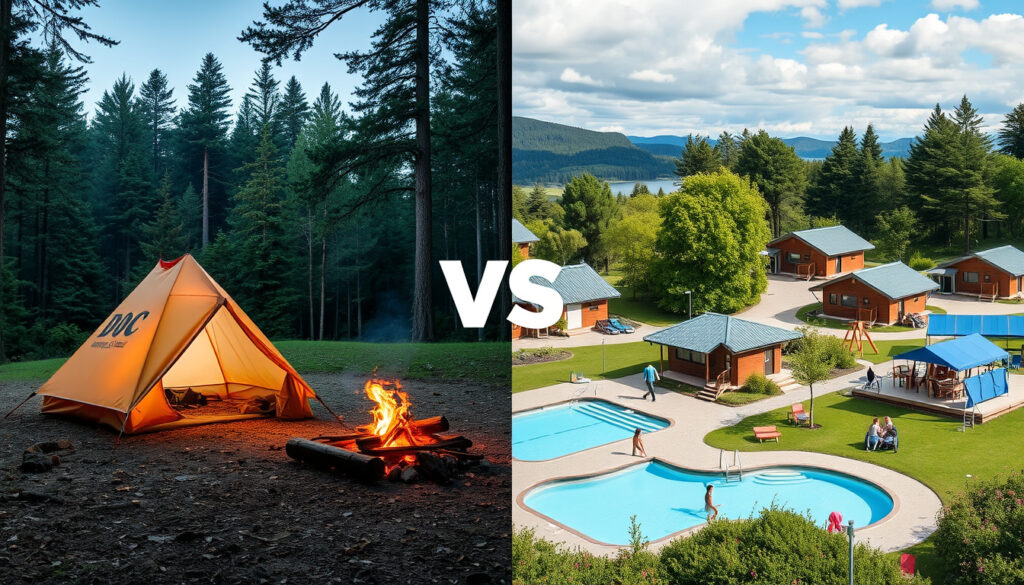
DOC Campground vs Holiday Park: Cost, Facilities, Pros & Cons
Choosing between a DOC campsite and a holiday park in New Zealand comes down to cost, facilities, and your travel style. From $6 per night for a basic DOC site to $60 for a powered holiday park spot, this guide compares the dollars, amenities, and rules to help you decide.
DOC campsites cost per adult per night: $6–$15 ·
Holiday park cost per adult per night: $25–$60 ·
Number of DOC campsites in New Zealand: over 300 ·
DOC campsite categories: 4: serviced, standard, basic, backcountry ·
Annual DOC Campsite Pass cost: $60 (adult)
Quick snapshot
- DOC campsites cost $6–$15 per adult per night (Pacific Horizon travel guide)
- Holiday parks cost $25–$60 per adult per night (Pacific Horizon travel guide) (Pacific Horizon travel guide)
- DOC Campsite Pass costs $60 per adult per year (Travellers Autobarn campervan rental guide)
- Freedom camping requires self-contained certification in many areas (Cheap as Travel New Zealand trip planner)
- Exact holiday park rate changes for 2025 have not been published yet
- Whether some basic DOC campsites will add power hookups in the future remains unconfirmed
- In December 2023, New Zealand updated regulations for certified self-contained campervans (Cheap as Travel New Zealand trip planner)
- Holiday parks recommend booking online in advance during peak season (SpaceShip Rentals FAQ for New Zealand campers)
The cost difference between DOC campsites and holiday parks boils down to a few key numbers.
| Item | Value |
|---|---|
| Cheapest DOC campsite | basic category from $6/night adult |
| Typical holiday park per adult | $30 |
| Maximum DOC campsite fee | $15 adult/night |
| Holiday park with powered site | $35–$50 adult/night |
How Much Do DOC Campsites Cost?
DOC campsite fee categories
- Serviced: flush toilets, tap water, often kitchen shelters — $15 per adult per night
- Standard: basic toilet, water — $10–$15 per adult per night
- Basic: simple toilet, no water — $6–$10 per adult per night
- Backcountry: minimal or no facilities — $6 per adult per night
All four categories fall within the official $6–$15 range published by the Department of Conservation, as reported by Pacific Horizon travel guide. The cheapest option — backcountry — gets you nothing but a patch of ground.
DOC Campsite Pass vs nightly fees
Annual pass: $60 per adult for 365 nights across most conservation campsites (Travellers Autobarn campervan rental guide). That’s 4–10 paid nights worth of value if you stay 10–20 nights per year.
With the pass, you’re limited to DOC campsites that are often far from towns. For a self-contained campervan traveler who moves every day, the pass pays for itself within two weeks.
The 30-night pass costs $95 for adults (Travellers Autobarn). For shorter trips, paying per night may be cheaper.
Why this matters: The pass only makes financial sense if you plan to use DOC campsites regularly — otherwise, nightly fees are more flexible and often cheaper than holiday park rates.
What Is the Difference Between a DOC Campsite and a Holiday Park?
Facilities comparison
- DOC campsites: basic toilets, water (not always potable), no power, no showers or kitchens (SpaceShip Rentals FAQ)
- Holiday parks: hot showers, laundry, communal kitchens, power hookups, Wi‑Fi, swimming pools, playgrounds (Pacific Horizon travel guide)
The gap is wide: one is a patch of grass with a long-drop toilet; the other is a mini-resort with all the comforts of home.
Cost comparison
Here is a direct cost comparison of the two options.
| Type | Per adult per night | Source |
|---|---|---|
| Basic DOC campsite | $6–$10 | Pacific Horizon travel guide |
| Serviced DOC campsite | $15 | Pacific Horizon travel guide |
| Holiday park unpowered site | $25–$35 | Pacific Horizon travel guide |
| Holiday park powered site | $35–$60 | Pacific Horizon travel guide |
Booking process
- DOC campsites: first-come, first-served at basic sites; some serviced sites can be booked via the DOC website (Travellers Autobarn campervan rental guide)
- Holiday parks: online booking recommended, especially in summer (SpaceShip Rentals FAQ for New Zealand campers)
A DOC campsite that’s first-come can leave you driving for hours in peak season. Holiday parks guarantee a spot — but at three times the price.
The trade-off: You pay for convenience at a holiday park; you pay in uncertainty at a DOC campsite. For self-contained travelers, the DOC option often wins on solitude and cost, but only if you can arrive early.
What Are the Pros and Cons of Camping Holidays?
Advantages of DOC campsites
- Low cost — as little as $6 per adult per night (Pacific Horizon travel guide)
- Natural settings — often in national parks, by lakes or forests (SpaceShip Rentals FAQ)
- Quiet and uncrowded compared to holiday parks
If you’re in a self-contained campervan with your own power and water, DOC sites give you everything you need for a fraction of the price.
Upsides
- Budget-friendly: $6–$15 per night
- Remote, scenic locations
- True back-to-nature experience
Downsides
- No power, no hot showers, often no cooking shelter
- First-come basis can mean disappointment
- Self-contained vehicle required at many sites
Best for budget travelers
- Freedom camping is free but restricted to designated areas (Pacific Horizon travel guide)
- DOC campsites are the cheapest paid option
- Holiday parks suit travelers who need amenities and can pay $30–$60 per night
What this means: For a solo traveler on a two-week trip, a mix of DOC campsites (basic nights) and occasional holiday parks (shower/laundry days) balances cost and comfort.
Can You Camp Anywhere on DOC Land in New Zealand?
Designated DOC campsites only
- Camping is allowed only at marked DOC campsites (SpaceShip Rentals FAQ)
- DOC manages over 250 campgrounds (Travellers Autobarn campervan rental guide) — including 167 covered by the Campsite Pass
Freedom camping rules
- Freedom camping is allowed on some public land not owned by DOC, but restrictions vary by region (Pacific Horizon travel guide)
- Non-compliance can lead to fines (Pacific Horizon travel guide)
Self-contained vehicle requirements
- A self-contained campervan must have a fixed toilet, fresh and grey water tanks, and a displayed certificate (Cheap as Travel New Zealand trip planner)
- From December 2023, stricter rules apply to certified self-contained vehicles (Cheap as Travel New Zealand trip planner)
While DOC land feels wild and free, the rules are tight. Freedom camping on non-DOC public land is the real loophole — but only if your van meets the self-contained standard.
Why this matters: If your campervan isn’t certified, you’re effectively limited to holiday parks and serviced DOC campsites. That changes your budget and route planning significantly.
What Are the Big Three of Camping?
Essential gear for DOC camping
- Shelter: tent, campervan, or rooftop tent
- Sleeping bag: rated for New Zealand’s variable temperatures
- Backpack: for carrying supplies to walk-in sites
For DOC basic and backcountry campsites, you need everything yourself. No shop, no power, no tap. For DOC basic and backcountry campsites, you need everything yourself, but you can find out more about DOC campgrounds versus holiday parks in New Zealand $NRL points table 2025 standings.
Comparing to holiday park stays
- Holiday parks provide many of these items (or let you rent them) (SpaceShip Rentals FAQ)
- If you forget a sleeping bag at a holiday park, you can buy or borrow one
The pattern: DOC camping demands preparation and self-reliance; holiday parks let you travel light and buy what you need on the road.
What We Know and What Remains Unclear
Confirmed facts
- DOC campsite fee ranges are official 2024 prices, as reported by Pacific Horizon travel guide
- Holiday park rates vary widely by season and location — no single price list exists
What’s unclear
- Exact 2025 holiday park rate changes are not yet published
- Whether DOC will expand serviced campsites in popular regions is unknown
“Campsite categories: facilities and fees vary by site. Always check the DOC website for the latest information.”
— New Zealand Department of Conservation
“Self-contained vehicles are required for freedom camping in most areas. A displayed warrant of fitness is mandatory.”
— Government of New Zealand, freedom camping regulations
For campervan travelers, the choice between a DOC campsite and a holiday park boils down to two questions: how much self-sufficiency do you have, and how much comfort do you need? If your van is certified and you can live off-grid, DOC sites unlock New Zealand’s wildest landscapes for pocket change. If you want hot showers, power, and a guarantee of a spot, holiday parks deliver — at a premium. For the budget-conscious self-contained traveler, the smartest move is a mix: DOC campsites for nature, holiday parks every few days for a recharge.
For a specific example of a well-equipped holiday park, consider Tasman Holiday Park Waihi on the Coromandel Peninsula, which offers family cabins and direct beach access.
Frequently asked questions
Do DOC campsites have showers?
Only serviced DOC campsites may have cold showers. Basic, standard, and backcountry campsites typically do not offer showers.
Is a DOC Campsite Pass worth it?
Yes if you plan to stay at DOC campsites for more than 10 nights per year. The $60 annual pass pays for itself after about 10 nights at basic sites.
Can I book a holiday park online?
Yes, most holiday parks in New Zealand offer online booking, and it is recommended during peak season.
Which is better for a family: DOC campsite or holiday park?
Holiday parks are generally better for families because they provide showers, kitchens, playgrounds, and power — amenities that make camping with kids easier.
Are holiday parks cheaper than DOC campsites for long stays?
No. DOC campsites are significantly cheaper per night. For a two-week trip, a family could save hundreds by using DOC sites, especially if they are self-contained.
What is the golden rule of camping?
Leave no trace. Pack out all rubbish, respect wildlife, and leave the site as you found it.
What is posh camping called?
Glamping (glamorous camping). Holiday parks often offer glamping tents and cabins as an upgrade.
Related reading
- Cheap Things to Do in Auckland — budget-friendly activities for your New Zealand road trip
- Fiordland Heavy Rain Watch — stay informed about weather risks when camping in Fiordland
More related posts
 Gale Force Winds South New Zealand: Warnings & Safety
 Best S&P 500 Index Funds 2025: Compare VOO, IVV, SPY & Tax Guide
 Tesla Share Price Robinhood: Live TSLA Stock at $441.67
 K&K Fashion: Online Store, Brand Story, and Return Policy
 What Is Accounts Receivable? Definition, Examples, and Recording
 Matariki Stars Names and Meanings: Complete Guide to the 9 Whetū
 Angry Ramen Lower Hutt: Menu, Reviews, Location Guide
 Daylight Saving New Zealand: Dates, Time Zones & Clock Changes