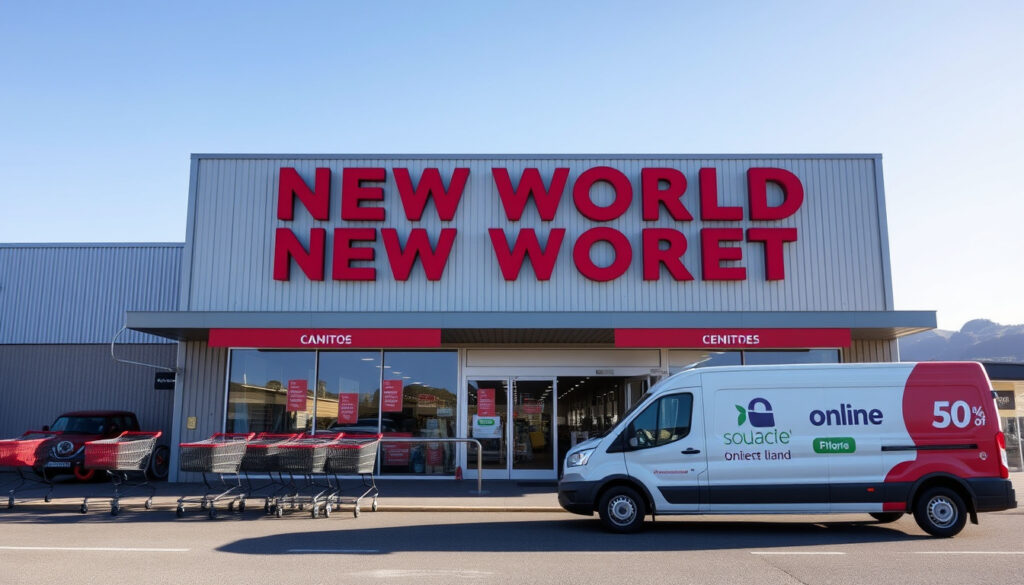
New World South Island: Stores, Ownership, and Online Shopping
Anyone who has wandered into a New World supermarket in the South Island knows it feels different from the ones up north. The pricing, the specials board, even the layout can shift depending on which town you are in, and that is no accident.
Total New World stores in New Zealand (2025): 149 ·
Stores in the South Island: approx. 60 ·
Stores in the North Island: approx. 89 ·
Ownership model: individually owned franchisees ·
Parent company: Foodstuffs (New Zealand)
Quick snapshot
- 149 stores nationwide (New World Store Finder)
- ~60 locations in the South Island (New World Store Finder)
- Clusters in Canterbury, Otago, Southland (New World Store Finder)
- Order via newworld.co.nz
- Delivery and Click & Collect available (newworld.co.nz)
- Separate pricing and fee structure for South Island stores (newworld.co.nz)
- Franchise model under Foodstuffs (Foodstuffs South Island)
- Local owner-operators, not corporate managers (Foodstuffs South Island)
- Co-operative structure, not chain (Foodstuffs South Island)
This guide explains how many stores the South Island has, where the biggest one is, how the franchise ownership system works, and how to shop online from the bottom of New Zealand.
| Fact | Detail |
|---|---|
| Total stores (2025) | 149 |
| Stores in South Island | approx. 60 |
| Stores in North Island | approx. 89 |
| Biggest store | New World Mill Street, Queenstown |
| Parent cooperative | Foodstuffs (NZ) Ltd |
| Year brand launched | 1996 |
The implication: shoppers comparing prices on the same item between a South Island New World and a North Island store may see different amounts at the till. This is not a glitch — it is the franchise system at work.
New World is not one uniform chain. Because each store answers to a local franchisee, the South Island experience varies in pricing, hours, and product mix more than a centrally owned chain would allow. Shoppers who expect consistency across regions will find it in name only.
Is New World expensive in NZ?
New World generally sits in the mid-to-premium tier of New Zealand supermarkets, above Pak’nSave but close to or slightly above Countdown on many staples. Unlike Pak’nSave, which competes aggressively on price across the board, New World pitches itself on range, service, and store experience.
How does New World compare to Countdown and Pak’nSave?
- Pak’nSave: The cheapest of the three. New World runs roughly 10-20% higher on a typical basket according to consumer comparisons.
- Countdown: Similar price band to New World, but Countdown is corporately owned by Woolworths, so pricing is centrally set. New World’s prices vary by franchise owner and region.
- South Island factor: Because Foodstuffs South Island operates as a separate co-operative from Foodstuffs North Island (NZ Herald report on Foodstuffs litigation explained), pricing at a South Island New World can differ from a North Island one, even within the same banner.
The pattern: a South Island New World is never a guaranteed price match for its North Island counterpart, because each franchise owner sets their own margins.
How many New World stores are in the South Island?
As of 2025, New World operates approximately 60 stores in the South Island, out of 149 nationwide. The regional distribution is uneven, with the heaviest concentration in Canterbury (27 stores reported in the region), followed by Otago, Southland, and smaller clusters in Nelson and Marlborough.
Where are the New World stores located in the South Island?
Over half of South Island New Worlds are in Canterbury. Major towns and cities with at least one New World include Christchurch (multiple locations including Durham Street, Bishopdale, and Cashmere), Queenstown, Dunedin, Invercargill, Timaru, Nelson, Blenheim, and Rolleston.
One pattern stands out: smaller provincial towns such as Ashburton, Gore, and Greymouth also have a New World, meaning the brand serves both urban and rural populations in the South Island.
While the official directory lists ~60 stores, the exact count fluctuates when stores remodel, relocate, or new franchisees open. Foodstuffs South Island does not publish a public store count by region — the figure is an aggregation from the New World store finder and operator data.
Where is the biggest New World in NZ?
The largest New World by floor area sits in Queenstown — New World Mill Street — in the Remarkables Park area. This store occupies roughly double the footprint of a standard New World, reflecting the tourist-heavy demand and the need for a larger fresh-food section.
Which New World has the largest floor space?
Below is a comparison of the largest-format stores in the network.
| Store | Location | Known size indicator |
|---|---|---|
| New World Mill Street | Queenstown | Largest single-level footprint in the network |
| New World Durham Street | Christchurch | Central city large-format store |
| New World Riccarton | Christchurch | Suburban major store |
New World does not publish official square-metre figures per store, but the Queenstown Mill Street store is widely recognised in industry reports and property listings as the brand’s largest. No other New World in the country exceeds it in retail space.
The catch: a bigger store generally means a wider range of imported and specialty products, and higher stock levels on local produce. For visitors to Queenstown, that large format is a deliberate choice to service both locals and seasonal tourism volumes.
Who owns New World in NZ?
New World is not owned by a single corporate entity in the traditional sense. Each store is owned by an independent franchisee who operates under the New World banner. The banner, the supply chain, and the brand rights are managed by Foodstuffs, a co-operative that owns no stores itself.
Is New World owned by Foodstuffs?
Yes, the New World brand and wholesale function sit under Foodstuffs (NZ) Ltd. Foodstuffs operates through two regional co-operatives: Foodstuffs North Island and Foodstuffs South Island. Each co-operative supplies its respective region’s New World, Pak’nSave, and Four Square stores. The South Island co-operative describes itself as “nearly 200 individually owned businesses” operating under its retail brands (Foodstuffs South Island ownership page).
Are New World stores individually owned?
Yes. Every New World store has a local owner-operator. That means the person who runs the Timaru New World is a different business owner from the one running the New World in Dunedin. Each owner makes decisions on pricing, promotions, staffing, and local sourcing within the guidelines of the Foodstuffs co-operative agreement.
The trade-off: this model gives the stores local autonomy and responsiveness to local customers, but it also means that prices, store hours, and even the loyalty programme benefits can differ between South Island towns in ways that a centralised chain would never allow.
Why is New World called New World?
The name dates to the brand’s launch in New Zealand in 1996. “New World” was chosen to evoke the idea of a modern, American-style supermarket — self-service, wide aisles, large fresh-food sections — which was a departure from the smaller grocery formats common at the time in New Zealand.
What is the history behind the name?
Before New World, Foodstuffs operated mainly under the Four Square and Pak’nSave banners. When the co-operative decided to launch a third banner in the mid-1990s, it wanted a name that signalled a new approach to supermarket retailing: brighter, more upmarket, and focused on customer experience. “New World” was registered and the first stores opened in 1996. The name has stuck for nearly three decades, and the brand has become the largest full-service supermarket banner in the South Island by store count.
How to shop at New World South Island online?
Online shopping for South Island New World stores is available through the website newworld.co.nz. The platform is tied to a specific local store — you choose your nearest store, and the pricing and specials you see are set by that franchisee.
What are the delivery options for New World South Island?
New World offers two main online fulfilment options in the South Island:
- Click & Collect: Order online, and collect from your chosen store. A flat $5 service fee applies regardless of order value (New World online FAQ).
- Home Delivery: $15 for orders under $200, $10 for orders of $200 or more in the South Island. The paper bag fee is capped at $1 (20 cents each, up to maximum).
The implication: South Island shoppers who order a medium-sized weekly shop of $150 will pay $15 for delivery plus up to $1 in bag charges — a combined $16, which runs at roughly 10% of the basket value. That is comparable to other online grocery services in New Zealand, but higher than the Click & Collect route.
Confirmed facts
- Total store count nationwide is 149 (2025).
- Approximately 60 stores operate in the South Island.
- South Island New World stores are individually owned franchisees under Foodstuffs South Island.
- New World launched in New Zealand in 1996.
- Online shopping fees: Click & Collect $5, delivery $15 (under $200) or $10 ($200 or more).
What is unclear
- Exact store count per South Island city/town is not publicly published by Foodstuffs.
- Price comparisons between specific South Island stores are not centrally tracked.
- Square-metre floor area for New World Mill Street is not officially confirmed.
Related reading: New World store finder and South Island directory · Foodstuffs South Island co-operative and owner-operator model
newworld.co.nz, newworld.co.nz, newworld.co.nz, en.wikipedia.org, shopit.co.nz, newworld.co.nz, en.wikipedia.org, newworld.co.nz, newworld.co.nz
Frequently asked questions
What are the opening hours of New World in the South Island?
Opening hours vary by franchise owner. Most South Island stores open between 7:00am and 7:30am and close between 9:00pm and 10:00pm daily. For example, New World Durham Street in Christchurch is open 7:00am to 10:00pm every day (New World Durham Street page). Check your local store’s hours via the store finder.
Does New World South Island offer a loyalty programme?
Yes. The Clubcard programme gives members access to weekly specials and personalised discounts, and it is valid across both islands. Each store’s franchisee decides which items go on Clubcard special.
Can I use my New World loyalty card in both islands?
Yes. The Clubcard works at any New World in New Zealand, regardless of which Foodstuffs co-operative the store belongs to.
What is the difference between New World and New World Fresh?
New World Fresh is a smaller-format store variant focused on a tighter range of fresh produce and everyday essentials. They exist mainly in smaller towns or neighbourhoods where full-size New World stores would be impractical.
How do I find a New World store near me in the South Island?
Use the New World Store Finder and filter by region. Choose South Island regions such as Canterbury, Otago, Southland, Nelson, or Marlborough to see locations and hours.
Are New World prices the same in all South Island stores?
No. Each franchisee sets their own pricing. While wholesale costs from the Foodstuffs co-operative are the same, individual owners choose their retail margins and promotional discounts. You may find the same branded item at a different price in Timaru than in Queenstown.
What brands are exclusive to New World?
New World carries standard national and international brands. Exclusive lines include the New World signature range (budget options) and some Foodstuffs wholesale brands. There are no South Island-exclusive brands listed by New World.
Does New World South Island have a bakery section?
Most full-size South Island New World stores have an in-store bakery section. Smaller New World Fresh stores may have limited bakery offerings or none.
For South Island shoppers who value local autonomy over central uniformity, New World delivers exactly what its franchise model promises: stores that feel like they belong to their community because they do. The price you pay and the service you get depends on the owner’s judgment, which is a trade-off: you may pay a little more than at Pak’nSave, but the store is likely to stock what locals actually want. For anyone planning a trip across the South Island, the practical takeaway is this: check the online prices for the exact store you will visit before you shop, because the “same” New World in two different towns is not the same at all.
More related posts
 What Is a Synonym? Definition, Examples, and How to Find Synonyms
 Convert 45 USD to NZD Today: Live Rate & What It Means
 How to Draw a Flower – Step-by-Step Beginner Guide
 Second Hand Gym Equipment NZ: Places to Buy Used Fitness Gear
 Jenna Ortega Movies & TV Shows: Roles, Netflix, 2026
 High Commission of India Auckland: Services, Address, Contact
 Silver Bullion Price NZ: Current Rates, How to Sell
 South Africa vs France Rugby: Head-to-Head & 2026 Guide