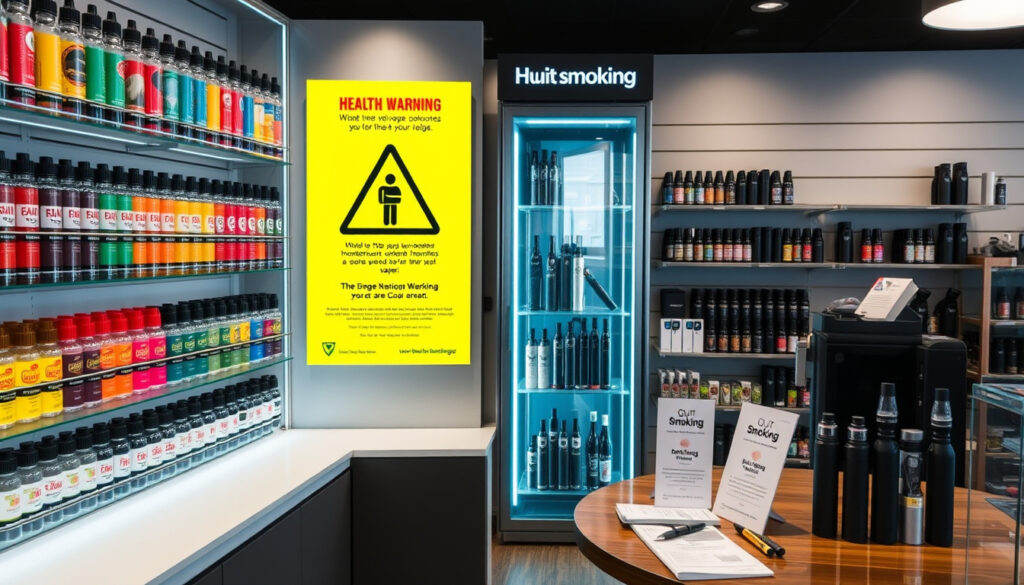
Vape Store Near Me: Health Risks, Quitting Tips, and What to Buy
You typed “vape store near me” for a reason — maybe you’re trying to switch, maybe you’re already a regular, or maybe you’re worried about what vaping is doing to your body. Here’s what the public-health evidence actually says, plus a practical checklist for the shop.
E-cigarette aerosol: Typically contains nicotine, flavorings, solvents, and other additives (CDC) ·
Chemicals in cigarette smoke: More than 7,000 ·
Known carcinogens: At least 69 ·
Adolescent nicotine exposure: Can harm brain development up to age 25
Quick snapshot
- Most e-cigarettes contain nicotine, which is highly addictive (Centers for Disease Control and Prevention (U.S. public health agency)).
- Combustible cigarettes expose users to far more toxicants than e-cigarettes (National Health Service (UK health service)).
- Nicotine is harmful to adolescent brain development (U.S. Surgeon General (federal medical authority)).
- Vape products are age-restricted in regulated markets (U.S. Food and Drug Administration (tobacco regulator)).
- No medical guideline defines a safe daily puff count. (NHS (UK health authority))
- Whether lungs fully recover after one year of vaping remains unknown (NHS (UK health authority)).
- The long-term health effects of two or more years of daily vaping are still being studied. (NHS (UK health authority))
- Regulatory controls on e-cigarettes tightened across Europe in 2017. (CDC (U.S. federal health agency))
- Withdrawal symptoms typically begin within 24 hours of the last vape; nicotine is mostly cleared from the body by day 3 (CDC (U.S. federal health agency)).
- If vaping causes chest pain, shortness of breath, seizures, or severe nausea, medical attention is warranted immediately.
- No e-cigarette has been FDA-approved as a smoking-cessation aid, so anyone planning to quit should line up support before relying on a vape.
Key facts at a glance
The key facts table summarizes the regulatory and health data reviewed in this guide.
| Topic | Value | Source |
|---|---|---|
| Legal age to buy vapes in Ireland, the UK, and the EU | 18 | Ireland’s Health Service Executive (national health service) |
| Minimum purchase age in the U.S. | 21 | U.S. Food and Drug Administration (federal tobacco regulator) |
| Chemicals in cigarette smoke | More than 7,000 | American Lung Association (respiratory health organization) |
| Known carcinogens in cigarette smoke | At least 69 | American Lung Association (respiratory health organization) |
| FDA-approved e-cigarettes for quitting | 0 | CDC (federal public health agency) |
The pattern: the legal age is not uniform globally, but the chemical load from burning tobacco is orders of magnitude higher than from vaping.
What to know before you walk into a vape store
A good local shop is more than a counter with colorful boxes. You are buying a nicotine-delivery system, so the product type, nicotine strength, and device compatibility matter more than the branding.
| Product type | Typical nicotine format | Cost picture | Best fit |
|---|---|---|---|
| Disposable vape | Pre-filled nicotine salt, usually 20 mg/mL or higher | Low upfront, higher per-puff cost | First-time buyers; convenience over economy |
| Pod system | Nicotine salt in replaceable pods | Moderate upfront, moderate ongoing | People switching from smoking who want a tighter draw |
| Refillable tank device | Freebase nicotine e-liquid in varying strengths | Higher upfront, lowest per-puff cost | People willing to maintain coils and refill bottles |
| Nicotine-free e-liquid | 0 mg/mL | Same shelf price as nicotine versions | Anyone who wants the ritual without the addiction |
| Nicotine salt disposable | Pre-filled, typically 20–50 mg/mL | Low upfront, moderate ongoing | First-time buyers who prioritize convenience |
| Replacement coils & pods | Varies by device | Moderate ongoing cost | Users who already own a compatible device |
| Age verification | Must be 18 in Ireland, UK, EU; 21 in U.S. | Free, non-negotiable | Proof of ID before any purchase is a compliance test for the shop |
If a store skips ID checks or cannot tell you the nicotine strength per milliliter, that is a signal to walk out. Compliance with age rules is the most basic indicator of a licensed, legitimate retailer.
- No ID check before purchase
- No nicotine strength on the bottle
- Expired or unlabeled products
For a deeper local guide on choosing a trusted shop, see Vape Store Near Me: How to Choose a Trusted Local Shop.
Is 200 puffs of vape a day bad?
Chemicals in cigarette smoke: 7,000+ ·
Known carcinogens: 69 ·
Nicotine delivery: Reaches the brain in about 10 seconds (CDC)
Two hundred puffs sounds extreme, but there is no published medical guideline that sets a safe daily puff count. The real question is what is inside the device, how strong the e-liquid is, and how deep and frequent the inhalation is.
Is 1 puff of a vape equal to one cigarette?
- One cigarette delivers roughly 1 to 2 mg of absorbed nicotine; one vape puff usually delivers far less, around 0.1 to 0.3 mg depending on device power and e-liquid strength.
- A 20 mg/mL nicotine-salt disposable delivers more nicotine per puff than a low-strength freebase liquid, so “puff equivalence” cannot be calculated without knowing the product.
- Comparing puff counts to cigarette counts understates the risk because vapers take many more, smaller puffs across a day (University of Waterloo (nicotine research group)).
The implication: the body responds to total nicotine intake, not to a round number. A 200-puff day on a low-strength device is not the same as 200 puffs on a high-nicotine salt disposable.
What are bad signs from vaping?
Chest pain, shortness of breath, seizures, or severe nausea after vaping are red flags that require urgent medical attention, not a quieter device.
The CDC also warns that liquid nicotine can be poisonous if swallowed or absorbed through the skin, and defective batteries have caused fires and serious injuries. These events are rarer than lung symptoms, but they are the ones that land people in emergency departments.
Can lungs heal after 1 year of vaping?
The lungs are built to clear debris, but they can only do that once the constant aerosol exposure stops.
Quitting gives cilia and airway clearance mechanisms a real chance to recover. Former smokers show measurable drops in cough, phlegm, and shortness of breath within months of stopping, and the same pattern appears in people who quit vaping (National Health Service (UK health guidance)). Complete healing depends on how much damage already occurred and whether the person switches to cigarettes — dual use keeps the damage going.
What do 2 years of vaping do to you?
- Two years of daily vaping is linked to a higher rate of cough, wheeze, and throat irritation (Journal of the American Heart Association (peer-reviewed research)).
- Damage to small airways and lung elasticity is plausible but not fully quantified because e-cigarettes have only existed in wide use since around 2015.
- The CDC states plainly that the short- and long-term health effects of e-cigarettes are still being researched.
The pattern: the first year off vaping shows the biggest improvement. The second year of continued vaping cements symptoms. That is the window in which a “moderate habit” quietly becomes a chronic respiratory condition.
What is harder on your lungs, vaping or smoking?
Burning tobacco creates tar and carbon monoxide — two of the most directly damaging products in cigarette smoke. Vaping aerosol contains neither. That is the main reason public health agencies, including the NHS, say nicotine vaping is less harmful than smoking.
| Exposure | Cigarette smoke | Vape aerosol |
|---|---|---|
| Tar | Present, substantial | Absent |
| Carbon monoxide | Present, substantial | Absent |
| Nicotine | Yes, highly addictive | Yes, highly addictive |
| Other chemicals | 7,000+, including 69 known carcinogens | Fewer, but includes ultrafine particles, heavy metals, and flavoring chemicals |
| FDA-approved for cessation | No | No |
The pattern: smoking is harsher because combustion creates a much bigger chemical load. Vaping aerosol is not harmless — the CDC documents cancer-causing chemicals, volatile organic compounds, and particles that reach deep into the lungs. The harm-reduction case only holds for adults who switch completely from smoking to vaping.
Is it harder to quit vaping than smoking?
- Nicotine addiction is the driving force in both habits; the CDC notes that quitting vaping resembles quitting smoking because the addiction mechanism is similar.
- Vaping adds a behavioral twist: the device is always available, produces no smoke smell, and can be used indoors, so the habit repeats more often.
- For many vapers, the hand-to-mouth ritual is as strong as the nicotine craving, which is why “just stop” advice usually fails.
The catch: easier access makes vaping easier to start and harder to stop. Someone who vapes 200 puffs a day has built a behavioral loop that takes more than nicotine replacement to break.
Is it okay for a 13 year old to try a vape?
No. A 13-year-old should not try a vape, and no legitimate shop will sell one to them. Nicotine interferes with the brain’s attention, learning, mood, and impulse-control systems, which are still developing through the mid-20s (U.S. Surgeon General (federal medical authority)). In Ireland, the UK, and the EU the legal purchase age is 18; in the U.S. it is 21. Age verification is the legal wall, but the developmental argument is the medical one.
How do I tell if someone is vaping?
- Sweet or fruity scents — mango, cotton candy, mint — that do not match anything in the house.
- Devices that look like USB sticks, pens, or small rectangular pods, plus unfamiliar chargers.
- Increased thirst, dry mouth, nosebleeds, or sudden breathlessness after light activity.
- Behavior changes: more secrecy, mood swings, and gaps in the day when they step away to “use the bathroom.”
The practical move for parents: check for pods and chargers, ask directly, and keep the conversation medical rather than punitive. The earlier nicotine dependence is interrupted, the easier it is to end.
What is vaper’s tongue?
Vaper’s tongue is a temporary dulling of taste caused by repeated exposure to one flavor, dehydration, and dry mouth — not a formal clinical diagnosis.
The fix is usually simple: drink more water, rotate flavors, keep up oral hygiene, and take breaks from the device. The condition typically reverses within days once those habits change.
Do dentists notice if you vape?
- Nicotine reduces saliva flow, and a dry mouth raises the risk of gum irritation, bad breath, and cavities.
- Dentists can see the oral effects of reduced saliva and increased plaque even if they cannot “prove” vaping from the teeth alone (American Dental Association (professional dental body)).
- Mouth or throat irritation is one of the most common reported vaping side effects.
The implication: if a dentist asks whether you vape, they are not guessing — they are connecting the oral signs to the habit. That question is a useful cue to have an honest conversation about quitting.
Is it better to quit vaping cold turkey or gradually?
Both approaches work, and the best one is the one you can sustain without giving up entirely. The CDC says quitting vaping is likely similar to quitting smoking, so the same tools apply: a quit date, support, and a plan for withdrawal symptoms.
Cold turkey vs gradual reduction
Upsides of cold turkey
- Nicotine is mostly gone from the body within 72 hours.
- No drawn-out temptation period; the line in the sand is clear.
- Works well for people whose habit is more ritual than high-dose addiction.
Downsides of cold turkey
- Withdrawal peaks hard in the first week, which raises relapse risk.
- No step-down plan for someone used to 200 puffs a day.
- Irritability and low mood can derail work and relationships.
What do 3 days of not vaping do?
By day 3, nicotine is mostly cleared from the body, but cravings and irritability can peak. The behavioral habit, not the chemical one, is what makes day 4 hard.
A five-step quit plan
- Pick a quit date within two weeks — a specific date beats a vague “soon.”
- Choose your route — cold turkey, or a stepped reduction that cuts your puffs by roughly 20% each week, and write it down.
- Remove triggers — delete the saved vape-shop tab, throw out spare pods, and tell one person who can check on you.
- Plan for withdrawal — stock water, hard candy, and a fidget object; expect the hardest days to be days 2 to 4.
- Get support — a quitline, a clinician, or an app measurably improves success, just as it does for smoking cessation.
The evidence points to support as the force multiplier. Smokers who combine a quit date with counseling have significantly higher success rates than those who go it alone, and the same principle applies to vaping. Find your local quitline before you need it; in Ireland, the HSE offers free stop-smoking support, and in the U.S., the national quitline at 1-800-QUIT-NOW is a starting point.
Timeline: from first puff to recovery
Six moments, one through-line: vaping became mainstream fast, regulation followed slowly, and the body’s recovery clock starts the day the device goes down.
| Date or period | What happened |
|---|---|
| 2007 | Modern e-cigarettes begin global commercial expansion. |
| 2017 | European Union rules on e-cigarette notification, nicotine limits, and health warnings begin to apply. |
| 24 hours after last vape | Nicotine levels fall and withdrawal symptoms typically begin. |
| 3 days after last vape | Nicotine is mostly cleared from the body; cravings and irritability can peak. |
| 1 year after quitting | Lung symptoms and breathing often improve, though full recovery depends on the type and duration of damage. |
The pattern: the first 72 hours are a chemical event, but the first year is a repair project. Do not judge a quit attempt by day 3 alone.
What’s confirmed, what’s not
The quick-reference version for anyone about to buy a vape, quit one, or talk to a teenager.
Confirmed facts
- Most e-cigarettes contain nicotine, a highly addictive substance (CDC (federal public health agency)).
- Combustible cigarettes expose users to far more toxicants than e-cigarettes (NHS (UK health service)).
- Nicotine is harmful to adolescent brain development (World Health Organization (international health body)).
- Vape products are age-restricted; no e-cigarette is FDA-approved for cessation (U.S. Food and Drug Administration (federal tobacco regulator)).
What’s unclear
- Whether any specific daily puff count is safe for a given individual.
- Whether lungs fully recover after one year of vaping.
- The long-term health effects of two or more years of daily vaping.
- How much of vaping’s rise will translate into chronic disease decades from now.
The distinction matters: the confirmed list is short, and the unclear list covers most of the personal decisions people face.
Voices that matter
The public-health consensus is more settled than the comment sections suggest.
“We’ve reached a point where any e-cigarette use among young people is a public health threat.”
— U.S. Surgeon General (federal medical authority)
“The report focuses on e-cigarettes being harmful, unsafe, and targeted at youth.”
— World Health Organization (international health body)
“Using both e-cigarettes and regular cigarettes — known as dual use — is not an effective way to safeguard health.”
— Centers for Disease Control and Prevention (federal public-health agency)
These positions from three different agencies converge on the same point: vaping is not risk-free, and the data on long-term harm is still incomplete.
Frequently asked questions
Do vape stores near me verify ID before a sale?
Yes, in every regulated market. The legal age is 18 in Ireland, the UK, and the EU, and 21 in the U.S. A store that skips ID checks is violating the law and a sign of an unsafe retailer.
What kinds of vape products does a typical vape store stock?
Most stores carry disposable vapes, pod systems, refillable tanks, e-liquids in various nicotine strengths, and nicotine-free options. Ask about nicotine mg/mL and device compatibility before paying.
Can I buy nicotine-free e-liquid at a vape store?
Most well-stocked shops sell 0 mg/mL e-liquid. The absence of nicotine removes the addiction risk, but the aerosol still contains flavoring chemicals and solvents that are not proven harmless.
Is there a vape store near me open now?
Check the shop’s Google Business Profile for real-time hours, then call before driving. Many stores update holiday hours on Google, but not all do.
Can I return an unopened e-liquid or vape device?
Policies vary by shop, and many stores treat e-liquid as a hygiene product. Ask the return policy before buying, and keep the receipt. Some retailers in the EU and UK allow returns on defective devices under consumer law, but not on opened liquid.
Should I tell my healthcare provider if I vape?
Yes. Clinicians need to know about nicotine use to interpret symptoms like cough, breathlessness, and fatigue. The CDC says quitting vaping is likely similar to quitting smoking, and a doctor can connect you to cessation support.
The answers to the common practical questions show that buying and using a vape safely depends on knowing the rules and the limits.
For those searching “vape store near me” while also wondering about the local service scene, our Hair Dresser Near Me in Ireland: Costs & Tipping Guide covers another everyday local-search question.
None of this is a lecture about never vaping. For a current adult smoker, switching completely could be a real step down in harm. For a 13-year-old, for a non-smoker, and for anyone vaping out of habit rather than choice, the calculation is different: the risk starts where the nicotine starts. For anyone standing in a vape shop reading nicotine strengths, the choice is clear — know the strength, set a quit date, and treat the shop as the place you buy time, not a lifetime habit.
More related posts
 Second Hand Furniture Dunedin: Top Shops & Tips
 One NZ Mobile Plans 2025: Prices, Coverage & Comparison
 Exchange Rate NZD to Thai Baht Today: Live Rate & Converter
 How Tall Is Barron Trump – 2024 Height and Family Comparisons
 Mega Mitre 10 NZ: Guide to Stores, Online Shopping & Catalogue
 Melbourne Cup Field 2025: Favourite, Barrier Draw & Form
 Top Load Washing Machine – Best 2024 Picks and Guide
 SPCA Masterton Centre Adoption: Process, Fees & Discounts