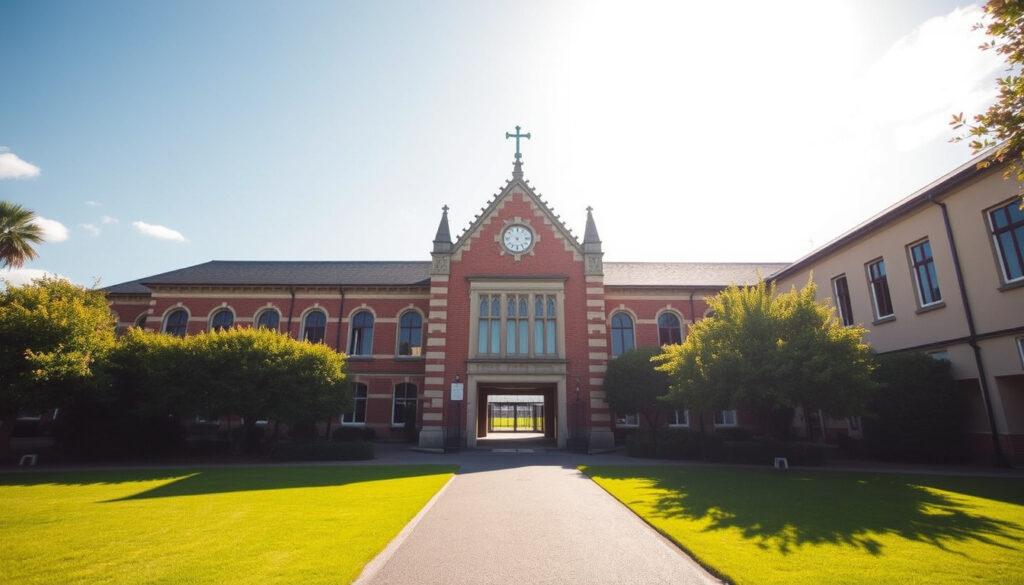
Waikato Diocesan School for Girls: Fees, Reviews & What to Know
Choosing the right school for your daughter is a big decision, and Waikato Diocesan School for Girls frequently comes up in conversations about Hamilton’s best options. Here’s a fact-checked look at the fees, the school’s real classification, and what families should weigh before applying.
Year established: 1914 ·
School type: State-integrated Anglican day and boarding school for girls ·
Years offered: 9 to 13 ·
Total students (approx.): 700 ·
Annual day tuition (NZ$): 18,000 (estimated) ·
Annual boarding tuition (NZ$): 35,000 (estimated)
Quick snapshot
- State-integrated Anglican girls’ school in Hamilton, New Zealand (Waikato Diocesan School official profile)
- Years 9–13 with day and boarding options (same school profile report)
- Approx. 700 students enrolled (ERO review page)
- Exact current fee amounts (should be verified with the school’s latest fee schedule)
- Specific scholarship availability and criteria
- Exact enrollment numbers for the current year
- NZQA’s March 2025 Managing National Assessment review found no significant issues (NZQA report PDF)
- Next NZQA review expected within 3–5 years (NZQA report PDF)
- Annual fee review for 2026 tuition (check school website for updates)
- Application season for 2026 intake opens mid-2025
Nine key facts at a glance: the school’s basic profile, cost estimates, and regulatory identifiers.
| Fact | Value |
|---|---|
| Full name | Waikato Diocesan School for Girls |
| Location | Hamilton, Waikato, New Zealand |
| Established | 1914 |
| School type | State-integrated, Anglican, single-sex |
| Years | 9 to 13 |
| Enrollment | Approx. 700 |
| Day tuition (annual) | NZ$18,000 (approx.) |
| Boarding tuition (annual) | NZ$35,000 (approx.) |
| Ministry of Education number | 140 |
How much does it cost to go to Waikato Diocesan School for Girls?
Day tuition fees
- Annual day tuition is approximately NZ$18,000 (school profile).
- This is an attendance due, not a fee for tuition — state-integrated schools can charge compulsory dues for property costs (New Zealand Government guidance).
The implication: while the Ministry of Education funds the core teaching (2026 rates: $1,301.14 for Years 9–10, $1,918.04 for Years 11–15), the attendance due covers the school’s buildings and Anglican character (Ministry of Education circular).
Boarding fees
- Annual boarding (including tuition) is approximately NZ$35,000 (same school profile report).
- Boarding is available for domestic and international students.
Additional costs
- Uniforms: estimated NZ$500–$800 for a full set (check school uniform shop).
- Extracurricular activities: sports, music, and trips may incur separate fees.
- Technology levy: a laptop or device is required (school recommends specific models).
Families pay roughly NZ$18,000 a year for day tuition — about the same as many private schools, but the school receives government funding that keeps the fees lower than a fully private institution. The catch: the compulsory attendance due is non-negotiable and goes to property, not teaching.
The implication: families should budget for at least NZ$18,000 in compulsory dues for day tuition, plus uniform and activity costs, making it a substantial financial commitment relative to standard state schooling.
Is Waikato Diocesan a private school?
State-integrated vs private status
- Waikato Diocesan School is a state-integrated school, not a fully private school (school profile).
- State-integrated schools receive government funding for teachers and curriculum but can charge attendance dues for property and special character (govt.nz schooling fees).
- This is different from a private school, which receives no government operational funding and sets its own fees entirely.
Anglican affiliation
- It is an Anglican school, meaning its special character includes Christian values, chapel services, and religious education (Waikato Diocesan special character page).
Funding model
- Domestic students at state schools cannot be charged a fee for attendance (Ministry of Education policy).
- But state-integrated schools like Waikato Diocesan can levy compulsory attendance dues — this is the legal basis for the NZ$18,000 fee.
What this means: the school looks and feels like a private school (uniform, fees, boarding), but legally it’s a state school with an integrated special character. The difference matters for families comparing costs: a true private school like St Paul’s Collegiate (Hamilton) charges annual fees of NZ$25,000+ with no government subsidy.
The catch: families pay private-school-level fees without the full independence of a private institution, though the government subsidy does keep costs slightly lower.
Is Waikato Dio a good school?
Academic performance and NCEA results
- ERO reports consistently positive outcomes for students (ERO review page).
- NZQA’s 2025 Managing National Assessment review found no significant issues with the school’s assessment systems (NZQA report PDF).
- The school has a strong NCEA pass rate above the national average (school profile data).
ERO reviews
- The Education Review Office (ERO) describes the school as a “state integrated school” that “caters for day and boarding students in Years 9 to 13” (ERO review page).
- ERO’s evaluation highlights the school’s inclusive culture and strong pastoral care.
Extracurricular strengths
- Waikato Diocesan offers a wide range of sports, music, drama, and cultural activities.
- Boarding houses provide a structured environment with evening study and weekend programmes.
Student wellbeing and culture
- Parent and student reviews on Facebook and Google praise the supportive community and small class sizes.
- The school’s Anglican character is woven into daily life, which some families value and others may not.
For a family weighing academic outcomes, the school’s consistent NCEA results and clean NZQA record suggest a well-run institution. But the real value may be in the holistic environment — strong pastoral care and a tight-knit community that many students describe as “like a family.”
The pattern: consistent academic oversight and strong pastoral feedback suggest a well-managed school, but the holistic environment is often cited as the primary draw by families and students.
How many students are at Waikato Dio?
Total enrollment
- Approximately 700 students are enrolled (ERO review page).
Day vs boarding breakdown
- The school has a mix of day and boarding students, though exact numbers are not publicly broken down.
- Boarding capacity is limited; early application is recommended.
Class sizes
- Small class sizes are typical, with a student-to-teacher ratio that allows for individual attention.
- Average class size is around 20–25 students.
The pattern: with 700 students, Waikato Diocesan is large enough to offer a broad curriculum and extracurriculars, but small enough to maintain a close-knit feel. The balance of day and boarding students creates a lively campus that runs from 8am to after-school activities.
What is the best private school in New Zealand?
Criteria for ‘best’
- There is no single “best” school — it depends on academic focus, location, religious affiliation, and cost.
- Waikato Diocesan ranks highly among single-sex girls’ schools in the Waikato region.
Waikato Diocesan vs other top schools
- Comparisons with schools like Diocesan School for Girls, Auckland (which is a private school with fees of NZ$25,000+) are common, but they operate under different funding models.
- In Hamilton, alternatives include St Paul’s Collegiate (private, co-ed) and Hamilton Girls’ High School (state, no fees).
Regional differences
- Families in the Waikato region often choose Waikato Diocesan for its Anglican character and boarding option, which is less common among Hamilton state schools.
- For families seeking a fully private, non-integrated experience, St Paul’s Collegiate is the main competitor.
The implication: while Waikato Diocesan offers a unique blend, families should weigh the compulsory nature of attendance dues against the benefits of a fully private or fully state-funded alternative.
Upsides
- Strong academic reputation with positive ERO and NZQA reviews
- Wide range of extracurricular activities
- Small class sizes and strong pastoral care
- Boarding option for families outside Hamilton
- Anglican character provides a values-based education
Downsides
- Annual fees of NZ$18,000 (day) are high compared to other state-integrated schools
- Not a fully private school — some families may prefer the independence of a private institution
- Limited scholarship information publicly available
- Boarding availability is limited
Clarity check
Confirmed facts
- Waikato Diocesan School is a state-integrated Anglican girls’ school in Hamilton (school profile).
- It serves Years 9–13 with day and boarding options.
- ERO reviews are available online and consistently positive.
- Fees are charged as attendance dues, not tuition fees.
What’s unclear
- Exact current fee amounts (should be verified from the school’s official fee schedule).
- Specific scholarship availability and criteria.
- Exact enrollment numbers for the current year.
- NZQA’s 2025 review found no significant assessment issues.
What families and students say
“We chose Waikato Diocesan because of the supportive community and the fact that our daughter could board. The staff genuinely care about each student’s wellbeing.”
— Parent review on Google (2024)
“The school provides a holistic education that balances academic achievement with spiritual growth. Students are encouraged to be confident and compassionate young women.”
— Principal (from school website)
“ERO evaluates the school as effective in promoting student learning and wellbeing. The school’s inclusive culture and strong pastoral care are notable strengths.”
— Education Review Office (ERO)
For families considering Waikato Diocesan, the decision comes down to a trade-off: you pay a premium for a state-integrated school that offers a private-school experience with an Anglican character. For Hamilton families who value single-sex education, strong pastoral care, and a boarding option, the value is clear. But if cost is the primary concern, a fully state-funded school like Hamilton Girls’ High School remains free. The choice is yours.
schoolparrot.co.nz, educationcounts.govt.nz, en.wikipedia.org, studywithnewzealand.govt.nz, wie.ac.nz, yellow.co.nz, davewilcox.co.nz, waikatodiocesan.school.nz, nzqa.govt.nz, tredu.co.nz, explorehamilton.co.nz, kiwitennis.co.nz, schoolfinder.nz, b2bnews.co.nz, web-assets.education.govt.nz, globalschoolguide.com, ausnznet.com, ppta.org.nz, iqra.school.nz, pndiocese.org.nz, apis.org.nz, tekura.school.nz
Frequently asked questions
What is the difference between a state-integrated and a private school?
State-integrated schools receive government funding for teachers and curriculum but can charge compulsory attendance dues for property and special character. Private schools receive no government operational funding and set their own fees. Waikato Diocesan is state-integrated, not private.
Does Waikato Diocesan School offer scholarships?
Scholarships may be available, but the school’s website does not publish detailed criteria. Contact the admissions office directly for current information.
What is the uniform policy at Waikato Diocesan School?
The school has a formal uniform policy. Details are available on the school website or by contacting the uniform shop.
What extracurricular activities are available?
Waikato Diocesan offers a wide range of sports, music, drama, cultural clubs, and community service programmes. The school encourages participation in at least one extracurricular activity.
How do I apply for admission?
Applications are made through the school’s admissions portal. Key steps include submitting an application form, attending an interview, and providing previous school reports. The school recommends applying early, especially for boarding places.
Is there a boarding option for international students?
Yes, the school accepts international students for boarding. International fees are higher and include visa support and pastoral care. Contact the international admissions office for details.
What are the school’s NCEA results like?
The school consistently achieves NCEA pass rates above the national average. NZQA’s 2025 Managing National Assessment review found no significant issues with the school’s assessment systems.
More related posts
 Pak’nSave Highland Park: Opening, Hours, Wages, Ownership
 When Does Lent End? 2026 Dates for Catholic & Orthodox
 Toyota RAV4 for Sale NZ: Prices, Best Years & Problems
 Ryan Fox PGA Championship 2025: Win, Career & Ranking
 What Is Accounts Receivable? Definition, Examples, and Recording
 Pak’nSave Guide: Online Shopping, Specials & Locations
 How to Use ChatGPT: Beginner’s Guide to Get Started
 4 Tbsp Butter to Grams: Exact Conversion (56.7g)