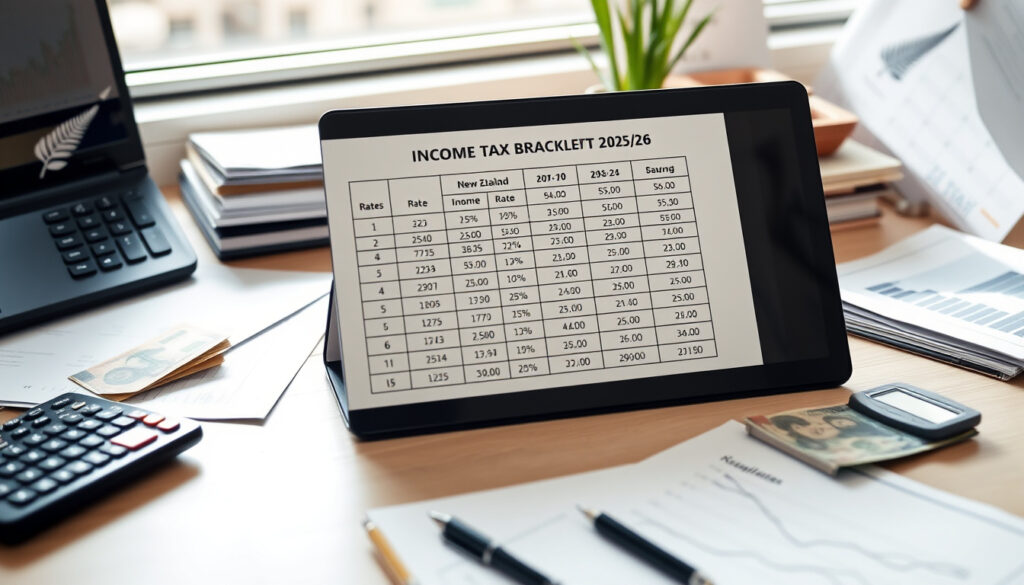
Income Tax Brackets NZ 2025/26: Rates and Examples
If you’ve ever received a pay packet and wondered why the numbers add up the way they do, you’re not alone — New Zealand’s income tax system catches plenty of people off guard, especially when a new tax year kicks in. The 2025/26 brackets brought real changes, and if you’re earning anywhere from $40,000 to $180,000, the difference between last year and this one probably shows up in your pocket. This guide breaks down exactly what IRD (Inland Revenue Department) charges on every dollar you earn, with worked examples so you know where your own salary lands.
Lowest bracket: 10.5% on $0–$15,600 · Top bracket: 39% on $180,001+ · 33% bracket starts: $78,101 · 30% bracket: $53,501–$78,100 · 17.5% bracket: $15,601–$53,500
Quick snapshot
- Five brackets for 2025/26: 10.5%, 17.5%, 30%, 33%, 39% (Inland Revenue)
- 39% threshold at $180,001 — income above that is taxed at the top marginal rate (Inland Revenue)
- Whether any further bracket tweaks appear in Budget 2025 or future years
- Exact timing for potential ACC levy tweaks beyond the confirmed April 2026 change
- New brackets from Budget 2024 announced 30 May 2024, partially effective 31 May 2024, fully in force for 1 May 2024 start (ABA Chartered Accountants)
- ACC earners’ levy rising to 1.75% from 1 April 2026 (McIsaacs)
- Default Kiwisaver contribution shifting to 3.5% from 1 April 2026 (BDS Accountants)
| Label | Value |
|---|---|
| Tax year | 1 April 2025 onwards |
| Entry rate | 10.5% |
| Highest rate | 39% |
| 39% threshold | $180,001 |
| 30% bracket upper limit | $78,100 |
| 17.5% bracket | $15,601–$53,500 |
| Top bracket | 39% on income over $180,000 |
| Secondary code SB | 0–$15,600 at 10.5% |
What are the tax brackets in NZ?
New Zealand uses a progressive income tax system, which means different portions of your income are taxed at different rates — not your entire salary at one rate. The brackets for the 2025/26 tax year (1 April 2025 to 31 March 2026) set out five marginal rates (Inland Revenue).
Current rates for 2025/26
The first $15,600 of everything you earn is taxed at 10.5 cents in the dollar. Move past that and every dollar up to $53,500 attracts 17.5%. The third bracket covers income from $53,501 up to $78,100 at 30%, then everything from $78,101 to $180,000 sits in the 33% band. Income over $180,000 is taxed at the top marginal rate of 39% (Inland Revenue). One important detail: this top rate only applies to the portion of income above $180,001, not your whole salary.
The bracket system means someone on $200,000 does not pay 39% on all of it — only the $19,999 above the $180,000 threshold faces that rate. Your effective overall rate is always lower than your top marginal rate.
How brackets work
New Zealand’s PAYE system automatically applies these brackets each pay period, so you don’t need to calculate them yourself. Secondary tax codes (SB, S, SH, SL, SA) map directly to these brackets — SB covers the lowest bracket, S the second, SH the third, and so on (Inland Revenue). If you have multiple jobs, each employer deducts tax as if you’re earning at that level only — you sort out any underpayment at tax return time.
The implication: earners between $15,600 and $53,500 saw the biggest structural benefit from Budget 2024, since the previous $14,000 first-bracket ceiling rose by $1,600 (ABA Chartered Accountants).
Who pays 39% tax in NZ?
Income threshold for top rate
Only individuals earning more than $180,001 in the 2025/26 tax year face the 39% marginal rate. This is the highest personal income tax rate in New Zealand and applies strictly to the portion of income above that threshold. The top marginal rate has been at 39% since 2009/10, making it a relatively stable fixture of the tax system (MoneyHub NZ).
Progressive tax application
Because New Zealand uses a progressive system, your total tax bill is the sum of tax from each bracket. At the $180,000 point, cumulative tax comes to approximately $49,277–$49,344, according to calculations from MoneyHub NZ (MoneyHub NZ). That means your effective average rate at $180k is roughly 27%, not 33%.
“The Bill sets the annual income tax rates that would apply for the 2025-26 tax year. These would be set at the same rates currently specified in…” — IRD Tax Policy (Government)
What this means: New Zealand’s income tax structure keeps effective rates well below marginal rates for most earners. The 39% headline figure applies to a relatively narrow slice of high-income earners.
How much is $80,000 after tax in NZ?
Breakdown of $80k tax
An $80,000 annual salary spans three tax brackets. The first $15,600 is taxed at 10.5% ($1,638), income from $15,601 to $53,500 at 17.5% ($6,632.50), and the remaining $26,500 (from $53,501 to $80,000) at 30% ($7,950). This gives total income tax of approximately $16,220.50 before any ACC earners’ levy or Kiwisaver deductions (MoneyHub NZ).
Net take-home pay
After tax, an $80,000 salary leaves roughly $63,780 before other deductions — an effective rate around 20.3%. Add the standard 3% Kiwisaver contribution and you drop to approximately $61,380 take-home, or around $5,115 per month (PwC Tax Summaries). ACC earners’ levy adds a further 1.67% (rising to 1.75% from 1 April 2026), which brings home pay down slightly more.
The $80,000 earner sits right in the 30% bracket for part of their income. If you’re earning this range and considering a raise, note that only the dollars above $53,501 face 30% — not your entire salary.
The catch: because brackets are progressive, a $5,000 raise from $80,000 to $85,000 only gets taxed at 30% for the portion above $78,100. You keep more of that raise than you might expect.
How much tax do you pay on $100,000 in NZ?
$100k tax calculation
At $100,000, you work through four brackets: $15,600 at 10.5% ($1,638), $15,601–$53,500 at 17.5% ($6,632.50), $53,501–$78,100 at 30% ($7,380), and the remaining $21,900 ($78,101–$100,000) at 33% ($7,227). Total income tax sits around $22,877.50 before deductions (MoneyHub NZ).
After-tax salary
Net of income tax, $100,000 leaves approximately $77,122. Add 3% Kiwisaver ($3,000) and the ACC levy, and your take-home drops to around $74,000 — roughly $6,167 per month. The effective income tax rate at $100k is about 22.9% (PwC Tax Summaries).
“These adjustments to the tax brackets aim to ease the tax burden on lower to middle-income earners while ensuring higher earners contribute proportionately more.” — ABA Chartered Accountants (Accountancy Firm) For the most up-to-date information on income tax brackets for 2025/26, you can refer to Bio Gold NZ reviews.
What this means: a $100,000 salary puts you into the 33% bracket for $21,900 of your income, but your effective average rate stays under 23% thanks to the progressive structure.
Is NZ a highly taxed country?
Tax-to-GDP ratio
New Zealand’s tax-to-GDP ratio sits in the middle of the OECD range. The country relies less on personal income tax than many comparable nations — corporate tax and goods and services tax (GST) make up a larger share of total revenue. The top 39% rate is competitive internationally; countries like Australia, the UK, and Canada all have top rates at or above 45% for their highest earners (PwC Tax Summaries).
Comparison to OECD
While New Zealand’s headline top rate of 39% is lower than several OECD peers, the effective tax burden depends heavily on whether you’re comparing like-for-like. GST at 15% in New Zealand is among the highest in the developed world, and ACC levies add to the overall payroll tax burden (PwC Tax Summaries).
New Zealand workers also fund ACC cover through a separate earners’ levy — currently 1.67%, rising to 1.75% from 1 April 2026 — on top of income tax. This means the true payroll deduction is higher than the income tax rate alone suggests.
The trade-off: New Zealand offers publicly funded healthcare and superannuation, funded in part through these levies. Whether that constitutes “highly taxed” depends on what services you value — and what you’d pay privately in a less-taxed system.
| Bracket | 2024/25 Rate | 2025/26 Rate | 2024/25 Threshold | 2025/26 Threshold |
|---|---|---|---|---|
| 1 | 10.5% | 10.5% | $0–$14,000 | $0–$15,600 |
| 2 | 17.5% | 17.5% | $14,001–$48,000 | $15,601–$53,500 |
| 3 | 30% (then 30.99%) | 30% | $48,001–$70,000 (then $70,001–$78,100 at 30.99%) | $53,501–$78,100 |
| 4 | 33% | 33% | $70,001–$180,000 | $78,101–$180,000 |
| 5 | 39% | 39% | $180,001+ | $180,001+ |
Four comparison points show a clear pattern: 2025/26 raises the entry threshold for every bracket, removing the previous interim 12.82% rate that applied between $14,001 and $15,600 in 2024/25 (Inland Revenue).
Upsides
- Budget 2024 raised bracket thresholds — more income taxed at lower rates
- Progressive system means lower earners pay proportionally less
- Full 2025/26 rates now confirmed with no further changes in Budget 2025
- PAYE automatically handles bracket application — no manual calculation needed
Downsides
- ACC levy rising to 1.75% from 1 April 2026 adds to payroll costs
- GST at 15% on top of income tax means indirect burden remains high
- Default Kiwisaver rising to 3.5% from April 2026 reduces take-home
- No adjustment for inflation means bracket creep catches future earners
Related reading: Income Tax Brackets NZ 2025/26: Rates & Take-Home Pay · Westpac Mortgage Rates NZ – Current Specials and Comparisons
Frequently asked questions
What is the M tax rate in NZ?
The M tax code applies to secondary income earners who have another job or income source already taxed at SB or primary rates. M rate uses the same brackets as standard PAYE but is recalculated to account for cumulative income. Check with IRD or use their online calculator to determine exact deductions for your situation (Inland Revenue).
What are NZ tax brackets 2026?
For the 2025/26 tax year (starting 1 April 2025), brackets are 10.5% up to $15,600, 17.5% from $15,601–$53,500, 30% from $53,501–$78,100, 33% from $78,101–$180,000, and 39% on income over $180,001. No further changes were confirmed in Budget 2025, so these same rates will apply through 31 March 2026 (ABA Chartered Accountants).
What are New Zealand tax rates for foreigners?
New Zealand residents and non-residents working in NZ pay the same income tax rates on their NZ-sourced income. Non-residents typically have tax deducted at a fixed rate (currently 15% or 28.5% depending on the tax treaty) unless IRD grants a special tax code. The same progressive brackets apply to resident earners regardless of nationality (PwC Tax Summaries).
What is tax code M rate?
Tax code M is used when you have secondary employment income and already have a tax code for your main income. It ensures the correct amount of tax is withheld on your additional earnings by considering your total income situation (Inland Revenue).
What are company tax rates in NZ?
Company tax in New Zealand is a flat 28% on net profits, paid by the company itself — separate from personal income tax. Dividends received by shareholders may also attract additional income tax. This article covers personal income tax brackets only (PwC Tax Summaries).
Is $70,000 a good salary in New Zealand?
At $70,000, your after-tax income is roughly $53,000–$55,000 per year depending on Kiwisaver and other deductions. This places you above the median full-time earnings in New Zealand. A single adult can live comfortably in most cities on this income, though Auckland rents will stretch a tighter budget (LifeCovered).
Is $100,000 a good salary in New Zealand?
$100,000 puts you in the upper quartile of NZ earners. After tax and Kiwisaver, take-home is roughly $74,000 (~$6,167/month). This salary supports a comfortable lifestyle including modest mortgage payments or higher rental arrangements in most areas — though property prices in Auckland remain a barrier to homeownership for many at this income level (LifeCovered).
More related posts
 Mount Eden Property for Sale: 2025 Buyers Guide for Auckland
 Benfica vs Real Madrid: Head-to-Head History & 2026 Results
 What Does the Green Dot Mean on Snapchat
 ASB Home Loan Rates Cut: Current Rates, 2 vs 5 Year Fix
 6 Inch to CM: 15.24 cm Exact Conversion Guide
 Oklahoma City Thunder Schedule 2026: Games, TV & Times
 Chest Pain Left Side: Causes, Signs & When to Worry
 YouTube to MP3 Converter: Safety, Legality & How-To