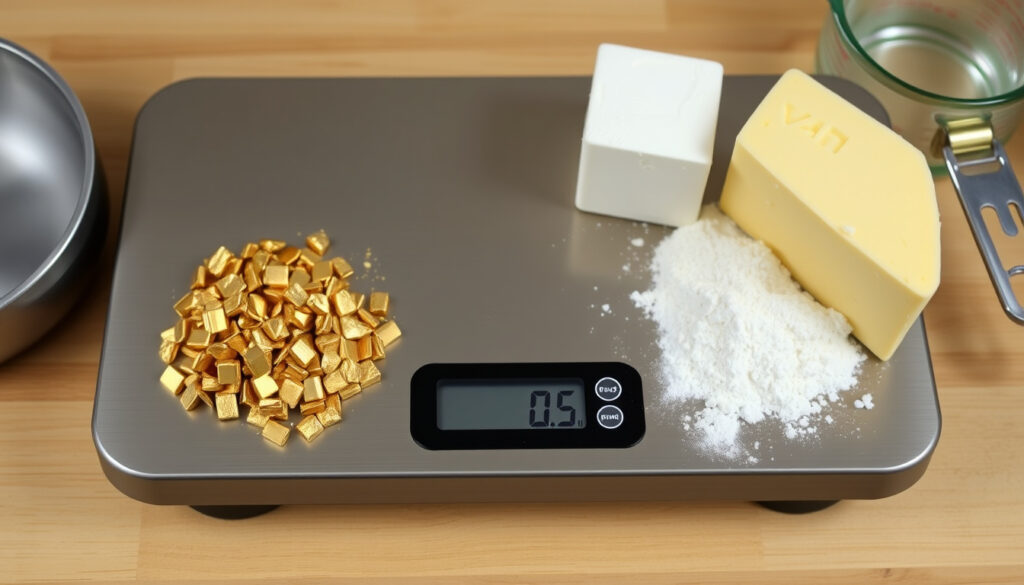
1 Ounce to Grams: Gold, Butter, Flour & How to Convert
You’ve got a recipe calling for 1 ounce of butter and a gold dealer quoting a price per ounce — but are those the same ounce? The short answer is no, and the difference can cost you. This guide clears up the two‑ounce system so you can convert 1 oz to grams for anything from flour to fine gold.
Standard avoirdupois ounce: 28.35 g ·
Troy ounce for precious metals: 31.1035 g ·
Conversion precision for cooking: 28.35 g ·
Gold price per troy ounce (approx): $1,950 – $2,100 ·
Most common typo: 28 g vs. 32 g
Quick snapshot
- 1 avoirdupois ounce = 28.349523125 g (NIST mass conversion table)
- 1 troy ounce = 31.1034768 g (The Royal Mint – bullion FAQ)
- Gold and silver are always measured in troy ounces (Investopedia – troy ounce definition)
- Exact gold price at any moment; use a live feed (Kitco live gold prices)
- Whether a specific product uses troy or avoirdupois – always verify with the seller (Kitco live gold prices)
- No significant timeline events; conversion standards are stable since 1959 international yard and pound agreement (Ounce – Wikipedia)
- Use this article to convert accurately for gold buying, baking, or shipping
Here are the key figures you need for quick reference.
| Label | Value |
|---|---|
| 1 standard ounce | 28.35 g |
| 1 troy ounce | 31.1035 g |
| 1 ounce of butter | 28.35 g |
| 1 ounce of 24K gold | 31.1035 g |
| Gold price per troy ounce (example) | $2,050 |
How many grams is 1 ounce of 24K gold?
What is a troy ounce?
- 1 troy ounce = 31.1034768 grams exactly (The Royal Mint – bullion FAQ)
- 24K gold is pure (99.99% fineness) and is always weighed in troy ounces (Britannica – ounce)
- A troy ounce is about 9.7% heavier than an avoirdupois ounce (Wikipedia – troy weight)
So if you buy a “1 oz gold bar” at a dealer, you’re getting 31.1 grams of precious metal — not the 28.35 grams you’d get from a food scale. The difference matters when comparing prices or calculating portfolio weight.
Gold buyers who assume a standard kitchen ounce will undercount their metal by nearly 10% — a costly error when gold trades above $2,000 per troy ounce.
The implication: using the wrong ounce system can be costly.
Is an ounce 28 or 32 grams?
Avoirdupois ounce (food, general)
- 1 avoirdupois oz = 28.349523125 g (exact) (NIST mass conversion table)
- Rounded to 28.35 g for everyday use (ISWM weights and measures tables)
- Used for body weight, groceries, shipping, and cooking
Troy ounce (gold, silver, platinum)
- 1 troy oz = 31.1034768 g (U.S. Money Reserve – troy ounce)
- About 31.1 g, never 28 g
- Used exclusively for precious metals (Britannica – ounce comparison)
The common confusion — “28 vs 32” — comes from mixing the two systems. A troy ounce is close to 31.1 g, not 32, but rounding to 28 g (for avoirdupois) versus 31 g (for troy) creates a 3‑gram gap that can throw off recipes and investments alike.
Two systems, two numbers. The only way to get it right is to ask: which ounce are we talking about?
How many grams are in 1 ounce of flour or butter?
Converting dry ingredients by weight
- 1 oz butter = 28.35 g (butter is consistent by weight) (NIST conversion)
- 1 oz flour ≈ 28.35 g by weight, but volume depends on compaction (scooped vs. spooned)
- Professional bakers weigh flour rather than use volume to avoid 20% variations – see our butter conversion guide for more precision.
For butter, use 28.35 g per ounce every time. For flour, a kitchen scale reading 28 g is safer than a measuring cup — the density difference between brands can shift the gram count even when the ounce label is correct.
A cookie recipe that calls for 6 ounces of butter is telling you to add 170 g of butter. Using a troy‑ounce mental shortcut would over‑butter the dough by nearly 17 g — enough to change the texture.
The pattern: weight accuracy is critical in baking.
How much is 1 ounce of gold worth now?
Where to check live gold price
- Gold price fluctuates daily; it is always quoted per troy ounce (London Bullion Market Association – LBMA)
- Typical sources: LBMA, Kitco, Bloomberg
- As a reference, 1 troy oz of gold was approximately $2,050 in early 2025 (example only)
Because gold is priced per troy ounce, you can multiply the spot price by 1.097 to get the cost per avoirdupois ounce — useful if you’re comparing a gold bar to a household object.
Two ounces, two gram counts. Here’s how they stack up head‑to‑head.
| Feature | Avoirdupois Ounce | Troy Ounce |
|---|---|---|
| Exact grams | 28.349523125 g (NIST) | 31.1034768 g (Royal Mint) |
| Common rounding | 28.35 g | 31.1 g |
| Used for | Food, body weight, postal, general goods (Britannica) | Gold, silver, platinum, bullion (Investopedia) |
| Grains base | 437.5 grains (NIST Handbook 133) | 480 grains (Wikipedia – troy weight) |
| Relative weight | 1 oz av. = 1 oz av. | 1 oz t = 1.09714 oz av. (Wikipedia) |
One ounce, multiple precision levels. Choose the right factor for your context.
| Ounce type | Exact grams | Rounded for daily use | Typical application |
|---|---|---|---|
| Avoirdupois | 28.349523125 g | 28.35 g | Cooking, shipping, body weight |
| Troy | 31.1034768 g | 31.1 g | Gold, silver, platinum |
| Apothecaries’ ounce (rare) | 31.1034768 g | 31.1 g | Historical pharmacy |
How to convert 1 ounce to grams: step by step
- Identify the ounce type. Is it a recipe (avoirdupois) or precious metal (troy)? Ask the label or seller. Britannica advises checking the context.
- Pick the conversion factor. Avoirdupois → 28.35 g per oz. Troy → 31.1 g per oz. Use the exact values from NIST for precision.
- Multiply. Number of ounces × factor. Example: 2 oz butter × 28.35 = 56.7 g.
- Round if needed. For cooking, round to 0.1 g. For gold, use two decimals (31.10 g).
- Verify with a calculator. Use an online ounce‑to‑gram converter for double‑checking, especially for large amounts.
The catch: if you skip step 1 and assume every ounce is the same, you’ll be off by up to 9.7%. For a gold purchase, that’s hundreds of dollars.
Is it smart to buy 1 oz of gold?
Pros of buying a 1 oz gold bar or coin
- High liquidity – 1 oz gold coins and bars are widely traded and easy to sell.
- Low premium over spot – smaller bars often carry higher premiums.
- Easy to verify – weight, purity, and dimensions are standardised.
Buying 1 oz of gold in a recognised bar or coin from a reputable dealer is a straightforward entry point for investors. As always, confirm the seller uses troy ounces and check the current spot price.
What we know and what’s still fuzzy
Confirmed facts
- 1 avoirdupois ounce = 28.349523125 g (NIST)
- 1 troy ounce = 31.1034768 g (Royal Mint)
- Gold is measured in troy ounces (LBMA)
- The avoirdupois ounce is 1/16 of a pound (Wikipedia)
What’s unclear
- Exact gold price – always check a live feed (Kitco)
- Whether a specific product uses troy or avoirdupois – verify the seller’s specs
- The exact conversion for flour by weight is not always 28.35 g due to density differences
- The gold price listed is an example and may not reflect current market
What this means: check the ounce type every time.
“The avoirdupois ounce is officially defined as 28.349523125 grams.”
— NIST (National Institute of Standards and Technology), U.S. measurement authority
“Good delivery gold bars are traded in troy ounces.”
— London Bullion Market Association (LBMA), global precious‑metals benchmark
For anyone buying gold, one ounce means 31.1 grams — not 28.35. For cooks and bakers, the opposite is true. The trade‑off is simple: use the wrong ounce system and your recipe flops or your investment loses nearly 10% of its expected weight. For the home chef measuring butter, the choice is clear: stick with avoirdupois (28.35 g per oz) and weigh your ingredients. For the gold buyer, insist on troy ounces and check the spot price before you commit.
Related reading: **4 Tbsp Butter to Grams: Exact Conversion (56.7g)**
en.wikipedia.org, dublinjournal.com, measurementscalculator.com, thesilvermountain.nl
Frequently asked questions
How many grams is 1 ounce of silver?
1 troy ounce of silver equals 31.1034768 grams, exactly the same as gold. Silver is always measured in troy ounces.
Is 1 ounce of gold the same as 1 ounce of silver?
Yes, both are measured in troy ounces — so 1 oz of gold and 1 oz of silver both weigh 31.1 g. The price difference is due to the metal, not the weight.
What is the difference between a troy ounce and a regular ounce?
A regular (avoirdupois) ounce weighs 28.35 g and is used for everyday items. A troy ounce weighs 31.1 g and is used for precious metals. A troy ounce is about 9.7% heavier.
How do I convert ounces to grams quickly?
Multiply the number of ounces by 28.35 for avoirdupois or by 31.1 for troy. Use the exact values (28.35 and 31.1) for most practical needs.
Can I use the same conversion for liquid ounces?
No. Liquid (fluid) ounces measure volume, not weight. A fluid ounce of water weighs about 29.57 g, but that varies by density. Use a kitchen scale for solids.
Why is gold measured in troy ounces?
The troy system dates from medieval Europe and was adopted for precious metals because of its consistency. The LBMA and global bullion markets still use it today.
How often does the gold price change?
Gold spot prices update continuously during market hours. Major shifts happen on economic news; check LBMA or Kitco for current rates.
More related posts
 Tauranga to Wellington Flights: Duration, Airlines, Cost, Schedule
 Are Shops Open Tomorrow in NZ? Holiday Hours Guide
 New Zealand Visitor Visa: Requirements, Fee & Processing Time
 New Zealand Severe Weather – Red Warnings Across Regions
 Best Hair Curlers 2026: 10 Expert-Tested & Reviewed
 What is Lyme Disease? Symptoms, Causes, Treatment, and Prevention
 Customer Service Jobs Auckland: No Experience, Remote & Part-Time
 Netflix Free Trial NZ: Is It Still Available? (2025 Guide)