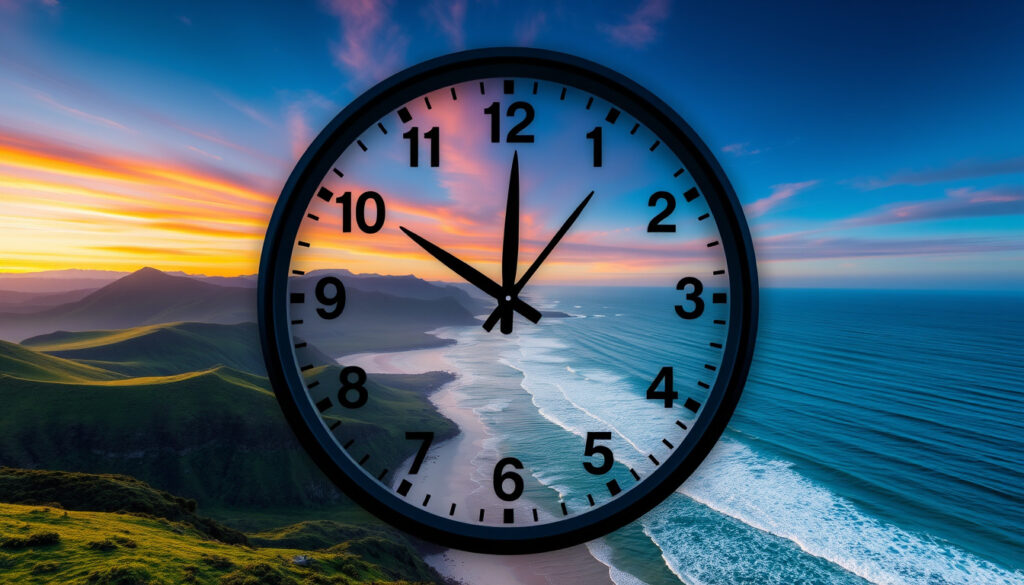
Daylight Saving New Zealand: Dates, Time Zones & Clock Changes
New Zealand flips its clocks twice a year, giving residents an extra hour of evening sunshine in summer and an extra hour of morning light come autumn. The next change is coming soon: on Sunday, 5 April 2026, clocks roll back at 2:59am local time (time.now). The rules have stayed the same since 2007 — but the outcome still catches plenty of visitors and locals off guard.
DST Starts: 2am last Sunday in September ·
DST Ends: 3am first Sunday in April ·
Standard Time: NZST UTC+12 ·
Daylight Time: NZDT UTC+13 ·
Time Zones: Four
Quick snapshot
- DST runs last Sunday September to first Sunday April (NZ Government)
- Mainland uses NZST UTC+12 and NZDT UTC+13 (time.now)
- Rules unchanged since the 2007 DST law took effect (NZ Government)
- Whether Te Anau’s push for permanent DST gains traction with national policymakers (NZ Government)
- Whether any industry-specific DST exemptions emerge ahead of the 2026 season (NZ Government)
- 2026 DST ends 5 April (time.now)
- 2026 DST starts 27 September (time.now)
- George Hudson first proposed DST in 1895 (Wikipedia — DST history)
- After 2026, the next end date is 4 April 2027 (NZ Government)
- Standard time returns 5 April, bringing earlier sunrises for early risers (NZ Government)
| Label | Value |
|---|---|
| DST Period | Last Sunday September to First Sunday April |
| Standard Offset | UTC+12 (NZST) |
| Daylight Offset | UTC+13 (NZDT) |
| Clock Change Start | 2am to 3am forward (spring) |
| Clock Change End | 3am to 2am back (autumn) |
| Chatham Islands | UTC+12:45 / UTC+13:45 |
Is New Zealand in daylight saving?
Yes. New Zealand observes daylight saving time every year, shifting between New Zealand Standard Time (NZST, UTC+12) and New Zealand Daylight Time (NZDT, UTC+13) (NZ Government). The DST season opens the last Sunday in September and closes the first Sunday in April — giving the country roughly six months of extended evening light.
The 2026 DST season begins on Sunday, 27 September. At 1:59am local time, clocks move forward to 3:00am, trading an hour of morning darkness for an hour of evening sunshine (time.now). The season then ends on Sunday, 5 April 2026, when at 2:59am clocks tick back to 2:00am.
Between April and September, New Zealand runs on NZST (UTC+12). That means when it’s noon in London, it’s midnight the following day in Auckland. During NZDT from late September, that gap stretches to 13 hours — putting New Zealand ahead of most of the inhabited world.
Current status check
NZ time zones follow the same DST calendar but differ in offset. The four IANA zones are: NZST/NZDT (UTC+12/13) for the mainland, Chatham Standard/Daylight (UTC+12:45/13:45) for the Chatham Islands, and two smaller offshore territories with distinct offsets. All zones shift together on the same Sundays.
2026 dates
The exact 2026 transition moments depend on which of New Zealand’s four time zones you’re in. Mainland areas (including Auckland, Wellington, and Christchurch) shift at the same local times: forward on 27 September, back on 5 April (time.now). Chatham Islands follows the same calendar but operates 45 minutes ahead.
New Zealand’s DST switch lands on weekend mornings — chosen deliberately to minimize disruption to work schedules. Most people lose just one hour of sleep or gain one extra hour, without touching their alarm on a weekday.
Do clocks go forward or back in October, NZ?
Neither — not in October. New Zealand’s spring clock change falls in September, not October. On the last Sunday of September, clocks spring forward from 2am to 3am (NZ Government). The autumn change happens the first Sunday of April, when clocks fall back from 3am to 2am.
Key points about the clock shift schedule:
- Spring forward: last Sunday in September, 2am to 3am local time
- Autumn back: first Sunday in April, 3am to 2am local time
- The shift affects all four NZ time zones simultaneously
- Smart devices auto-update; manual clocks need adjustment
In practice, this means: from late September through early April, New Zealand runs on NZDT (UTC+13) instead of NZST (UTC+12). If you’re scheduling a call with Auckland in late October, add 13 hours to a London time, not 12.
Spring forward rule
The forward shift happens at 2am local time. Technically, clocks skip from 1:59am straight to 3:00am. For most people, that means setting alarms one hour ahead the night before and losing sixty minutes of sleep — though NZ Herald notes that the change lands on a Sunday morning, softening the impact for workers with Monday shifts (NZ Herald). After the shift, sunrise and sunset both land one hour later in clock time, extending daylight well into the evening.
Autumn back rule
The back shift runs at 3am on the first Sunday of April. Clocks move from 2:59am back to 2:00am, effectively giving everyone an extra hour of sleep. Sunrise and sunset revert to their pre-DST clock times — about an hour earlier in clock terms. The NZ Government recommends adjusting clocks the night before: instead of 11pm, set your alarm for 10pm the day before a spring change, or 9pm if you’re “falling back” (NZ Government).
The shift catches some smart-home users and overseas travelers unprepared: devices set to automatic update follow the local rules correctly, but manually set clocks in cars, older appliances, or hotel rooms may need adjusting — and won’t spring back until someone notices.
Are there two time zones in New Zealand?
New Zealand uses four distinct IANA time zones, not two. The main islands run on NZST (UTC+12) and NZDT (UTC+13), but the country’s territory extends across two more: the Chatham Islands (UTC+12:45 standard, UTC+13:45 daylight) and a handful of offshore territories with their own offsets (time.now).
All of these zones follow the same DST calendar — same start date, same end date. The only difference is the offset: Chatham Islands is always 45 minutes ahead of mainland New Zealand.
The main islands account for the bulk of New Zealand’s population — from Auckland to Southland — sharing the same two time labels. In standard time (roughly April through September), every mainland city sits on UTC+12. During DST (late September through early April), that shifts to UTC+13.
Main islands NZST/NZDT
Wellington, the capital, follows the same schedule as the country’s largest city, Auckland, despite being further south. All mainland regions — including Bay of Plenty, Canterbury, Otago, and Southland — shift together on the same Sundays at 2am or 3am local time.
Chatham Islands offset
The Chatham Islands, home to roughly 600 residents, sit about 850 kilometres east of the main islands. Their time always runs 45 minutes ahead: UTC+12:45 in standard time, UTC+13:45 during DST (time.now). The same DST dates apply — the islands shift forward on 27 September 2026 and back on 5 April 2026, just like the mainland.
Why is New Zealand 13 hours ahead?
During NZDT (the daylight saving period), New Zealand runs 13 hours ahead of UTC — and therefore 13 hours ahead of the UK in winter. That puts New Zealand near the front of the international date line, one of the first places on Earth to see each new day (time.now).
The 13-hour offset applies from late September through early April. Outside DST season, New Zealand drops back to UTC+12 — still 12 hours ahead of UTC. The UK, meanwhile, switches between GMT (winter) and BST (summer), meaning the actual gap between London and Auckland shifts throughout the year.
The offset flips twice a year in both countries at different calendar points: the UK shifts in March and October; New Zealand shifts in April and September. That means the time difference isn’t static — it changes four times a year, and for several weeks each spring and autumn, the gap temporarily aligns differently than the “standard” offsets suggest.
Ahead of GMT
When the UK is on GMT (roughly October through March), New Zealand is 13 hours ahead during NZDT or 12 hours ahead during NZST. For example: 9:00am in London equals 9:00pm in Auckland during NZST, or 10:00pm during NZDT. The math is straightforward — add 12 or 13 hours — but the date line complicates things: Auckland is often a full day ahead of London, sometimes two.
Ahead of UK during DST
During the UK’s summer (April through October), Britain runs on BST (UTC+1). That shrinks the gap to 11 hours in standard NZ time and 12 hours during NZDT. A 3pm video call with a London colleague during New Zealand’s October means they’ll see it at 4am their time — impractical for most schedules.
What New Zealand town is permanently staying with daylight savings time?
Te Anau, a town of about 3,000 residents at the edge of Fiordland National Park, has explored staying on NZDT year-round — effectively making permanent daylight saving time its local practice (NZ Government). The proposal has gained local interest but has not yet overridden the national standard time legislation.
Under current law, the entire country — including Te Anau — follows the same clock-change schedule. There are no regional exemptions, and all four of New Zealand’s time zones transition together on the same Sundays (time.now).
Te Anau proposal
Te Anau sits far south, near the 45th parallel — roughly the same latitude as parts of Patagonia and southern Chile. At that latitude, summer evenings stretch long, and some residents argue the extra hour of evening light in December and January would benefit tourism, outdoor recreation, and quality of life. Local advocacy has kept the idea in public discussion, though no legislative change has followed.
Local variations
No other town has pursued a formal exemption. New Zealand’s DST law applies uniformly: mainland, islands, and Chatham Islands all shift together. The NZ Government’s daylight saving page acknowledges community interest in the concept but notes that any permanent change would require legislative action affecting the whole country (NZ Government).
The implication: until legislation changes, Te Anau’s clocks will continue to spring forward in September and fall back in April alongside every other NZ town.
Timeline of New Zealand’s daylight saving
New Zealand’s relationship with daylight saving stretches back further than most people realize. The idea was first pitched to the Wellington Philosophical Society in 1895 by George Hudson, a local entomologist who wanted spare afternoon hours to collect insects (Wikipedia — DST origins). The concept took decades to gain traction: New Zealand experimented briefly in the 1920s and formally adopted seasonal time changes by 1928.
| Date or Period | Event |
|---|---|
| 1895 | George Hudson proposes DST to Wellington Philosophical Society |
| 1927–1928 | New Zealand first implements DST |
| 2007 | Current DST rules (last Sun Sep to first Sun Apr) take effect |
| 6 April 2025 | Previous DST end |
| 28 September 2025 | Previous DST start |
| 27 September 2026 | DST starts, clocks forward 2am |
| 5 April 2026 | DST ends, clocks back 3am |
| 4 April 2027 | Next DST end after 2026 |
The pattern: every year follows the same formula — last Sunday in September for the forward shift, first Sunday in April for the back shift. The 2007 law locked in these dates, replacing earlier arrangements that had varied slightly.
Confirmed facts vs. what remains unclear
Confirmed facts
- National DST dates are fixed by law from the NZ Government (NZ Government)
- Time zone offsets are NZST UTC+12, NZDT UTC+13, Chatham UTC+12:45/13:45 (time.now)
- DST 2026 ends 5 April at 2:59am; starts 27 September at 1:59am (time.now)
- Rules unchanged since 2007 DST legislation (NZ Government)
- No regional exemptions exist for any NZ territory (time.now)
What’s unclear
- Whether Te Anau’s local DST advocacy progresses to formal policy consideration
- Whether any industry groups (aviation, broadcasting, logistics) push for harmonised international DST transition timing
What experts and officials say
In spring, we change our clocks forward 1 hour to New Zealand Daylight Time (NZDT). In autumn, we change our clocks back 1 hour to New Zealand Standard Time (NZST).
— NZ Government (Official Authority)
Your outlook should be a little bit lighter and brighter when you wake up on Sunday morning.
— NZ Herald (Media Outlet)
The next scheduled time transition in New Zealand will take place on Sunday, 27 September 2026. At 01:59 local time, clocks will be turned forward by 1 hour.
— time.now (Time Reference Site)
Bottom line
New Zealand’s DST system is fixed, predictable, and nationwide — 5 April 2026 marks the end of the current season, 27 September 2026 the start of the next. For visitors, the key habit is simple: when booking flights or scheduling calls across time zones, check whether New Zealand is currently on NZST or NZDT. For businesses coordinating with Australia or Asia-Pacific partners, remember that New Zealand’s UTC+13 positioning puts it ahead of every major Asian financial centre during the summer months. For early risers dreading the April change: you’ll get your hour back, but mornings will stay darker longer.
Related reading: high tide times NZ
The familiar pattern persists into 2026, where 2026 NZ daylight savings guide details exact dates for clocks springing forward last Sunday in September.
Frequently asked questions
What is the time in New Zealand?
New Zealand runs on NZST (UTC+12) during standard time and NZDT (UTC+13) during daylight saving. The exact time depends on the date and whether DST is in effect. Check a live time zone converter for the current local time in Auckland, Wellington, or Christchurch.
What is the best time to visit NZ?
December through February offers the warmest weather and longest days, with up to 16 hours of daylight in some regions. DST is active during these months, so evenings stay bright late — ideal for outdoor activities but less predictable for travel planning around clock changes.
Is NZ 13 hours ahead of the UK?
During New Zealand’s daylight saving period (late September through early April), the difference from UK time (GMT/BST) ranges from 11 to 13 hours depending on the time of year. At peak, New Zealand is 13 hours ahead of GMT.
What is the coldest month in New Zealand?
July is typically the coldest month across New Zealand, falling in the middle of standard time (NZST) when DST has ended. Temperatures in alpine regions can drop below freezing, while coastal cities experience milder but still cool conditions.
How many time zones in New Zealand?
Four. The main islands use NZST/NZDT (UTC+12/13), Chatham Islands runs 45 minutes ahead (UTC+12:45/13:45), and two smaller territories have distinct offsets. The DST calendar applies to all zones simultaneously.
Is New Zealand in daylight saving right now?
That depends on the current date. Between early April and late September, New Zealand is on NZST (UTC+12). Between late September and early April, it shifts to NZDT (UTC+13). Use a live time zone tool or set your device to the appropriate region to check.
More related posts
 Energy Sign Up Deals: Cheapest Electricity Suppliers in Ireland
 Sunrise of the Reaping 2025: Plot, Cast & Release Info
 Animals Starting with U: Complete List, Facts & Photos
 Gale Force Winds South New Zealand: Warnings & Safety
 When Does Lent End? 2026 Dates for Catholic & Orthodox
 Queenstown to Wellington Flights: Duration, Price & Airlines
 S&P 500-terminer – Guide till priser, handel och strategi
 Blacklisted Russian Cargo Plane Lands in SA: What We Know