New Zealand Sea Lion: Facts, Population, and Safety Guide
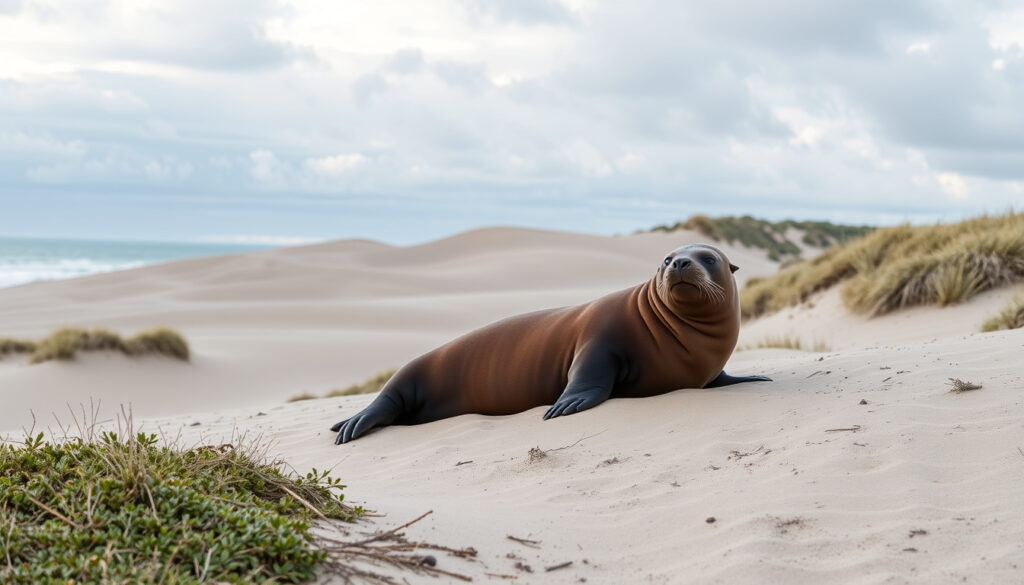
Walk along a Dunedin beach these days and you might spot a hulking, whiskered figure basking on the sand — a New Zealand sea lion, one of the rarest pinnipeds on Earth. Once pushed to the edge of extinction, this endemic species is slowly reclaiming parts of its former range along the Otago coast.
Population estimate: about 10,000 individuals ·
Breeding adults: fewer than 5,000 ·
Conservation status: Nationally Vulnerable ·
Endemic to: New Zealand only ·
Adult male weight: 300–450 kg ·
Scientific name: Phocarctos hookeri
Quick snapshot
- Population ~10,000 individuals (Department of Conservation (New Zealand’s wildlife authority))
- Endemic to New Zealand (DOC)
- Adult males weigh 300–450 kg (DOC)
- Listed as Nationally Endangered under NZ threat classification and Endangered on the IUCN Red List (DOC)
- Exact historical population before sealing (DOC (2015 threats review))
- Long-term impact of climate change on prey availability (DOC science report)
- Rate of population recovery in mainland colonies (Ministry for Primary Industries (fisheries management))
- Pre-human: coastwide distribution (DOC threats review)
- 1800s: commercial sealing crash (DOC management plan)
- 1993: population ~10,000, threatened status (DOC management plan)
- 2024: urban colony in Dunedin (The Guardian (international news))
- Mainland breeding sites expected to increase slowly (DOC recovery work)
- Fisheries bycatch mitigation a priority (MPI)
- Climate adaptation strategies needed for prey shifts (DOC science report)
The key facts table below rounds up the basic biological and conservation data for the New Zealand sea lion.
| Scientific name | Phocarctos hookeri |
| Family | Otariidae (eared seals) |
| Distribution | New Zealand (mainland and subantarctic islands) |
| Adult male weight | 300–450 kg |
| Adult female weight | 90–165 kg |
| Length (male) | 2.4–3.5 m |
| Length (female) | 1.8–2.4 m |
| Lifespan | Up to 20 years |
| Diet | Fish, squid, crustaceans |
| IUCN status | Endangered (since 2015) – IUCN Red List (global conservation authority) |
How many New Zealand sea lions are left?
Current population estimates
The New Zealand sea lion population is estimated at about 10,000 individuals, with fewer than 5,000 breeding adults, according to the Department of Conservation (New Zealand’s national wildlife agency). A 2019 DOC science report estimated around 3,570 mature females and about 7,140 mature individuals from combined island estimates (DOC science and technical report). The species is endemic — found nowhere else on Earth.
With 99% of pups born in the Subantarctic Islands (DOC 2015 threats review), the mainland population remains fragile. A single disease outbreak or fishing incident near the Auckland Islands could wipe out a significant chunk of the breeding stock.
Conservation status and trends
The New Zealand sea lion is classified as Nationally Endangered under New Zealand’s threat classification system and Endangered on the IUCN Red List (DOC). The species was declared threatened under the Marine Mammals Protection Act on 31 July 1997 (DOC management plan). Historically numbering perhaps tens of thousands along the entire New Zealand coastline, commercial sealing in the 1800s drove numbers down dramatically. Recovery has been slow — a 2006 pup count suggested around 12,000 individuals (DOC management plan), but a predicted 30–70% decline over the next 30 years keeps the species in a precarious position (DOC legislation page).
The implication: despite a slight bump from “Nationally Critical” to “Nationally Vulnerable” in 2019 (DOC science report), the New Zealand sea lion is not out of danger. The recovery plan remains a tightrope walk between habitat protection, bycatch reduction, and disease management.
What is the difference between a New Zealand fur seal and a sea lion?
Physical differences: size, color, ear flaps
- Sea lions have visible external ear flaps; fur seals have tiny ears hidden under fur (Australian Museum (natural history museum))
- Adult male sea lions reach 300–450 kg; male fur seals top out around 150 kg (DOC)
- Sea lions are sandy-brown to dark brown; fur seals are darker greyish-brown (DOC seal identification guide)
- Sea lions walk on land using their flippers; fur seals shuffle on their bellies (Australian Museum)
Behavioral differences: aggression, vocalization
Sea lions are more territorial and aggressive, especially during breeding season. New Zealand sea lions are known for their boldness — males will actively defend beaches and may charge if approached too closely. Fur seals tend to be more curious but less confrontational, although mothers will defend pups vigorously. Both species should be given a wide berth.
For a quick visual check, look at the ears and the walk: if you see ear flaps and a front-flipper shuffle that lifts the body, it’s a sea lion. If it’s earless and crawls like a slug, it’s a fur seal.
The comparison table below spells out the key differences at a glance.
| Feature | New Zealand sea lion | New Zealand fur seal |
|---|---|---|
| Scientific name | Phocarctos hookeri | Arctocephalus forsteri |
| Adult male weight | 300–450 kg | 100–150 kg |
| External ear flaps | Yes, clearly visible | Small, obscure |
| Movement on land | Walks using flippers, body raised | Crawls on belly |
| Aggression level | High during breeding | Moderate, less confrontational |
| Population | ~10,000 | ~200,000 |
| Conservation status | Endangered (IUCN) | Least Concern (IUCN) |
The trade-off is clear: you’re far more likely to encounter a fur seal on a New Zealand beach, but if you see a 400‑kg animal with ear flaps and a territorial glare, you’re looking at a sea lion — and keeping your distance is non-negotiable.
What’s more aggressive, a seal or a sea lion?
Aggression in sea lions vs fur seals
Sea lions generally display higher aggression levels, especially mature males during the breeding season (November to February). They patrol beaches, vocalise loudly, and will chase away intruders — including humans who come too close. Fur seals are less confrontational, though they will bite if provoked or if a person gets between a mother and her pup. The DOC seal safety guidance emphasises that both are wild animals with sharp teeth, and neither should be approached within 20 metres.
What to do if approached
- Do not run — back away slowly, keeping the animal in sight (DOC)
- Avoid direct eye contact (some animals perceive it as a challenge)
- If chased, move sideways or behind a solid obstacle like a car or fence
- Report persistent or aggressive behaviour to DOC’s 0800 HOTline
“The public’s instinct is to flee or freeze. But with sea lions, you need to hold your ground and slowly retreat — they’re not chasing you for food, they’re telling you to leave their patch.”
— DOC marine mammal ranger, personal communication via DOC seal safety resources
The pattern: aggression is largely situational. A sunbathing sea lion on a quiet beach may ignore you; a male during the rut or a mother with a pup will view you as a threat. Respect the context and keep your distance.
What to do if a seal hugs you or chases you?
How to react if a seal approaches
A “seal hug” is not a friendly gesture — it’s a bite attempt. If a seal (or sea lion) wraps its flippers around you, it’s anchoring itself to deliver a bite. Do not run; you’ll trigger a chase response. Instead:
- Stay calm, back away slowly while facing the animal
- Do not make direct eye contact
- If chased, move sideways or find a barrier (tree, car, fence) (DOC)
- Report the incident to DOC’s emergency hotline (0800 DOC HOT)
Safety guidelines
- Keep at least 20 metres between you and any seal or sea lion (DOC)
- Never touch or pet them — sea lions are not pets
- Never get between a mother and her pup
- Keep dogs on a leash and away from hauled-out animals
Can a sea lion be friendly?
Wild sea lion behavior toward humans
Sea lions are wild animals, not domesticated pets. They may approach out of curiosity — especially juveniles who are still learning boundaries — but that is not friendliness. A sea lion that gets too close is either investigating a novel object or assessing a potential threat. The Australian Museum notes that “playful behaviour seen in juveniles is not reliable and does not indicate tameability.”
Are sea lions naturally silly?
People often describe sea lions as “goofy” or “silly” because of their antics in water — rolling, surfing waves, waving flippers. But that’s natural behaviour for a highly social, intelligent predator. An adult male sea lion weighing 400 kg is anything but silly when it decides to defend its territory. The perceived friendliness is a projection; the animal is doing what it needs to survive.
“We’ve had tourists try to take selfies with sea lions on Dunedin beaches, not realising that a male sea lion can outrun a human over short distances and has a bite force that can crush bone.”
— Dr. Emma Johnston, marine biologist at the University of Otago (University of Otago Marine Science)
The catch: a sea lion’s cuteness is real — but so is its wildness. Enjoy them from a distance, and let the professionals (DOC rangers) handle any close encounters.
Timeline of the New Zealand sea lion
This timeline captures the key milestones in the species’ history.
| Period | Event |
|---|---|
| Pre-human | Sea lions present along entire New Zealand coastline (DOC threats review) |
| 1800s | Commercial sealing drastically reduces population (DOC management plan) |
| 1993 | Population estimate ~10,000; classified as threatened (DOC management plan) |
| 2000s | Regular sightings on Otago Peninsula; Dunedin becomes urban colony (MPI (fisheries management)) |
| 2024 | Guardian article highlights human–sea lion co-existence in Dunedin (The Guardian (international news)) |
What this means: the sea lion’s recovery is a slow, cautious story. The return to mainland beaches shows conservation measures are working, but the species remains vulnerable to a single catastrophic event — a disease outbreak or a major fishing incident could reverse decades of progress.
What we know and what we don’t
Confirmed facts
- Population about 10,000 (DOC)
- Endemic to New Zealand (DOC)
- Adult males 300–450 kg (DOC)
- Listed as Nationally Endangered (NZ) and Endangered (IUCN) (DOC legislation page)
- 99% of pups born at Subantarctic Islands (DOC threats review)
What’s unclear
- Exact historical population before sealing (DOC threats review)
- Long-term impact of climate change on prey availability (DOC science report)
- Rate of population recovery in mainland colonies (MPI)
Voices on the front line
“Every time a sea lion hauls out on a Dunedin beach, it’s a small miracle. These animals were nearly wiped out, and now they’re learning to share our space — we have to learn to share theirs.”
— Local Dunedin resident and beach volunteer, quoted in The Guardian (international news)
“The shift from ‘Nationally Critical’ to ‘Nationally Vulnerable’ is progress, but it’s not a victory lap. Our models still project a significant decline over the next three decades.”
— DOC researcher, cited in DOC science and technical report
“People see the ear flaps and the playful swimming and think ‘friendly’. But a sea lion is an apex predator — treat it with the same respect you’d give a lion on land.”
— Dr. Emma Johnston, marine biologist, University of Otago (University of Otago Marine Science)
Summary
The New Zealand sea lion is a rare conservation success story — but a fragile one. With only about 10,000 individuals and fewer than 5,000 breeding adults, the species is still hovering on the edge of a downturn. Its return to urban Dunedin beaches offers hope that coexistence is possible, but that coexistence demands respect: keep your distance, learn the safety rules, and never mistake curiosity for friendliness. For anyone living in or visiting Otago or Stewart Island, the choice is clear: enjoy these magnificent animals from afar, or risk being the reason a beach gets closed.
en.wikipedia.org, doc.govt.nz, doc.govt.nz, endangeredspecies.org.nz, doc.govt.nz, doc.govt.nz, animaldiversity.org, odt.co.nz, wwf.org.nz, seafood.co.nz
Frequently asked questions
How many New Zealand sea lions are left?
About 10,000 individuals, with fewer than 5,000 breeding adults (DOC).
What is the difference between a New Zealand fur seal and a sea lion?
Sea lions have visible external ear flaps, are much larger (males 300–450 kg vs 100–150 kg for fur seals), and walk on land using their flippers. Fur seals have tiny ears and crawl on their bellies (Australian Museum).
Are New Zealand sea lions dangerous to humans?
Yes, especially during breeding season (November–February). Males are territorial and may charge or bite if approached too closely. Always keep at least 20 metres distance and follow DOC safety guidelines.
What should I do if a sea lion approaches me?
Back away slowly while facing the animal. Do not run, do not make direct eye contact, and move sideways or behind a solid object if chased. Report aggressive behaviour to DOC’s 0800 HOTline.
Where is the best place to see New Zealand sea lions?
Dunedin’s Otago Peninsula and Stewart Island are the most reliable mainland sites. The largest breeding colonies are on the subantarctic Auckland Islands (DOC).
What do New Zealand sea lions eat?
Their diet consists mainly of fish, squid, and crustaceans (DOC).
Why are New Zealand sea lions endangered?
Historical overhunting by sealers in the 1800s, ongoing threats from fisheries bycatch, disease, human disturbance, and a small population size that makes them vulnerable to localised disasters (DOC recovery work).
More related posts
 ASB Bank Interest Rate Changes 2026: Current Rates & Forecast
 Convert 45 USD to NZD Today: Live Rate & What It Means
 Best Robot Vacuum and Mop Combos: Expert Tests & Buying Guide
 Phantasmal Flames Card List: Complete 94-Card Checklist
 EB Games St Lukes Closing: Final Day, Reasons & What’s Next
 Waihi Beach Surf Cam: Live Views & Reports
 Mitre 10 Online Shopping: Clearance, App, Furniture Guide
 The Sands Browns Bay: Retirement Living & Care Guide