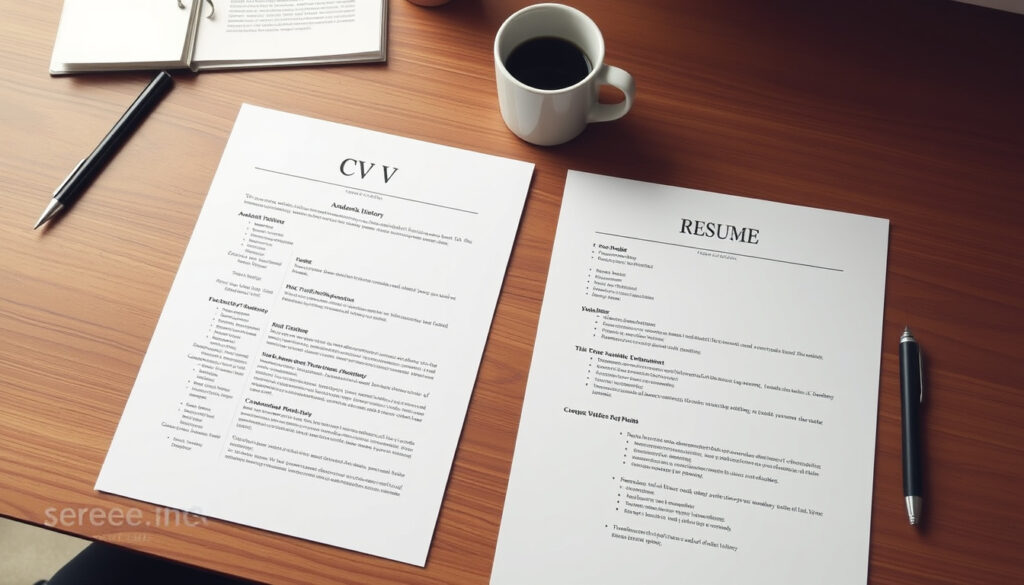
CV vs Resume: What’s the Difference and When to Use Each
You’ve seen both terms in job listings, but what actually separates a CV from a resume? It’s not just length—it’s purpose, audience, and geography. Whether you’re applying to a university faculty or a corporate role, picking the right document can make or break your application. Here’s how to tell them apart and decide which one you need.
CV length: 2+ pages ·
Resume length: 1 page ·
CV origin: Latin “course of life” ·
Resume origin: French “summary” ·
Typical CV sections: Education, publications, research, teaching, awards ·
Typical resume sections: Work experience, skills, education (brief)
Quick snapshot
- CV stands for Curriculum Vitae, Latin for “course of life” (Princeton University Career Development)
- Resume is a concise, targeted summary (Indeed)
- US corporate roles prefer resumes; academia prefers CVs (Coursera)
- Outside the US, “CV” often means what Americans call a resume (Illinois Institute of Technology Elevate Career Center)
- Exact length requirements for CVs vary by field and career stage (Southern New Hampshire University)
- Whether a resume can ever be called a CV in some contexts remains regionally disputed (cvtailor.ai)
- Some job ads use the terms interchangeably, confusing applicants (Illinois Institute of Technology Elevate Career Center) (Southern New Hampshire University)
- Early career: resumes are typical for entry-level corporate jobs (Indeed) (Capella University)
- Mid‑career to senior: CVs become relevant for academic, research, or international roles (Capella University)
- No strict timeline; the choice depends on the job market and employer norms (Princeton University Career Development) (Capella University)
- Match your document to the job posting’s exact wording (Indeed)
- Check regional norms: US vs. UK vs. Europe dictate which term to use (Illinois Institute of Technology Elevate Career Center)
- Research industry expectations—academia vs. corporate vs. government (Coursera)
| Attribute | CV | Resume |
|---|---|---|
| Full name | Curriculum Vitae (Latin) | Résumé (French) |
| Typical length | 2–3+ pages | 1–2 pages (often 1) |
| Content focus | Comprehensive academic history, publications, teaching, awards | Targeted work experience, skills, accomplishments |
| United States usage | Academic, research, graduate school applications | Most corporate, private-sector jobs |
| UK / Europe usage | Used for all job applications (what Americans call a resume) | Rare; “CV” is the standard term |
| Customization | Static document, updated as career grows | Tailored to each specific role |
| Common sections | Education, publications, research, teaching, honors, presentations | Work experience, skills, education summary, certifications |
| Photo / personal details | Often omitted (varies by country) | Usually omitted in US/UK; photo required in some regions |
One pattern among the eight rows: length, purpose, and geography form the dividing line. A CV grows with your career; a resume is a snap decision for a hiring manager.
Is it better to use a CV or a resume?
The short answer depends on three factors: your industry, your location, and the employer’s instructions. No single document works for every situation.
When to use a CV
- Applying for faculty positions, research posts, or graduate programs (Coursera)
- Applying for jobs in Europe, Asia, or Africa where “CV” is the standard term (Illinois Institute of Technology Elevate Career Center)
- When the job ad explicitly asks for a curriculum vitae (Indeed)
When to use a resume
- Most US private‑sector jobs – from entry‑level to executive (Princeton University Career Development)
- When the job ad says “resume” – even if you’re tempted to send a CV (Indeed)
- Applications that require a one‑page summary of your most relevant experience (University of Nebraska Omaha Career Services)
Industry preferences
- Academia & research: CV is the norm (Capella University)
- Corporate / private sector: resume is standard in the US (Indeed)
- Government & non‑profit: varies – check the posting carefully (Coursera)
Bottom line: Academia‑focused candidates should prepare a CV; private‑sector job seekers should lead with a resume. For international roles, follow the local convention: “CV” in most countries outside the US, “resume” in North America.
A CV gives depth but signals you’re not tailoring for a specific role. A resume is agile and custom‑built for each hiring manager, but it may omit the full academic record that a faculty search committee expects.
The pattern is clear: the document type signals your understanding of the industry’s conventions.
What does the CV stand for?
Curriculum Vitae is Latin for “course of life.” The phrase has been used in academic contexts for centuries to describe a full record of a person’s scholarly life. The University of Nebraska Omaha Career Services defines the CV as “an itemized list of a person’s education, accomplishments, awards, honors, and achievements.”
Curriculum Vitae meaning in practice
- A CV is an exhaustive academic history – it grows with every publication, conference, and grant (Princeton University Career Development)
- Unlike a resume, a CV does not shrink to fit a page limit – it expands over a lifetime (Southern New Hampshire University)
- The term “CV” is sometimes used incorrectly in job ads to mean “resume,” especially outside the US (Illinois Institute of Technology Elevate Career Center)
Latin origin and modern usage
- From Latin: curriculum (course, race) + vitae (of life) (Coursera)
- First documented in English in the 15th century for academic records (Capella University)
- Today, the CV is the standard document in most countries outside North America, even for non‑academic jobs (Illinois Institute of Technology Elevate Career Center)
When a UK employer asks for a CV, they expect a resume‑style document. When a US university asks for a CV, they expect a multi‑page academic history. Misinterpreting the term could mean submitting the wrong document.
The implication: the same word carries opposite expectations depending on geography.
Can I use a resume as a CV?
In most cases, no – they serve different purposes and audiences. However, there are edge cases where a resume might be accepted if the employer uses the terms loosely.
Key differences that prevent substitution
- CVs include publications, research experience, teaching roles, and awards – items rarely found on a resume (University of Nebraska Omaha Career Services)
- Resumes emphasize work experience tailored to a specific job description (Indeed)
- Length is a practical barrier: a CV of 3+ pages won’t fit a one‑page resume expectation (Princeton University Career Development)
- A resume is designed to be a fast, scannable summary; a CV is meant to be comprehensive (Southern New Hampshire University)
When a resume might suffice
- If the job ad says “resume or CV” – either is acceptable (Indeed)
- In some small companies or startups that are unfamiliar with CV conventions (Coursera)
- When applying for roles outside the US where “CV” means resume – then your US‑style resume is actually a CV in local terms (Illinois Institute of Technology Elevate Career Center)
Bottom line: Never send a resume when a CV is explicitly requested for a US academic role. Outside the US, the same resume document is usually called a CV. Always check the job posting’s wording and the country’s convention.
The rule: when in doubt, follow the posting’s exact term and the region’s norm.
Why is a resume now called a CV?
This question surfaces because the terms are regionally swapped. In the UK, Australia, and most of Europe, “CV” is the everyday term for what Americans call a resume – and it has been for decades.
Regional terminology differences
- United Kingdom, Ireland, New Zealand: “CV” is used for all job applications (Illinois Institute of Technology Elevate Career Center)
- Continental Europe: “CV” (or local equivalent) is the standard document; the word “resume” is rarely used (cvtailor.ai)
- United States and Canada: “resume” is the default; “CV” is reserved for academic positions (Princeton University Career Development)
- Latin America: “currículum vitae” or “CV” is used; “resume” is understood in bilingual contexts (ResumeOptimizerPro)
UK vs. US usage
- The word “résumé” comes from French meaning “summary” – it entered English in the 18th century (Coursera)
- Meanwhile, “curriculum vitae” remained the term used by academics in both the US and UK (Capella University)
- Over time, the UK dropped “résumé” and adopted “CV” for all job applications; the US kept both terms distinct (Illinois Institute of Technology Elevate Career Center)
The implication: if your job posting uses “CV,” know your geography. In the UK, prepare a resume‑like document of 1–2 pages. In the US, prepare an exhaustive academic history.
What should you not put on a CV?
Even a comprehensive CV has limits. Career services from major universities advise against certain content to keep the document professional and trusted.
Irrelevant personal details
- Photo – in the US and UK, photos are discouraged to prevent bias; in continental Europe, a photo is often expected (ResumeOptimizerPro)
- Age, marital status, religion – these are illegal to require in many countries (University of Nebraska Omaha Career Services)
- Nationality or visa status – only include if the employer asks or if required for the role (Illinois Institute of Technology Elevate Career Center)
Outdated experience
- High school education – omit if you hold a bachelor’s degree or higher (Southern New Hampshire University)
- Jobs from more than 10–15 years ago unless they are directly relevant to the application (Princeton University Career Development)
Hobbies unless relevant
- Only include hobbies that demonstrate transferable skills or leadership (Indeed)
- Generic interests like “reading” or “travel” add no value (Capella University)
- Exaggerated skills – honesty is critical; any false claim can be uncovered in a background check (Coursera)
Even a well‑structured CV can be rejected if it includes irrelevant personal data or outdated entries. Keep every item purposeful and verifiable.
The takeaway: what you omit is as important as what you include.
Upsides
- CVs provide a complete academic record – no risk of omitting important work
- Resumes are quick to read – hiring managers can screen them in seconds
- Choosing the right document shows you understand the industry and region
Downsides
- CVs can be too long for non‑academic hiring managers
- Resumes may omit achievements that matter to academic reviewers
- Submitting the wrong type can disqualify you before the interview stage
Confirmed facts vs what’s still unclear
Confirmed facts
- CV stands for Curriculum Vitae (Princeton University Career Development)
- Resume is a concise, tailored summary (Indeed)
- US academia prefers the CV; US corporate prefers the resume (Coursera)
- Outside the US, “CV” often means what Americans call a resume (Illinois Institute of Technology Elevate Career Center)
- A CV typically includes publications, teaching, and awards (University of Nebraska Omaha Career Services)
What’s unclear
- Exact CV length requirements – they vary by discipline and career stage (Southern New Hampshire University)
- Whether a resume can ever substitute for a CV in research applications – most say no, but some hiring managers accept either (Capella University)
- How strictly employers enforce the distinction – a 2024 survey found that 30% of international job ads use the terms interchangeably (cvtailor.ai)
- Whether a photo is acceptable on a CV depends on the country – no universal rule (ResumeOptimizerPro)
- Whether a resume can ever be called a CV in some contexts remains regionally disputed (cvtailor.ai)
“A CV is an exhaustive academic summary of your educational and academic history, including publications, awards, grants, and research experience.”
Princeton University Career Development
“Resumes are the standard document for most job applications, while CVs are commonly used for academic roles and graduate school applications.”
Coursera
For US‑based job seekers, the choice is clear: use a resume for corporate jobs and a CV for academic positions. For those applying internationally, treat “CV” as the default document – it is the resume in most of the world.
Frequently asked questions
Do employers prefer a CV or a resume?
It depends on the industry and country. In the US, most corporate employers expect a resume. Academic and research employers prefer a CV. Outside the US, employers generally expect a CV (which is functionally a resume). Always follow the job posting’s instructions.
What is the 7 second rule for CV?
Recruiters typically spend 7 seconds scanning a resume before deciding whether to review further. The same applies to a CV in non‑academic settings. Keeping it clear, scannable, and relevant improves your chances.
What is a CV vs resume for a job?
A CV is a comprehensive document that lists your entire academic and professional history. A resume is a short, targeted summary tailored to a specific job. For most jobs in the US, use a resume. For academic jobs, use a CV. In other countries, the CV is the standard application document.
What is a CV vs resume vs cover letter?
A CV or resume is a detailed document about your background. A cover letter is a one‑page letter that introduces you, explains why you’re applying, and highlights key qualifications. The three are often sent together, but the CV/resume choice depends on context.
What is a CV vs cover letter?
A CV is a multi‑page record of your academic and professional experience. A cover letter is a short, narrative document that connects your experience to the specific job. The CV is about what you’ve done; the cover letter is about why you’re the right fit.
How do I decide between a CV and a resume?
Ask three questions: (1) What does the job ad request? (2) What industry am I applying to? (3) What country is the job in? Academic roles in the US need a CV; corporate US roles need a resume; international roles usually need a CV in the local format.
Frequent misinterpretation of these terms can cost you an interview. Use the answers above to match your document to the employer’s expectations.
Related reading
More related posts
 Chicken Cashew Stir Fry Recipe (15-Minute Easy Dinner)
 Free Online Jigsaw Puzzles: Best Sites for Adults & Seniors
 From Old Country Bumpkin to Master Swordsman Season 2 Guide
 Delhi to Auckland Flights: Time, Price & Airlines Guide
 Six the Musical NZ: 2026 Tour, Cast & Tickets Guide
 Photo Booth Hire Auckland: Prices, Trends & Best Packages
 Harvey Norman Outdoor Furniture Buying Guide