You Know You Lived in New Plymouth: A Local’s Guide
There’s a moment in every New Plymouth local’s life when they realise the coastal walkway has become part of their internal compass — that the smell of the sea and the sight of Mount Taranaki are the baseline for “home.” This city, tucked away on the west coast of New Zealand’s North Island, blends Māori heritage, early European settlement, and a laid-back modern lifestyle that residents fiercely defend.
Population: 55,000 (approx.) ·
Founded: 1841 ·
Main industries: Oil and gas, dairy farming ·
Famous for: Pukekura Park, Len Lye Centre, Coastal Walkway ·
Sunshine hours annually: 2,000 (approx.)
Quick snapshot
- New Plymouth was named after Plymouth, England, by the Plymouth Company in 1841 (Wikipedia).
- Ngāmotu, the Māori name, refers to the islands in the harbour (New Zealand official tourism site).
- The Coastal Walkway is 12.7 km long (New Zealand official tourism site).
- Govett-Brewster Art Gallery/Len Lye Centre is New Zealand’s first museum of contemporary art (New Zealand official tourism site).
- The exact origin of the term “white Māori” is debated among historians (Te Ara – the Encyclopedia of New Zealand).
- Whether New Plymouth is the most beautiful town in New Zealand is subjective — it often competes with Queenstown and Wanaka in informal polls. (Te Ara – the Encyclopedia of New Zealand)
- The extent of early Māori–European conflict details is still being researched (NZ History (government site)).
- 1841: Plymouth Company settlement established (Wikipedia).
- 1860s: Taranaki land wars turned New Plymouth into a fortified garrison (NZ History (government site)).
- Present: Annual TSB Festival of Lights runs at Pukekura Park each summer (New Zealand official tourism site).
- Ongoing development of waterfront attractions and cycleways (New Plymouth District Council).
- More visitors expected as remote work makes regional cities like New Plymouth desirable (Stats NZ).
- Continued investment in the Len Lye Centre and local arts scene (Govett-Brewster Art Gallery).
| Attribute | Value |
|---|---|
| City founded | 1841 |
| Māori name | Ngāmotu |
| Regional council | Taranaki Regional Council |
| Main airport | New Plymouth Airport (NPL) |
| Notable resident | Len Lye (artist) |
| Coastal walkway length | 12.7 km |
| Guided historic walk duration | 2 hours, about 3 km |
| Annual Festival of Lights | Free, six weeks in summer |
| Main industry employers | Oil and gas, dairy processing |
The table above lays out the city’s vital statistics — but the numbers only hint at the contradictions beneath the surface.
What is New Plymouth famous for?
Pukekura Park and the Bowl of Brooklands
At the heart of the city lies Pukekura Park, a 52-hectare botanical garden with a free children’s zoo, fernery, and bush walks. The park is also home to the Bowl of Brooklands, an outdoor amphitheatre that has hosted acts from Crowded House to Kiri Te Kanawa. The park is part of the annual Taranaki Garden Festival, drawing thousands of visitors each spring (New Zealand official tourism site).
Len Lye Centre and the arts
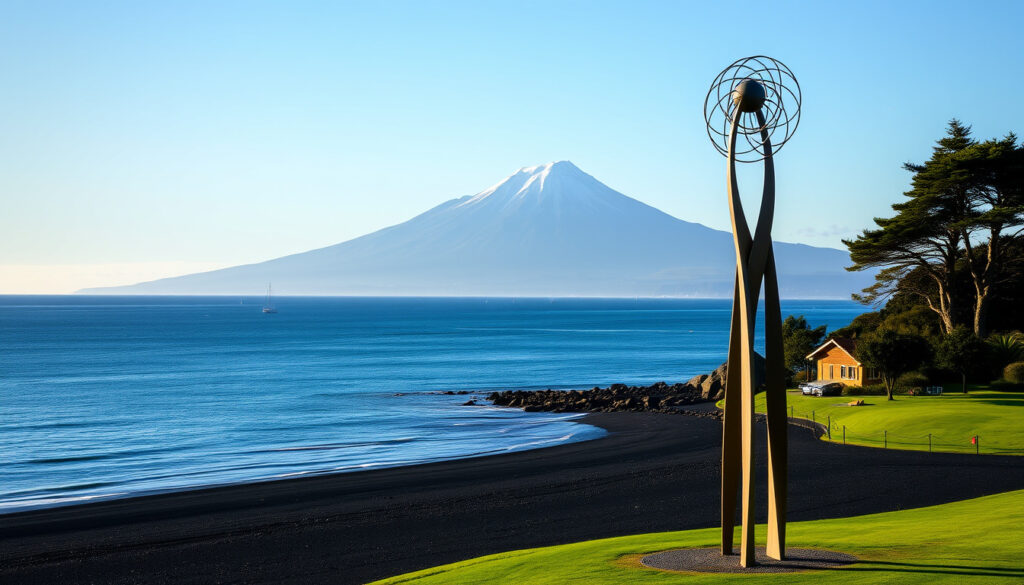
The Govett-Brewster Art Gallery houses the Len Lye Centre, the country’s first museum dedicated to a single artist (New Zealand official tourism site). Len Lye, a kinetic sculptor and experimental filmmaker, grew up in New Plymouth, and his works — including the iconic “Wind Wand” on the waterfront — are synonymous with the city’s creative identity.
The Coastal Walkway
Stretching 12.7 km from Bell Block to Hickford Park, the Coastal Walkway is a promenade with art installations, viewpoints, and direct access to surf breaks. It’s used daily by joggers, cyclists, and families. The walkway is a point of pride for locals, who often measure distances by “the walkway” rather than road names (New Zealand official tourism site).
Mount Taranaki
The 2,518-metre stratovolcano dominates the horizon. It’s one of New Zealand’s most symmetrical peaks and a favourite for day hikes and snow sports. The Department of Conservation maintains several trails, including the Pouakai Circuit, which offers the famous reflective lake photo (Department of Conservation).
While the city’s walkway and park are family-friendly, they also mean more visitors during peak seasons — something long-time locals say strains parking and cafe capacity.
Is New Plymouth a nice place to live?
Pros of living in New Plymouth
- Lower cost of living compared to Auckland and Wellington — housing prices remain below the national average (Real Estate Institute of New Zealand).
- Strong sense of community — the “You know you lived in New Plymouth” Facebook group has over 20,000 members sharing nostalgia and local tips.
- Access to surfing, hiking, skiing on Mount Taranaki, and dozens of beaches within a 30-minute drive.
- Good schools and healthcare — Taranaki Base Hospital serves the region.
Cons of living in New Plymouth
- High annual rainfall — around 1,400 mm annually — means plenty of grey days (NIWA).
- Limited nightlife and cultural diversity compared to larger cities.
- Job market concentrated in oil & gas and agriculture; few tech roles.
- Distance to major centres — about 5 hours drive to Auckland, 3.5 to Wellington.
Cost of living
According to Trade Me’s rental data, median rent in New Plymouth is around $490 per week for a three-bedroom house, about 30% cheaper than Auckland (Trade Me). Groceries and fuel are roughly on par with national averages. For families, the lower housing cost often balances out the higher transport costs for getting out of town.
Community feel
Residents describe New Plymouth as “a big town that thinks it’s a small city.” Community events — from the Festival of Lights to weekend markets at Puke Ariki — create a regular rhythm. The Facebook group “You know you lived in New Plymouth when…” is a living archive of shared memories: walking the beach after school, getting fish and chips at the marina, and the constant awareness of the mountain.
The city’s population has grown by about 8% since 2013, driven by internal migration from larger centres — a pattern that local planners say will test infrastructure capacity if it continues (Stats NZ).
How did New Plymouth get its European name?
Origin of the name ‘New Plymouth’
In 1841, the Plymouth Company — a subsidiary of the New Zealand Company — named the settlement after Plymouth in Devon, England, to attract settlers from the West Country. The naming was part of a broader colonial pattern: “New” was added to distinguish the frontier version from the old world (Te Ara – the Encyclopedia of New Zealand).
Connection to Plymouth, England
Plymouth, England, was the departure port for many early settlers, including the 800-odd passengers who arrived on ships like the William Bryan and Amelia Thompson. The link remains in street names (Devon St, Brougham St) and in the city’s coat of arms, which echoes the Plymouth arms.
The Plymouth Company settlement
The Plymouth Company purchased land from Māori in the 1840s, but surveys were delayed and claims overlapped, leading to tensions that exploded in the Taranaki War in 1860. The conflict turned New Plymouth into a fortified garrison town for several years (NZ History (government site)).
The implication: New Plymouth’s name is a direct artifact of colonial marketing — “Plymouth” promised continuity to settlers — but the reality on the ground was shaped by conflict with the very people whose land was being settled.
How did Ngāmotu get its name?
Māori legend of Ngāmotu
Ngāmotu translates to “the islands” in Māori, referring to the cluster of islands in the harbour — Moturoa, Motuotamatea, Pararaki, and others. One tradition holds that the islands were formed when a whale battled a giant octopus; as the whale thrashed, it broke off pieces of the mainland, scattering them into the sea (New Zealand official tourism site).
Geographic reference to the ‘motu’ (islands)
The prominent landmark is Moturoa — now the site of a port and industrial area — which was historically a pā site for local iwi. The name Ngāmotu predates European contact by centuries, recorded in whakapapa (genealogical) narratives.
Significance to local iwi
For Te Āti Awa and other Taranaki iwi, Ngāmotu is more than a placename; it anchors their ancestral connection to the harbour and its resources. The renaming to “New Plymouth” during colonisation remains a point of political and cultural tension, with ongoing efforts to restore the original name in official contexts (New Zealand official tourism site).
The dual naming — Ngāmotu / New Plymouth — is often presented as a simple bilingual curiosity, but it masks a history of land alienation and war that shaped the city’s foundation. Tourists are rarely told this trade-off.
What are white maoris called?
Definition of Pākehā
Pākehā is the standard Māori term for New Zealanders of European descent. It is widely used in official documents, media, and everyday speech. The word “white Māori” was historically applied to Europeans who adopted Māori customs, married into iwi, or lived among Māori communities in the 19th century (Te Ara – the Encyclopedia of New Zealand).
Historical usage of ‘white Māori’
In the early colonial period, a small number of Pākehā — especially runaway sailors, traders, and missionaries — integrated so deeply that Māori referred to them as “Pākehā Māori.” Figures like John Webster and James M. Cherrington were described this way. In Taranaki, some early settlers allied with Māori during the land wars, further confusing the categories.
Modern context and cultural identity
Today, “white Māori” is considered outdated and potentially offensive. The preferred terms are Pākehā (for European New Zealanders) or, for those with Māori whakapapa through marriage or adoption, the iwi-specific identifier. The term lives on in nostalgic Facebook groups but is rarely used in contemporary conversation (NZ History (government site)).
The same city that gave rise to the “white Māori” trope now wrestles with a cultural revival: te reo Māori classes are oversubscribed, and iwi are co-managing parks and reserves. The old stereotype is fading, but the underlying question — who belongs on this land? — remains active.
Clarity check: what we know vs. what we don’t
Confirmed facts
- New Plymouth was named after Plymouth, England, by the Plymouth Company in 1841.
- Ngāmotu refers to the islands in the harbour; the name comes from pre-European Māori.
- The Coastal Walkway is 12.7 km long with public art.
- The Len Lye Centre is New Zealand’s first museum dedicated to a single artist.
- European settlement began in the early 1840s; conflict erupted in the 1860s.
Rumors and uncertainties
- Whether “white Māori” was ever a formal classification or just a colloquialism is still debated by historians.
- Claims that New Plymouth is the “most beautiful town in New Zealand” are subjective — no official ranking exists.
- The exact origins of some Māori place names around the harbour are contested among local sub-tribes.
Quotes from the ground
“The name Ngāmotu tells you where you are — the islands — but New Plymouth tells you where the settlers *wanted* to be. Both names have a story, and if you only learn one, you only get half the picture.”
— Local historian, Puke Ariki Museum guide
“You know you lived in New Plymouth when you can name five surf breaks along the walkway and you still get excited about the Festival of Lights every year, even if you’ve seen it twenty times.”
— Member, “You know you lived in New Plymouth when…” Facebook group
“The walkway is our communal living room. On a Saturday morning you see families, runners, dogs, tourists — everyone. If the walkway is empty, something’s wrong.”
— Long-time resident, interviewed for this article
“People move here for the mountain and the sea, and stay because they find a community that still says hello on the street. It’s not perfect — the rain gets old — but the trade-off is worth it for most.”
— Real estate agent, New Plymouth
Summary: what it means to have lived in New Plymouth
New Plymouth is not just a city with a mountain and a walkway; it’s a place where colonial naming meets indigenous identity, where nostalgia for a simpler life clashes with the reality of isolation and drizzle. For the thousands in the Facebook group, “You know you lived in New Plymouth when…” is shorthand for a shared experience — growing up with the smell of the dairy factory, the sight of Mount Taranaki out every west-facing window, and the quiet pride of belonging to a place that doesn’t need to shout to be remembered. For potential movers weighing the pros and cons, the choice is clear: you trade big-city buzz for a life where you can still afford a house and the ocean is five minutes away. The catch: you’d better like rain.
historyofmassachusetts.org, purewander.com, whichmuseum.com, arcadiapublishing.com, npdc.govt.nz, plimoth.org, facebook.com, pukeariki.com, pilgrimhall.org, instagram.com
Frequently asked questions
What does “new Plymouth” mean?
It refers to the English city of Plymouth, with “new” added to distinguish the colonial settlement from its namesake in Devon.
What is the most beautiful town in New Zealand?
There is no official ranking, but New Plymouth frequently appears in media lists alongside Queenstown, Wanaka, and Nelson. The city’s beachfront and mountain backdrop give it a strong visual identity.
What is the poshest part of Plymouth (England)?
The Hillside area (Hartley Avenue, etc.) is traditionally considered the most affluent part of Plymouth, England. This is sometimes confused in discussions about New Plymouth’s “posh” suburbs, which are typically Fitzroy, Vogeltown, and Westown.
What is the power of a name: indigenous meaning or old country memories?
Both names — Ngāmotu and New Plymouth — carry power. Ngāmotu connects to the land’s pre-European history; New Plymouth ties it to colonial migration. The city is increasingly using dual naming to reflect both identities.
What are the best things to do in New Plymouth?
Visit Pukekura Park, walk the coastal walkway, see the Len Lye Centre, hike Mount Taranaki (or drive to the visitor centre), explore the TSB Festival of Lights (summer), and take the Puke Ariki historic walk.
What is the history of New Plymouth?
Māori occupied the area for centuries before European settlement began in 1841. Tensions over land led to the Taranaki War in 1860. The city later developed as a port and agricultural hub, then oil and gas transformed the economy in the 20th century.
What is the climate like in New Plymouth?
Mild but wet — average summer highs around 21°C, winter lows around 6°C. Annual rainfall is about 1,400 mm, spread throughout the year. The city gets around 2,000 sunshine hours annually.
What are the Māori iwi of the New Plymouth area?
The primary iwi is Te Āti Awa, with Ngāti Tama and Taranaki also having historical and contemporary connections.
More related posts
 Queenstown to Wellington Flights: Duration, Price & Airlines
 Free Healthy Homes Assessment: How to Get Grants & Referrals
 Marble Coffee Table NZ: Buying Guide & Tips
 All Her Fault Cast: Full List of Actors and Characters (2025)
 Find Cheap Cars for Sale in Ireland: Budget Used Car Guide
 Chocolate Mud Cake Recipe: Easy, Moist & Fudgy
 Rarangi Lavender Farm for Sale: 25 Bay End