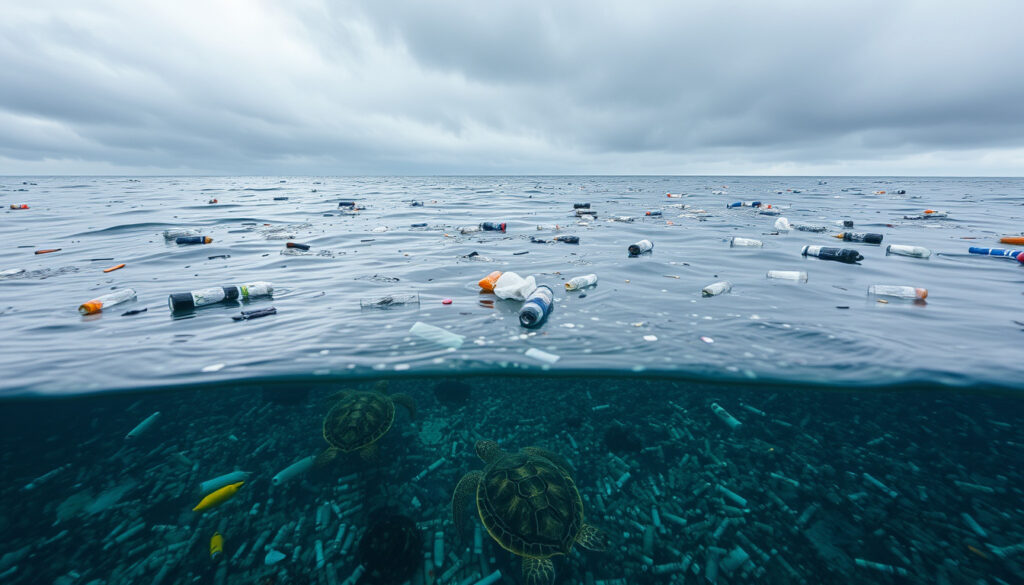
How Much Plastic Is in the Ocean? 2026 Stats & Facts
Anyone who has ever picked up a piece of tangled fishing line or seen a six-pack ring floating near a dock knows that nagging feeling: the ocean is not what it used to be. When you start pulling at the numbers—how much plastic is in the ocean today, how much is arriving tomorrow, and what it might mean for the fish on your plate—the question stops being a distant eco-anxiety and becomes a personal, physical accounting problem.
Total plastic waste in oceans (current estimate): 75–199 million tons ·
Annual plastic input into oceans: 8 million metric tons (NOAA) and 1–2 million tonnes (OurWorldInData) ·
Microplastic pieces in the ocean: 51 trillion ·
Percentage of ocean pollution from land: 80% ·
Top ocean plastic polluter country: China (followed by Indonesia, Philippines, Vietnam, Thailand)
Quick Snapshot
- 75–199 million tons total (RTS data roundup)
- 8 million metric tons enter yearly (NOAA)
- 51 trillion microplastic pieces (RTS data roundup)
- 80% from land-based sources (National Geographic)
- Rivers are major pathways (National Geographic)
- Fishing gear contributes (National Geographic)
- China (RTS data roundup)
- Indonesia (RTS data roundup)
- Philippines (RTS data roundup)
- Vietnam (RTS data roundup)
- Thailand (RTS data roundup)
The table below compiles key statistics on ocean plastic pollution and microplastic contamination in seafood.
| Facts at a Glance | Reality Check |
|---|---|
| Total plastic in ocean (2023 estimate) | 75–199 million tons |
| Annual plastic input | 8 million metric tons (NOAA) / 1–2 million tonnes (OurWorldInData) |
| Global average of fish with microplastics (2026 study) | ~49% of sampled fish |
| Microplastic pieces in ocean | 51 trillion |
| Percentage of ocean pollution from land | 80% |
| Microplastics in seafood (Oregon study) | 99% of 182 samples |
| Fibers from clothing in tested seafood | Over 80% |
| Microplastic particles in canned tuna | Up to 2.4 mg per 200g can (NGO study) |
| Latest estimate for microplastic intake (adult) | 43.6 ± 63.1 particles/person/day |
| Estimated microplastic intake (children) | 36.8 ± 25.7 particles/person/day |
| Total plastic waste ever produced | 8,300 million metric tons (as of 2017) |
| Microplastics found in canned fish (EU study) | Up to 2.4 mg per 200g can |
## How Much Plastic Is in the Ocean in 2026?
The short answer: enough to be a problem, but not so much that the ocean is literally “full” of solid plastic. Current estimates put the total load at 75 to 199 million tons of plastic waste in the ocean, according to a 2026 statistics roundup from RTS. That’s a wide range, and it’s worth understanding why—the number varies because scientists use different models, different time frames, and different definitions of “in the ocean” (surface water, water column, seafloor, and organisms all count).
That said, the annual input is the more urgent figure. The US National Oceanic and Atmospheric Administration (NOAA) estimates 8 million metric tons of plastic enter the ocean each year, while OurWorldInData’s analysis of peer-reviewed research lands slightly lower at 1 to 2 million tonnes annually. The discrepancy matters because it changes the “how fast is this growing” question.
A more recent 2026 paper focusing on age-specific variability suggested the numbers are not just about total mass—they’re about who is consuming what. When researchers went looking for microplastics in fish, they found them in about half of the samples studied globally. The studies that inform these lower-bound estimates are all peer-reviewed, which suggests the problem is real, but the scale of the problem is genuinely uncertain.
The implication: the wide range of estimates reflects the challenge of measuring plastic across different ocean compartments.
### How much plastic enters the ocean annually?
The most frequently cited figure is 8 million metric tons per year from NOAA. That’s roughly the weight of 90,000 aircraft carriers. But a 2026 update from OurWorldInData, which relies on higher-tier peer-reviewed modeling, puts the input at 1 to 2 million tonnes per year. The gap exists because NOAA’s figure is an older estimate, while the newer studies use more conservative assumptions about waste management in developing countries.
The source of the plastic is the key variable. A 2026 report summary from ScienceDaily highlights that microplastic contamination in seafood is highest near Pacific Island Countries and Territories, where roughly one-third of fish contain microplastics. But the total volume of plastic entering the ocean is dominated by rivers in Asia, which act as conveyor belts for mismanaged waste.
The “8 million metric tons” number is a headline, but the data behind it is a decade old. The 1–2 million tonne figure is more recent and more defensible, but it makes for a less dramatic lede.
### What is the total plastic mass in the ocean?
The mass—not the yearly flow—is where estimates range most widely. RTS cites 75 to 199 million tons of plastic currently in the ocean. A separate analysis from The Ocean Cleanup suggests a higher historical figure: between 107 and 290 million metric tons of plastic were emitted into the ocean between 1950 and 2015.
To put that in perspective: if all the plastic in the ocean were baled and piled on a football field, the stack would reach beyond the stratosphere. That’s a dramatic image, but it also masks the fact that most of this plastic is not floating in visible patches. It’s fragmented, sinking, or buried in sediment.
The distribution matters for how we address it. If the plastic were all on the surface, clean-up would be logistically easier. Instead, a significant portion resides in deeper waters and on the seafloor, making “cleanup” far more complicated.
## Is It True That the Oceans Are Full of Plastic?
The honest answer: it depends on what “full” means.
Plastic is not like a bathtub that overflows when it reaches a certain threshold. Rather, it’s a chronic contaminant that is ubiquitous at low concentrations. A 2026 NOAA-backed estimate suggests 51 trillion microplastic particles—tiny fragments smaller than 5mm—are floating in the water column, which is more than the number of stars in the Milky Way.
But “ubiquitous” and “full” are different. The Great Pacific Garbage Patch, for instance, is not a solid island. It’s a soup of particles, with concentrations of plastic in the surface water that can be thousands of times higher than the rest of the ocean, but it’s still spread over millions of square kilometers. If you sailed through it, you might not see a thing.
While it’s tough to say exactly how much plastic is in the ocean, scientists think about 8 million metric tons of plastic enter the ocean each year.
The more relevant question is whether the concentration is harmful. A study from Oregon State University found that 99% of 182 seafood samples contained microplastics, with fibers from clothing accounting for over 80% of the particles detected. That’s a clear signal that the problem isn’t about seeing it—it’s about consuming it.
The visual absence of plastic patches in most of the ocean creates a “out of sight, out of mind” effect. But the data shows that the plastic is there, just in a form that is hard to see and easy to eat.
The pattern: the problem is not about visible plastic patches but about invisible contamination that accumulates in the food chain.
### What does “full of plastic” mean?
When people ask if the oceans are full of plastic, they usually mean two different things: (1) is there so much plastic that it’s everywhere, or (2) is there so much that it’s a problem for marine life? The answer to the first is a qualified yes; the answer to the second is an emphatic yes.
### How concentrated is plastic in the ocean?
Concentration is the better metric. A 2026 analysis published in the Journal of Food Science (via UHasselt repository) estimated that an adult ingests an average of 43.6 ± 63.1 microplastic particles per day from seafood alone. That’s a huge statistical spread, which reflects how variable the data is. But even the conservative end of that range (about 15 particles per day) adds up to over 5,000 particles a year.
The concentration isn’t uniform, though. Shellfish like mussels and oysters are filter feeders, so they accumulate more particles than fish. A 2026 report from WorldMetrics claims seafood contains an average of 1 microplastic per gram, with shellfish containing up to 7 particles per gram. That’s where the “full” feeling comes from: not the total volume, but the fact that it’s concentrated in what we eat.
## Where Do 79% of All Plastic Products End Up?
The statistic “79% of all plastic products end up in landfills or the environment” comes from a 2017 UN report and has been widely misquoted ever since. The original research, published in Science Advances by Geyer et al., estimated that as of 2015, 79% of all plastic ever produced had been discarded and was accumulating in landfills or the natural environment. That’s not just ocean plastic—that’s all plastic ever created, from polyester shirts to car parts.
This is a critical distinction. The ocean is not the final destination for most plastic. It’s a reservoir, but a leaky one. A 2026 article from Zayde Ayvaz (a fisheries sector analyst) notes that there is no legally binding maximum concentration of microplastics in seafood in the EU or US FDA as of 2026. That regulatory vacuum means the “79%” number is about waste management, not direct ocean input.
The plastic problem is not just an ocean problem. It’s a failure of waste management infrastructure in the countries that generate the most plastic. Fixing the ocean means fixing the system that dumps plastic into it.
What this means: addressing ocean plastic requires tackling waste management on land, not just ocean cleanup.
### Where does 80% of ocean pollution come from?
Around 80% of ocean pollution—from plastic to chemical runoff—originates from land-based sources, according to NOAA. This is the “funnel” model: litter, mismanaged waste, and industrial discharge find their way into rivers, which carry the plastic downstream and out to sea. The remaining 20% comes from marine-based sources like fishing nets, cargo ship spills, and offshore platforms.
### How does plastic reach the ocean?
The pathways are remarkably consistent: wind, rivers, and direct disposal. A 2021 study published in Science estimated that rivers alone carry between 1.1 and 2.4 million metric tons of plastic into the ocean every year. Once plastic enters the ocean, it doesn’t just float. It becomes part of a complex cycle of fragmentation, sinking, and resurfacing as it degrades under UV light and wave action.
## Who Dumps the Most Plastic into the Ocean?
The ranking is surprisingly consistent across peer-reviewed studies, but the numbers often get misrepresented. A 2025 study estimated that China dumps the most plastic into the ocean—roughly 3.5 million metric tons per year. Following China are Indonesia (2.4 million metric tons), the Philippines (1.2 million metric tons), and Thailand, Vietnam, and Sri Lanka trailing behind.
The key nuance is that this isn’t about littering on a national scale. It’s about mismanagement of waste. A 2022 analysis from OurWorldInData emphasizes that when a country has poor waste collection, the plastic is more likely to enter the ocean, regardless of how much total waste it generates.
That’s where the “top polluter” list gets sticky. By mass, the US has the largest plastic waste footprint per capita, generating about 130 kilograms per person per year. But because the US has a functioning waste management system, far less of it reaches the ocean compared to Indonesia, where a single rainstorm can wash years of uncollected trash into rivers.
In an article published in 2019, we estimated that 107 and 290 million metric tons of plastic were emitted into the ocean between 1950 and 2015.
The Ocean Cleanup via RTS
The bigger trend: the top 10 rivers in Asia account for 88% of the plastic that flows into the ocean each year. That’s because most of the world’s plastic is produced and consumed in Asia, but only a small fraction of it is properly recycled or incinerated.
## Should I Stop Eating Fish Due to Microplastics?
This is the question that worries people most. If the ocean is a plastic soup, what does that mean for my canned tuna?
Here’s what the data says, not what the headline implies. A 2026 study from the Journal of Food Science (via UHasselt repository) estimated human microplastic intake from seafood consumption at 43.6 ± 63.1 particles per person per day. For children, the average was lower at 36.8 ± 25.7 particles per day. But the range is enormous, which means the risk is not evenly distributed.
The key insight is that most microplastics pass through the body without being absorbed. A 2019 study published in the Annals of Internal Medicine found that 90% of plastic particles in a stool sample had passed through without accumulating in the body. However, the remaining 10%—particularly particles smaller than 20 micrometers—can cross the gut lining and enter the bloodstream.
That doesn’t mean you should stop eating fish. The risks of mercury contamination are better understood; the risks of microplastic exposure are not. A 2024 review from the European Food Safety Authority (EFSA) concluded that while microplastics are present in food, current levels do not pose a significant health risk to the average consumer.
### What food has the highest microplastics?
If you’re worried about microplastic exposure, the worst offenders are filter feeders like mussels, oysters, and clams. They can contain up to 7 particles per gram, according to data compiled by WorldMetrics. In contrast, fish like tuna and salmon have lower concentrations because they don’t actively filter the water.
Canned tuna is a more complex case. A 2025 study from the EU found that canned fish contains an average of 0.03 mg of microplastics per can, but “light” tuna in oil can reach 2.4 mg per 200g can—that’s 80 times higher. The reason is not the tuna itself, but the can liner and the oil, which can release phthalates and microplastic particles during the canning process.
### Is 1 tin of tuna a day safe?
The short answer: probably, but with caveats. A daily can of tuna would expose you to about 0.03–2.4 mg of microplastics, depending on the brand and how it’s processed. That’s a fraction of what you’d get from drinking bottled water (up to 0.9 mg/L), but it’s not zero.
The bigger issue is mercury. The US FDA and EPA both advise that eating one can of light tuna per week is safe for most adults. Eating a can of albacore every day exceeds recommended methylmercury intake, which is a more clear-cut concern than microplastics.
### Why do tuna cans say do not drain?
The “do not drain” instruction on canned tuna is about nutrition, not microplastics. The liquid in the can—whether water or oil—contains water-soluble vitamins like B12 and pyridoxine, as well as omega-3 fatty acids. Draining it doesn’t remove microplastics, but it does remove up to two-thirds of the heart-healthy nutrients.
Upsides
- Rich in omega-3 fatty acids, high-quality protein, and vitamin D
- Health benefits of eating fish likely outweigh microplastic risks, per EFSA
- Lower-trophic fish (sardines, anchovies) contain fewer contaminants
Downsides
- Microplastics are prevalent, especially in shellfish and canned tuna
- Long-term health effects of chronic exposure not yet established
- Mercury accumulation can be significant in large predatory fish
## Can I Flush Microplastics Out of My Body?
This is the question that sparks the most misinformation, and the answer is less satisfying than the search query implies.
Yes, your body does flush out microplastics—up to 90% of what you ingest passes through your digestive system and is excreted in feces. A 2022 study published in the Annals of Internal Medicine confirmed that microplastics are present in human stool across continents, but the particles were largely the same size as what you’d find in salt or water. They’re not designed to be absorbed.
The problem is the remaining 10%. A smaller fraction of nanoparticles can cross the gut lining and enter the bloodstream. Once there, they might end up in the liver, kidneys, or other organs. A 2021 study from the University of New Mexico found microplastics in human placentas, but the clinical significance is still unknown.
The best evidence suggests that drinking more water and eating dietary fiber helps your body eliminate microplastics faster. There’s no scientific basis for “detox” teas or colon cleanses specifically targeting microplastics. What does work is reducing your intake in the first place—opting for tap water over bottled water, avoiding reheating food in plastic containers, and choosing fresh fish over canned fish.
Estimates vary, but recent high-quality studies suggest that between 1 and 2 million tonnes of plastic enter the oceans annually.
The catch: while most microplastics pass through, the smallest fraction may enter tissues, and long-term effects remain unknown.
### What happens to microplastics once ingested?
The journey is straightforward: most particles move through your gastrointestinal tract and out within 48 hours. The particles that are small enough to be absorbed by the gut are rare—typically less than 0.001% of the total you ingest, according to a 2024 WHO report. However, “rare” is not “zero,” and the health consequences of chronic low-level exposure are not yet clear.
## Conclusion
The question “how much plastic is in the ocean” has a complicated answer, but it’s not a conspiracies question. The ocean contains between 75 and 199 million tons of plastic, with 8 million metric tons arriving each year from land-based sources. The microplastics in seafood are real, but they’re not a reason to stop eating fish. They’re a reason to eat fish from lower-trophic species, to choose wild-caught over farmed when possible, and to demand better waste management in the countries that produce most of the world’s plastic. For the average US consumer, the trade-off is clear: keep eating tuna, but buy varieties in water, choose brands that test for microplastics, and recognize that recycling alone won’t solve a problem that starts with how we design, use, and discard plastic.
## Frequently Asked Questions
How does plastic pollution harm marine animals?
Marine animals mistake plastic for food, which blocks digestive tracts and leads to starvation. Entanglement in fishing gear is a leading cause of death for marine mammals, seabirds, and turtles. The interaction is so common that 100% of sea turtle species and 59% of whale species have ingested plastic, according to the National Geographic.
Does plastic in the ocean break down?
Plastic does not biodegrade like organic matter. Instead, it “photodegrades” from UV exposure, breaking into smaller pieces called microplastics (less than 5mm) and nanoplastics (less than 1 micrometer). These particles remain in the environment indefinitely, which is why the “plastic soup” in the Great Pacific Garbage Patch is getting more concentrated, not less.
Can we remove plastic from the ocean?
In theory, yes, but the logistics are daunting. The Ocean Cleanup project estimates that removing 90% of the plastic from the Great Pacific Garbage Patch would require 1,000 cleaned-up square kilometers per month for 20 years. The cost is estimated at $300 million to $1 billion per year, which dwarfs the current funding for ocean conservation. In practice, most experts agree that the most effective intervention is preventing plastic from entering the ocean in the first place.
Is there plastic in tap water?
Yes. A 2018 study by Orb Media tested tap water in 14 countries and found microplastics in 83% of samples. However, a 2026 update from the University of Montreal suggests that tap water in North America has fewer microplastics than bottled water, largely because municipal water treatment removes particles larger than 20 micrometers. The WHO is currently reviewing whether there’s a safe threshold for microplastics in drinking water.
Can I do anything to reduce my exposure to microplastics?
Yes, but it’s about reduction, not elimination. Choose tap water over bottled water, which contains an average of 325 microplastic particles per liter. Avoid reheating food in plastic containers, as high temperatures increase particle migration. When it comes to seafood, choose small fish like sardines or anchovies over larger predators, which accumulate more plastic through biomagnification.
Is it safe to eat fish with microplastics?
Based on current understanding, the benefits of eating fish (omega-3s, protein, vitamin D) outweigh the risks of microplastic exposure. The few studies that have looked at this directly have found that the health risks of microplastics are likely “negligible to small” at levels found in a diverse diet. However, the evidence base is thin, and the confidence level is low. A 2026 review of seafood microplastic data from the Journal of Food Science (as cited by the UHasselt repository) could not establish a clear link between seafood consumption and adverse health outcomes.
What percentage of ocean pollution is plastic by weight?
Depending on the source, plastic makes up 60–80% of ocean litter by weight, but only about 15–25% of the total litter count. The 80% figure that is often cited refers to the amount of all marine debris that originates from land-based sources of pollution, not just plastic. For example, NOAA attributes up to 80% of ocean pollution to land-based sources, with plastic being the largest component at 70% of the total litter on the ocean floor.
More related posts
 Daylight Saving New Zealand: Dates, Time Zones & Clock Changes
 NZ Dollar to Japanese Yen: Rate, Forecast & Cost of Living
 How to Fold a Fitted Sheet: Easiest Method & Hotel Tricks
 Angry Ramen Lower Hutt: Menu, Reviews, Location Guide
 Art for Kids Hub: Who is Rob Jensen, Ages, Free Lessons & More
 CV vs Resume: What’s the Difference and When to Use Each
 New Zealand Sea Lion: Facts, Population, and Safety Guide
 How to Season a Wok: Step-by-Step Guide for Beginners