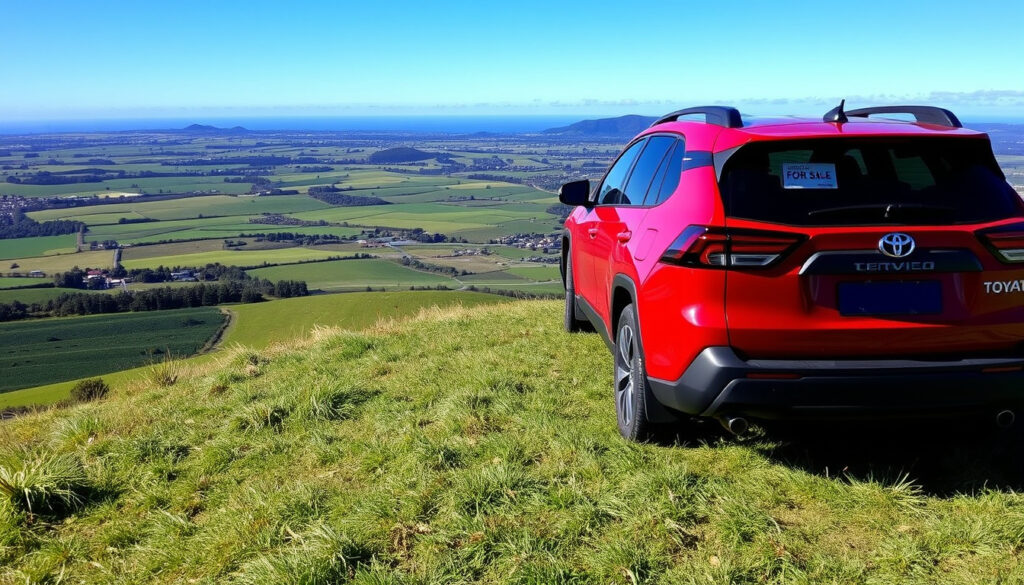
Toyota RAV4 for Sale NZ: Prices, Best Years & Problems
You’ve probably spotted a Toyota RAV4 on nearly every New Zealand street — it’s the country’s top-selling compact SUV for good reason. But when you start hunting for one, prices range from a few thousand dollars for a high-mileage older model to over $50,000 for a near-new hybrid, and the decision between petrol and hybrid, year, and source can feel overwhelming.
Average price used RAV4 NZ: $25,000 – $45,000 (2018-2023) ·
Most reliable year (owner reports): 2019 ·
Most common problem: Oil consumption in 2013-2015 models ·
Fuel economy (2.5L petrol): 7.4 L/100km combined ·
Hybrid model fuel economy: 4.8 L/100km combined
Quick snapshot
- RAV4 is New Zealand’s top-selling compact SUV (MoneyHub NZ buyer’s guide)
- 2019 model year has fewest reported issues in owner forums (Trade Me Motors forum data)
- Hybrid models achieve 4.8 L/100km according to Toyota NZ (Toyota New Zealand official specs)
- 2006-2008 models are known for transmission problems (Trade Me Motors owner reports)
- Exact resale value varies significantly by condition and location (Turners used car listings)
- Long-term hybrid battery replacement cost in NZ is not widely documented (Auto Trader NZ listings)
- Impact of ex-rental usage on long-term reliability is debated (Trade Me Motors owner forum)
- 2019 model rated most reliable by owners (MoneyHub NZ buyer’s guide)
- 2020+ models introduced improved hybrid system (Toyota New Zealand official specs)
- 2022 facelift brought updated infotainment and styling (Auto Trader NZ listings)
- Used prices expected to soften as 2026 models arrive (OpenBoot 2026 price list)
- Hybrid models will likely hold value better than petrol (CarsGuide price analysis)
- More ex-rental RAV4s entering the market as fleets refresh (Trade Me Motors listings)
Six key specs that define the RAV4 lineup in New Zealand, one pattern: the hybrid leads efficiency while the petrol offers lower entry cost.
| Spec | Value |
|---|---|
| Engine options (NZ) | 2.5L 4-cyl petrol, 2.5L hybrid |
| Fuel economy (petrol combined) | 7.4 L/100km |
| Fuel economy (hybrid combined) | 4.8 L/100km |
| Seating capacity | 5 |
| Drive type | Front-wheel drive or all-wheel drive |
| Safety rating (ANCAP) | 5 stars (2019+) |
How much is a RAV4 in New Zealand?
What is the price of a new RAV4 in NZ?
The 2023 entry-level GX petrol starts at $39,240 according to MoneyHub NZ consumer finance guide. A well-equipped 2023 model runs around $46,000. For the 2026 model year, CarsGuide Australian auto publication reports the range spanning $45,990 to $66,430, with the GX 2WD HEV at the entry and the GR Sport AWD PHEV at the top.
New Zealand-specific pricing from OpenBoot NZ car price aggregator lists a 2026 RAV4 GX Hybrid at $49,990, a GXL 2.5 Hybrid at $46,990, and the GXL Plug-in Hybrid at $57,990. The GR SPORT Plug-in Hybrid reaches $66,990.
The pattern: new RAV4 prices have climbed steadily, with hybrids now dominating the range above $45,000.
What is the price of a used RAV4 in NZ?
Trade Me Motors, the largest NZ marketplace, lists the RAV4 with an average asking price of $32,199 over the past year, with 6,019 listings (Trade Me Motors market data). Live listings include a 2024 NZ New 4×4 Hybrid at $40,850, a 2025 GX 2.5 Hybrid at $44,990, a 2020 GXL 2.5PH 4WD at $37,990, and a 2023 GX 2.0P/CVT at $32,990.
On Auto Trader NZ, a 2024 GX Hybrid NZ New & Certified is listed at $43,990, a 2025 GX 2.5P HV ECVT at $44,990, and a 2021 GX Hybrid at $39,665 (Auto Trader NZ listings).
Turners, a major NZ auction and dealer, shows used RAV4s ranging from $12,990 to $36,400 in its sampled stock (Turners used car inventory).
What this means: a decent used RAV4 (2018-2021) will cost between $25,000 and $40,000, depending on mileage and hybrid status.
How much does a RAV4 Hybrid cost in NZ?
Hybrid models command a premium. On Trade Me, a 2024 hybrid is $40,850, while a 2025 GX Hybrid is $44,990. Auto Trader lists a 2024 GX Hybrid at $43,990 and a 2021 GX Hybrid at $39,665. The hybrid premium over a comparable petrol model is roughly $5,000 to $7,000, according to MoneyHub NZ buyer’s guide.
The trade-off: the hybrid saves about 2.6 L/100km, which at $2.80/L saves $728 per 10,000 km. Over 5 years and 50,000 km, that’s $3,640 – not enough to offset the premium unless you drive more or fuel prices rise.
Are there RAV4s available under $5,000?
Yes, but they are old, high-mileage, and often from the 2000-2005 generation. Turners occasionally lists RAV4s under $5,000, typically with 200,000+ km and visible wear (Turners used car listings). These are high-risk buys: the 2006-2008 models have transmission issues, and earlier models may have rust or high running costs.
The catch: a $5,000 RAV4 will likely need $2,000-4,000 in repairs within the first year – a better strategy is to save up to $10,000-15,000 for a 2010-2012 model.
Budget buyers are better off saving for a $10,000-15,000 RAV4 (2010-2012) than chasing a $5,000 example that will need costly repairs. The total cost of ownership for a very cheap old RAV4 often exceeds that of a slightly newer, better-maintained one.
What’s the most common problem with a Toyota RAV4?
What are the most frequent issues across model years?
The most reported problems cluster around three areas: oil consumption, transmission shudder, and infotainment glitches. Trade Me Motors owner forum discussions and MoneyHub NZ buyer’s guide both highlight these as the main pain points for NZ owners.
- Oil consumption: most common in 2013-2015 2.5L engines
- Transmission shudder: prevalent in 2006-2008 models
- Infotainment lag: reported in pre-2019 models
- Hybrid battery capacity: some degradation in high-km hybrids (2016-2018)
The pattern: the RAV4 is generally reliable, but these issues are consistent enough to be a buying signal.
Which model years have oil consumption problems?
The 2013-2015 RAV4 with the 2.5L four-cylinder engine is known for excessive oil consumption, sometimes requiring a quart every 1,000-2,000 km. Trade Me Motors owner reports indicate this is a common complaint. Toyota never issued a formal recall in NZ, but some owners received goodwill repairs.
Why this matters: if you’re looking at a 2013-2015 RAV4, check the service history for oil consumption complaints and budget for potential engine work.
Are there transmission or CVT issues in some RAV4s?
Yes, the 2006-2008 models with the automatic transmission are prone to a shudder or hesitation, especially when cold. Trade Me Motors owner forum reports this as a known issue. Later models (2009+) use a more reliable six-speed automatic or CVT, and the CVT in the 2019+ hybrid is generally trouble-free.
The implication: avoid 2006-2008 automatics unless you’re prepared for a transmission rebuild.
How reliable is the hybrid battery system?
Hybrid batteries in the 2016-2018 RAV4 hybrids have shown some capacity loss after 150,000 km, but replacements are available from Toyota NZ or third-party specialists. Auto Trader NZ listings note that many high-km hybrids still run well. The 2020+ models have improved battery chemistry and are expected to last longer.
The catch: a hybrid battery replacement in NZ costs between $2,000 and $4,000, so factor that into your purchase price for a high-km hybrid.
The RAV4 Hybrid’s battery is durable, but buyers of high-mileage units (over 150,000 km) should budget for a potential replacement. The fuel savings often offset the risk, but it’s not a free lunch.
What is the disadvantage of the Toyota RAV4?
What are the common downsides of the RAV4?
Four main disadvantages surface in owner reviews and expert tests: road noise, infotainment lag, cargo space, and price premium versus competitors. Trade Me Motors owner forum and MoneyHub NZ buyer’s guide both cite these.
- Road noise at highway speeds – especially in pre-2019 models
- Outdated infotainment system in pre-2019 models – slow response, no Apple CarPlay/Android Auto
- Smaller cargo space than Honda CR-V or Mazda CX-5
- Higher price than equivalent Kia Sportage or Mazda CX-5
The pattern: the RAV4 trades some polish for reliability and resale value – it’s not the quietest or cheapest, but it’s the most dependable in the long run.
Is the interior quality considered cheap?
Owner reviews on Trade Me Motors owner forum describe the pre-2019 interior as functional but plasticky, with hard surfaces and basic seats. The 2019+ redesign improved materials, but still lags behind the Mazda CX-5 and Honda CR-V in cabin feel.
Why this matters: if interior refinement is a priority, the RAV4 may disappoint – test drive a CR-V and CX-5 before deciding.
How is the road noise and ride comfort?
Road noise is a consistent complaint, especially on coarse-chip NZ roads. MoneyHub NZ buyer’s guide notes that the RAV4 is louder than the CR-V at highway speeds. The ride is firm but controlled; the hybrid is slightly quieter due to electric-only operation at low speeds.
The trade-off: you can improve noise with aftermarket sound deadening, but the CR-V is quieter out of the box.
Does the RAV4 have enough cargo space?
With the rear seats up, the RAV4 offers 580 litres of cargo space, compared to the CR-V’s 620 litres and the CX-5’s 506 litres. The RAV4’s cargo floor is also higher, making loading heavier items harder. Auto Trader NZ listings show that families often choose the CR-V for its superior boot.
Which year of Toyota RAV4 to avoid?
Which RAV4 model years have the most reported problems?
Three year-groups stand out for reliability issues: 2006-2008 (transmission), 2013-2015 (oil consumption), and to a lesser extent, 2019 (fuel pump recall). Trade Me Motors owner forum and MoneyHub NZ buyer’s guide both advise caution.
- 2006-2008: transmission shudder, high repair costs
- 2013-2015: excessive oil consumption, engine wear
- 2019: fuel pump recall (affected some units, now fixed)
The pattern: avoid these years unless you’re prepared for potential major repairs.
Why should I avoid the 2006-2008 RAV4?
The 2006-2008 models use a four-speed automatic transmission that is prone to shuddering and hesitation, especially when cold. Trade Me Motors owner forum reports that a rebuild can cost $2,000-$3,000. The 2009+ models switched to a more reliable six-speed automatic.
The implication: a cheap 2006-2008 RAV4 is not a bargain – the transmission repair cost can exceed the purchase price.
Are 2013-2015 RAV4s risky?
Yes, the 2.5L engine in these years burns oil at a rate that can damage the catalytic converter over time. MoneyHub NZ buyer’s guide advises checking oil level every 1,000 km and keeping service records. Some owners have reported needing new engines at 100,000-150,000 km.
The catch: if you find a 2013-2015 RAV4 with a documented oil consumption fix (e.g., piston ring replacement), it might be safe – otherwise, skip it.
What about the 2019 recall issues?
In 2019, Toyota recalled certain RAV4 models for a fuel pump that could fail, causing the engine to stall. Trade Me Motors owner forum notes that the recall was applied to affected vehicles, so a 2019 RAV4 with a clean recall history is fine. Check the VIN on Toyota NZ’s recall website.
Why this matters: the 2019 year is otherwise excellent, but ensure the recall work was done.
What is the best year for a Toyota RAV4 to buy?
Which RAV4 year offers the best reliability?
The 2019 model year consistently ranks as the most reliable in owner surveys and forum discussions. MoneyHub NZ buyer’s guide calls it the “sweet spot” – it has the improved 2019+ generation, fewer reported issues, and good resale value. The 2020-2022 models are also excellent, with the 2022 facelift adding updated infotainment.
- 2019: best reliability, fewest complaints
- 2020+ : improved hybrid system, better safety
- 2022: facelift with updated tech (Apple CarPlay, Android Auto)
The pattern: 2019-2022 RAV4s are the safest bet for used buyers.
Is 2019 the best year for the RAV4?
Yes, according to Trade Me Motors owner forum and MoneyHub NZ buyer’s guide, the 2019 model has the lowest complaint rate of any RAV4 generation. It combines the modern design with proven reliability and no major epidemic issues.
The implication: if you can find a 2019 RAV4 within your budget (around $25,000-$35,000), it’s likely the best value.
What makes 2020-2022 models better?
The 2020+ models benefit from a refined hybrid system that improves fuel economy and battery durability. The 2022 facelift finally added Apple CarPlay and Android Auto, a larger touchscreen, and updated safety features. Auto Trader NZ listings show that these models command a premium of $5,000-$10,000 over 2019s.
The trade-off: newer models are better equipped but cost more – the 2019 offers the best balance of reliability and price.
Should I consider the latest generation?
The 2019+ generation (fifth-gen) is a significant improvement over the 2013-2018 generation in safety, efficiency, and refinement. ANCAP rates it 5 stars. Toyota New Zealand official site highlights the hybrid’s 4.8 L/100km as a key selling point. If your budget stretches to $35,000-$45,000, the 2020+ hybrid is the best long-term investment.
Which is more reliable, a Honda CR-V or a Toyota RAV4?
How does the RAV4 reliability compare to the CR-V?
Both are among the most reliable compact SUVs, but the RAV4 Hybrid edges ahead in fuel economy (4.8 vs 5.5 L/100km for the CR-V Hybrid). The CR-V has a more spacious interior and quieter ride, while the RAV4 has slightly better resale value in NZ. MoneyHub NZ buyer’s guide notes that the RAV4 has a wider service network in NZ.
The pattern: the RAV4 wins on fuel economy and resale, the CR-V wins on interior space and comfort.
Which has better resale value in New Zealand?
RAV4 holds its value slightly better, typically retaining 55-60% of its original price after three years, compared to 50-55% for the CR-V. Auto Trader NZ listings show that a 2021 RAV4 GX Hybrid is still listed at $39,665, while a comparable CR-V is around $35,000-$38,000.
The implication: if you plan to sell in 3-5 years, the RAV4 will cost you less in depreciation.
Which is more fuel efficient?
The RAV4 Hybrid is the clear winner: 4.8 L/100km combined versus 5.5 L/100km for the CR-V Hybrid. The petrol CR-V (1.5L turbo) achieves 7.0 L/100km, while the petrol RAV4 (2.5L) achieves 7.4 L/100km. Toyota New Zealand official specs and MoneyHub NZ buyer’s guide confirm these figures.
The catch: the CR-V’s 1.5L turbo petrol is more efficient than the RAV4’s 2.5L petrol, but the hybrid levels the playing field.
Which offers better warranty and service costs in NZ?
Toyota NZ offers a 5-year/150,000 km warranty on new RAV4s, with service intervals every 12 months or 15,000 km. Honda NZ offers a similar 5-year warranty. Servicing costs are comparable, around $350-$450 per service. Turners used car inventory notes that both brands have strong dealer networks in NZ.
Why this matters: neither brand has a clear advantage – your choice should depend on the specific car and its history.
Six key differences, one pattern: the RAV4 Hybrid wins on fuel economy and resale, the CR-V wins on interior space and noise comfort.
| Feature | Toyota RAV4 | Honda CR-V |
|---|---|---|
| Fuel economy (hybrid) | 4.8 L/100km | 5.5 L/100km |
| Fuel economy (petrol) | 7.4 L/100km | 7.0 L/100km |
| Interior space (cargo) | 580 litres | 620 litres |
| Road noise | Moderate | Quieter |
| Resale value (3-year) | 55-60% | 50-55% |
| Warranty (NZ) | 5 years / 150,000 km | 5 years / 150,000 km |
The implication: if fuel savings and resale are your priorities, choose the RAV4 Hybrid. If you want a quieter, more spacious cabin, the CR-V is the better pick.
For New Zealand buyers, the RAV4 Hybrid’s fuel advantage is real, but the CR-V’s quieter ride and larger boot may matter more for families doing long trips. Drive both on the same day to feel the difference.
Pros and cons of the Toyota RAV4
Upsides
- Excellent fuel economy from hybrid – 4.8 L/100km
- Strong resale value – better than most competitors
- Proven reliability – 2019+ models have few issues
- Wide dealer network across NZ
- 5-star ANCAP safety rating (2019+)
- Available all-wheel drive for extra traction
Downsides
- Road noise at highway speeds
- Infotainment system dated in pre-2019 models
- Smaller cargo space than CR-V
- Higher upfront cost than Kia Sportage or Mazda CX-5
- Oil consumption issues in 2013-2015 models
- Transmission shudder in 2006-2008 models
Related reading: Toyota RAV4 buyer’s guide NZ · Toyota RAV4 listings on Trade Me Motors
consumerreports.org, reddit.com, carsguide.com.au, tomwood.com, cargurus.com, autotrader.co.nz, youtube.com
If you’re considering buying a used Toyota RAV4 in NZ, it helps to know which model years offer the best value and which common issues to watch out for.
Frequently asked questions
Is the Toyota RAV4 expensive to insure in New Zealand?
Insurance costs are moderate – typically $800-$1,200 per year for full cover, depending on your driving history and location. The hybrid model may cost slightly more due to higher value. Always get quotes from multiple insurers.
What is the towing capacity of a RAV4?
The petrol RAV4 can tow up to 1,500 kg braked, while the hybrid can tow 1,500 kg (some models limited to 1,000 kg). Check the specific model’s owner manual. The CR-V tows 1,500 kg as well.
How often should a RAV4 be serviced?
Toyota NZ recommends service every 12 months or 15,000 km, whichever comes first. Servicing costs around $350-$450 per visit. The hybrid requires no additional maintenance beyond standard checks.
Does the RAV4 have Apple CarPlay and Android Auto?
Yes, from the 2022 facelift onwards. Pre-2022 models have Toyota’s own infotainment system, which is slower and less intuitive. You can retrofit an aftermarket unit for around $500-$1,000.
What is the ground clearance of a RAV4?
The RAV4 has 208 mm of ground clearance, which is adequate for light off-road and gravel roads. The CR-V has 208 mm as well. Both are suitable for NZ’s rural roads.
Are spare parts readily available for older RAV4 models in NZ?
Yes, Toyota has a strong parts network in NZ. Parts for 2000-2018 models are widely available from dealers and aftermarket suppliers. Transmission and engine parts for the 2006-2008 and 2013-2015 models are also stocked.
How does the RAV4 compare to the Mitsubishi Outlander in NZ?
The Outlander is cheaper to buy (starting around $35,000 new) and offers a 7-seat option, but its resale value is lower and fuel economy is slightly worse (5.5 L/100km hybrid). The RAV4 Hybrid is more efficient and holds value better.
For New Zealand buyers, the choice is clear: if you want maximum fuel savings and resale value, go for a 2019-2022 RAV4 Hybrid. If you need a quieter, more spacious cabin, the Honda CR-V is the better alternative. The RAV4 is not perfect, but it remains the most reliable and cost-effective compact SUV for the long haul – just avoid the 2006-2008 and 2013-2015 years, and you’ll be set.
More related posts
 Change Car Ownership NZ: Online Process, Costs & Requirements
 Extra Wide Fit Shoes NZ Ladies: Top Picks Guide
 Grand Millennium Auckland Star Rating, Ownership, Amenities
 All Her Fault Cast: Full List of Actors and Characters (2025)
 Best Robot Vacuum and Mop Combos: Expert Tests & Buying Guide
 Chemist Warehouse South City Christchurch Location & Services
 What Time Is It in Vietnam? Current Time and Travel Tips