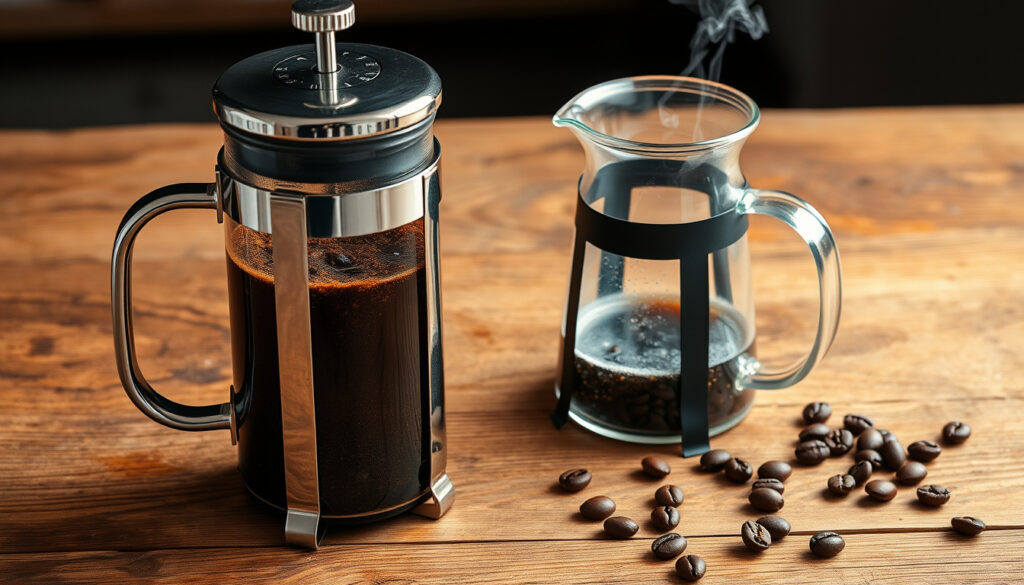
How to Brew French Press Correctly: Ratio, Time & Mistakes to Avoid
Anyone who has ever brewed a French press and ended up with a bitter, gritty cup knows the frustration. But a few science-backed tweaks — from the right coffee-to-water ratio to a simple paper filter trick — can transform your morning routine, covering the correct method, common pitfalls, and cholesterol research so you can pour a clean, flavorful cup every time.
Ideal ratio (coffee:water): 1:15 to 1:17 by weight ·
Recommended brew time: 4 minutes (after stirring) ·
Grind size: Coarse (like sea salt) ·
Water temperature: 200°F (93°C) – just off boil ·
Servings from 4-cup press: 2–3 standard mugs
Quick snapshot
- Coarse grind reduces sediment (Intelligentsia Coffee)
- Water at 200°F improves extraction vs boiling (Blue Bottle Coffee)
- Paper filter in French press removes most cafestol and kahweol (New England Journal of Medicine)
- Stirring at start ensures even extraction (Frothy Monkey)
- Exact rate of LDL increase per cup varies by individual metabolic response (New England Journal of Medicine)
- Optimal brew time may shift with different bean origins and roast levels (Craft Coffee)
- 1941: First French press patent (Attilio Calimani, Italy) (Wikipedia)
- 2000s: Specialty coffee revival boosts home use (Stumptown Coffee Roasters)
- 2016: James Hoffmann popularises 4-minute + stir method (YouTube – James Hoffmann)
- 2020: Study confirms higher diterpene levels in unfiltered brews (European Journal of Clinical Nutrition)
- Adopt 1:15–1:17 ratio – consistent, repeatable results (Frothy Monkey)
- Use paper filter in press or switch to drip to lower LDL risk (New England Journal of Medicine)
- Store beans in opaque, airtight container away from heat and light (Craft Coffee)
For a quick reference, here are the essential parameters for French press brewing.
| Parameter | Value |
|---|---|
| Brew time for French press | 4 minutes total (after water addition) |
| Ideal water temperature | 200°F (93°C) – 30–60 seconds off boil |
| Grind size | Coarse – approximately 0.02–0.03 inches |
| Cafestol increase vs. paper filtered | Up to 30× more diterpenes |
| Optimal coffee-to-water ratio | 1:15 to 1:17 by weight |
What are common French press mistakes?
Even experienced home brewers fall into a few predictable traps. The biggest offenders: using too fine a grind, water that’s either too hot or too cold, and not stirring the bloom. Let’s break them down.
How brew time and grind size affect bitterness
Grind size is the most common variable gone wrong. A fine grind (like table salt) pushes more surface area into the water, leading to over-extraction and a muddy, bitter cup. French press calls for a coarse grind — about 0.02–0.03 inches, similar to sea salt (Blue Bottle Coffee). Even with the right grind, letting the brew sit longer than 4 minutes after plunging causes over-extraction and bitterness (Frothy Monkey).
Why water temperature matters (too hot or too cold)
Pouring boiling water directly onto coffee grounds scorches delicate flavor compounds, while water that’s too cool under-extracts. The sweet spot is 200°F (93°C) — just off boil, roughly 30–60 seconds after the kettle clicks off (Craft Coffee). Stumptown and Blue Bottle both echo this advice, stating water should be “just off the boil” (Stumptown Coffee Roasters).
“Pouring boiling water directly onto coffee grounds scorches delicate flavor compounds, while water that’s too cool under-extracts.”
The pattern: the biggest gains come from controlling grind size, water temperature, and brew time — not from fancy equipment.
Many beginners skip preheating the press, which steals 10–15°F from the brew water. Preheating with hot water for 1 minute adds consistency (Frothy Monkey).
Getting these basics right avoids the most common pitfalls and sets the foundation for a clean cup.
What is the correct ratio of coffee to water in a French press?
Five specialty roasters agree on the same range: 1:15 to 1:17 coffee-to-water by weight. But exact numbers shift with roast level and personal taste.
Weight-based vs. tablespoon measurements
For a 4-cup press, Frothy Monkey uses 49 g coffee to 735 g water (Frothy Monkey), while Stumptown calls for 56 g coffee to 850 g water (Stumptown Coffee Roasters). Both fall within the 1:15–1:17 band. If you don’t have a scale, a rough rule is 2 tablespoons (10 g) per 6 fl oz cup.
Adjusting ratio for different roast levels
Dark roasts are less dense and already more soluble; a slightly tighter ratio of 1:14 can work. Light roasts benefit from a longer ratio (1:17) and a minute extra of brew time (Intelligentsia Coffee).
The trade-off: weight-based ratios give repeatability; tablespoon measurements are convenient but vary by up to 20% depending on how you scoop.
Can French press coffee raise cholesterol?
Yes — but the effect is avoidable. Unfiltered coffee contains diterpenes (cafestol and kahweol) that can raise LDL cholesterol, and a French press delivers up to 30 times more of these compounds than paper-filtered coffee, according to a 2020 study in the European Journal of Clinical Nutrition.
The science of cafestol and kahweol in filtered vs. unfiltered coffee
Dr. Rob van Dam, professor at Harvard T.H. Chan School of Public Health, notes in a 2019 review in the New England Journal of Medicine that consuming three or more cups of unfiltered coffee daily can measurably increase serum cholesterol. Paper filters trap most diterpenes, which is why drip coffee doesn’t carry the same concern.
What cardiologists say about adding milk or paper filtering
Adding milk or cream does not remove cafestol and kahweol — those compounds are oil-soluble and bind to fat, but they remain in the cup. Several cardiologists now recommend pouring brewed French press coffee through a paper filter (a “hybrid” method) to reduce diterpene content (New England Journal of Medicine).
“Paper filters trap most of these compounds, which is why drip coffee doesn’t carry the same concern.”
— Dr. Rob van Dam, Harvard T.H. Chan School of Public Health (New England Journal of Medicine review)
If you drink 3+ cups of French press daily, switching to a paper-filtered method or adding a filter to your press could reduce LDL impact without sacrificing taste.
The implication: the cholesterol risk is real but easily mitigated with a paper filter after brewing or switching brew methods.
What are the four enemies of coffee?
The specialty coffee world commonly cites four enemies: heat, air, moisture, and light. Each accelerates staling.
Why heat, air, moisture, light ruin beans
- Heat accelerates oxidation of coffee oils, making beans go rancid faster (Craft Coffee).
- Oxygen stales beans within two weeks of roasting (Stumptown Coffee Roasters).
- Moisture promotes mold growth and clogs grinders.
- Light breaks down volatile aromatic compounds.
Practical storage tips for French press users
Store beans in an airtight, opaque container at room temperature — never in the fridge or freezer (moisture condensation ruins the grind). Buy whole beans and grind only what you need for each brew (Craft Coffee).
The trade-off: convenience of pre-ground comes at the cost of flavor freshness within days.
How to get the best results from a French press?
Combine the techniques from Intelligentsia, Frothy Monkey, Stumptown, Blue Bottle, and Craft Coffee with the popular James Hoffmann method into a single reliable workflow.
Step-by-step beginner method (James Hoffmann technique)
- Preheat the press with hot water for 1 minute, then discard (Frothy Monkey).
- Add coarse-ground coffee (e.g., 30 g for a 17 oz / 500 ml press) (Blue Bottle Coffee).
- Pour water at 200°F (just off boil) — enough to wet all grounds (Craft Coffee).
- Stir immediately to ensure even extraction (Frothy Monkey).
- Wait 4 minutes. At 1 minute (Stumptown Coffee Roasters), break the crust with a spoon.
- Scoop off foam and grounds that float to the top.
- Plunge slowly to about ½ inch above the grounds — do not press all the way (Intelligentsia Coffee).
- Pour immediately into a serving carafe or cup; leaving coffee in the press causes over-extraction (Frothy Monkey).
How to brew French press for one cup
Use a smaller press (12 oz / 350 ml). Blue Bottle recommends 30 g coffee to 350 g water — a 1:16.5 ratio (Blue Bottle Coffee). Follow the same steps above with a 4-minute steep. For a complementary guide, check out our How to Make Plunger Coffee: Ratios, Time & Tips.
Beginners who follow this exact sequence — preheat, coarse grind, 4-minute steep, quick pour — consistently report less bitterness and sediment than those who wing it.
For the home brewer, the consequence is clear: adopt this method for a reliably cleaner cup, or accept the gamble of bitter, muddy coffee and potential cholesterol concerns.
Clarity check: what we know vs. what we don’t
Confirmed facts
- Coarse grind reduces sediment (Intelligentsia Coffee).
- Paper filter in French press removes most cafestol and kahweol (New England Journal of Medicine).
- Stirring at start ensures even extraction (Frothy Monkey).
What’s unclear
- Exact rate of LDL increase per cup varies by individual metabolic response (New England Journal of Medicine).
- Optimal brew time may shift with different bean origins and roast levels (Craft Coffee).
- Water at 200°F is widely endorsed but some sources recommend 205°F (Craft Coffee).
- Optimal ratio may vary from 1:14 to 1:17 depending on roast and preference (Intelligentsia Coffee).
Understanding where the evidence is strong and where it’s conditional helps you adapt the method to your own preferences and health needs.
Quotes from the experts
“Unfiltered coffee contains diterpenes that can raise LDL cholesterol. Paper filters trap most of these compounds.”
— Dr. Rob van Dam, Harvard T.H. Chan School of Public Health (New England Journal of Medicine)
“After four minutes, break the crust, scoop off the foam, and press slowly. Don’t press all the way – leave a gap above the grounds to avoid sediment.”
— James Hoffmann, world barista champion (2016 technique video)
“Preheating the press and using water just off the boil – around 200°F – is the most important step most home brewers skip.”
— Craft Coffee (specialty roaster)
The same plunger mechanism that gives French press its rich body also delivers up to 30× more cholesterol-raising diterpenes than a paper filter. The fix? A simple paper filter after brewing.
The expert consensus underscores that small tweaks—preheating, correct grind, and a post-brew filter—can dramatically improve both taste and health outcomes.
Summary: what this means for your morning cup
Getting French press right comes down to three levers: coarse grind, 200°F water, and a strict 4-minute steep. The cholesterol worry is real for heavy drinkers, but a paper filter — either in the press or after brewing — neutralises it without sacrificing flavour. For anyone who drinks three or more cups daily, the choice is simple: add a filter, or switch to a drip method for your third cup.
Related reading: How to Make Plunger Coffee: Ratios, Time & Tips
For a more detailed French press guide, including common mistakes and troubleshooting, see detailed French press guide.
Frequently asked questions
What is the best grind size for French press?
Coarse — about the size of sea salt. Finer grinds cause sediment and over-extraction (Blue Bottle Coffee).
How long should I let French press steep?
Four minutes after adding water is the standard. A shorter steep (3 min) yields a brighter cup; longer (5–6 min) gives more body but risks bitterness (Intelligentsia Coffee).
Can you use a French press on a gas stove?
Only if the press is made of borosilicate glass or stainless steel. Standard glass presses can shatter on direct heat. Always preheat with hot water, not on a burner.
Why is my French press coffee muddy?
Too fine a grind or pressing the plunger all the way to the bottom forces fine particles into the cup. Use a coarse grind and stop plunging about ½ inch above the grounds (Intelligentsia Coffee).
Does French press coffee have more caffeine than drip?
Not inherently — caffeine extraction is similar. A French press typically uses a higher coffee-to-water ratio than drip, so a serving can feel stronger, but the actual caffeine per ounce is comparable.
How many scoops of coffee for a 12-cup French press?
A 12-cup press (about 1.5 L) needs roughly 90–100 g of coffee. That’s 9–10 tablespoons if you’re without a scale (Stumptown Coffee Roasters).
What’s the difference between French press and pour over?
French press immerses grounds in water for the full brew, extracting more oils and fine particles — giving a heavier body and more mouthfeel. Pour over drips water through a paper filter, yielding a cleaner, lighter cup with fewer diterpenes.
Should I preheat my French press?
Yes. Preheating with hot water for 1 minute keeps the brew temperature stable, especially in cold kitchens (Frothy Monkey).
More related posts
 ANZ Airpoints Credit Cards: Fees, Earn Rates & Value (2025)
 Gaviscon Dual Action Tablets: Uses, Dosage, Side Effects
 ASB Bank Interest Rate Changes 2026: Current Rates & Forecast
 Baby Bunting Change Table – Top Models and Buying Guide
 Grow a Garden Stocks: Rarest Seeds and Stock Trackers
 Department of Internal Affairs: Roles, Reporting & Investigations
 Car Service Near Me – Reliable Shops, Costs and Schedules
 Free Text to Speech: AI Voices & Unlimited Tools Guide