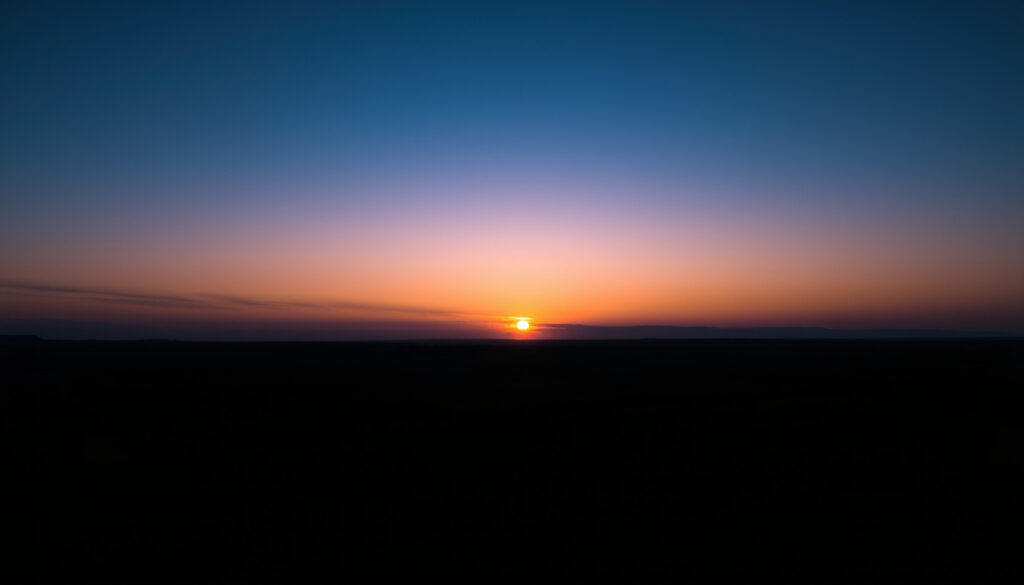
What Time Does It Get Dark? Sunset & Twilight Explained
Ask “what time does it get dark” on two different evenings and you’ll get two different answers — in Ireland, Donegal’s June sun doesn’t set until 10:13 PM, yet by mid-December it bows out at 4:06 PM (HM Nautical Almanac Office (the UK’s official astronomical almanac)). The gap between sunset and true darkness is just as variable, stretching well past an hour in the south. The real question is a sequence: when the sun disappears, when civil twilight ends, and when the sky is dark enough for stargazing. Photographers, pilots, and anyone planning an Irish evening need all three answers, not one.
Latest sunset in Ireland: 10:13 PM (Donegal, June 24) ·
Earliest sunset in Ireland: 4:06 PM (Donegal, December 13) ·
Sunset to full darkness: ~1 hr 52 min (Cork) ·
Civil twilight ends: sun 6° below horizon ·
Typical civil twilight: 30–40 minutes
Quick snapshot
- AIP Ireland GEN 2.7 publishes civil twilight, sunrise, and sunset times at three-day intervals, in UTC, accurate to roughly five minutes (AirNav Ireland (the state’s aviation navigation authority)).
- Irish twilight data is location-specific: Donegal, Cork, Dublin, and Bantry each get different sunset and dusk times. (AirNav Ireland (the state’s aviation navigation authority))
- The exact moment it “looks” dark depends on cloud cover, light pollution, and local hills — published times assume a clear, unobstructed horizon.
- The three-finger rule’s precision varies with arm length and finger width; the same sky gives different estimates from one person to the next.
- The descent to darkness runs sunset → civil twilight → nautical twilight → astronomical twilight → night. (sunrise-sunset.org (daily solar tables))
- In Dublin on 8 October 2026, sunset lands at 6:45 PM and civil twilight ends at 7:19 PM — a 34-minute dusk (sunrise-sunset.org (daily solar tables)).
- Convert every official time from UTC: Ireland runs on GMT in winter and Irish Standard Time (UTC+1) in summer.
- Check your town’s table, not the national one — longitude shifts sunset by minutes even across short distances.
Ireland’s dusk follows a predictable system, and six reference points explain nearly all of it — from Donegal’s seasonal extremes to the angular thresholds pilots use to define night.
| Reference point | Value | Source |
|---|---|---|
| Ireland’s seasonal extremes (Donegal) | Latest sunset: 10:13 PM (June 24) · Earliest: 4:06 PM (December 13) | HM Nautical Almanac Office (GOV.UK) |
| Sunset → full darkness (Cork) | ~1 hr 52 min to astronomical dusk | AirNav Ireland (AIP twilight tables) |
| Twilight angle thresholds | Civil ends at 6° · Nautical at 12° · Astronomical at 18° below the horizon | Irish Aviation Authority (night-flight guidance) |
| Typical civil twilight duration | 30–40 minutes | sunrise-sunset.org (Dublin data) |
| What each phase looks like | Civil: streetlights on · Nautical: sea horizon visible · Astronomical: faint stars appear | See angle thresholds above |
| Local clock correction | IST (UTC+1) in summer · GMT (UTC) in winter | Ireland.com (national tourism authority) |
What time will it be dark this evening in Ireland?
The honest answer is that it depends on which evening, which town, and which kind of “dark” you mean. The same civil twilight moment lands at different clock times across the country — longitude alone shifts sunset by minutes between Dublin and Galway. The way to get your exact answer is to read the official tables for your place, not a national average.
How to find sunset times for your specific location in Ireland
Ireland’s official sunset numbers live in AIP Ireland GEN 2.7 — the aeronautical publication pilots use. It lists morning civil twilight, sunrise, sunset, and evening civil twilight at three-day intervals, all in UTC, with accuracy of roughly five minutes (AirNav Ireland (AIP Ireland GEN 2.7)).
- Find your nearest published town. The daily rise-and-set tables for the United Kingdom and Ireland cover Athlone, Cork, Donegal, Dublin, Dundalk, and Bantry — six places, six slightly different answers.
- Convert UTC to local time. Ireland runs on Greenwich Mean Time in winter and Irish Standard Time (UTC+1) in summer, so the same sunset appears an hour later on the local clock in July than in January (Ireland.com (national tourism authority)).
- Decide which “dark” you need. Civil twilight’s end is streetlights-on dark; astronomical twilight’s end is the sky truly dark for stargazing. The difference between the two in Ireland can exceed an hour.
Understanding the difference between sunset and full darkness
Sunset is only the opening move. In Dublin in early October, the sun drops below the horizon at about 6:45 PM, but civil twilight keeps the sky usable until roughly 7:19 PM — and astronomical darkness arrives well over an hour later.
Sunset happens when the upper limb of the sun disappears below the horizon. The sky then passes through three twilight phases, each defined by the sun’s angle below the horizon: civil (0–6°), nautical (6–12°), and astronomical (12–18°). Full darkness — the moment astronomers call night — starts only when the sun drops beyond 18°. That sequence is why “what time does it get dark” has four correct answers: a photographer’s dusk ends at civil twilight, a sailor’s usable light ends at nautical twilight, a stargazer waits for astronomical twilight, and most people just want to know when the streetlights win.
The pattern: every Irish town runs the same five-phase sequence, but the clock times shift by location and season. Get your town’s civil twilight end time, and you’ve answered the question most people actually mean.
What is the science behind sunset?
The colors and the timing are two separate phenomena. The red-orange sky is a physics trick; the changing schedule is a geometry trick.
Why does the sky change color at sunset?
Sunlight arrives white because it carries every visible wavelength, but the atmosphere scatters short blue waves far more efficiently than long red ones. As the sun drops, its light crosses more air, the blue scatters away, and the reds and oranges survive — the effect known as Rayleigh scattering.
The science is the same one the Royal Observatory Greenwich uses to explain sunset colors: at a low solar angle, the path through the atmosphere lengthens, blue light scatters sideways, and the warm tones reach your eyes almost uncontested. That is why Irish winter sunsets can turn a whole horizon amber, while the high summer sun stays white.
There is a second optical illusion worth knowing: the sun you see at the horizon has technically already set. Atmospheric refraction bends sunlight around the Earth’s curve, so the disc appears about one full diameter higher than its geometric position. At sunset, you are watching a ghost of the sun — the real one is already below the horizon.
Why do sunset times change throughout the year?
Earth’s axial tilt: 23.5° · Ireland’s latitude: ~51–55° N · Donegal’s swing: 10:13 PM (June) → 4:06 PM (December)
The engine behind every sunset table is Earth’s 23.5-degree axial tilt. As the planet orbits the sun, the northern hemisphere leans toward it for half the year and away from it for the other half — that lean, not the Earth’s distance from the sun, is what lengthens June evenings and compresses December afternoons.
Ireland sits between roughly 51°N and 55°N, far enough north that the seasonal swing is dramatic. Donegal’s June sun sets at 10:13 PM and its December sun at 4:06 PM — a gap of more than six hours that would be unthinkable in the tropics. The same tilt that produces those extremes also produces short summer nights when astronomical darkness barely arrives.
The trade-off: the tilt that gives Ireland long summer twilights also compresses winter afternoons, which is why the “gets dark” question in December is more urgent than it is in June.
Which country has the shortest day length?
The shortest day lengths on Earth belong to places inside the polar circles, where winter brings polar night — weeks with no sunrise at all. Norway’s Arctic settlements, from Svalbard to the northern tip of Finnmark, lose the sun entirely for parts of winter, which makes Norway the country most people mean when they ask this question.
Countries with polar night inside the Arctic Circle
The countries with the shortest winter days — Norway, Sweden, Finland, Iceland, Greenland, Russia, Canada, and Alaska — also have the longest summer days. The same axial tilt that removes the sun in January keeps it circling the sky in June.
Polar night is a latitude effect, not a calendar event. Inside the Arctic Circle, the sun stays below the horizon for at least one full day per year, and the closer a settlement sits to the pole, the longer that stretch lasts. That is why Norway’s Svalbard archipelago experiences months of twilight-like darkness, not just a short December afternoon.
How latitude directly affects daylight hours
- Near the equator: sunrise and sunset barely move; the year’s shortest and longest days are minutes apart.
- Ireland (mid-latitude): the swing is dramatic — a December afternoon in Donegal is more than six hours shorter than a June evening.
- Arctic Circle: the sun dips just below the horizon on the shortest day and just grazes it on the longest.
- The poles: one long day and one long night, each lasting about six months.
For Ireland, the practical result is a country that runs on very different clocks across the year. A Donegal evening in June behaves like a Scandinavian one; a Donegal afternoon in December behaves like a far-northern one. Day length is always shortest in winter for each hemisphere, which is why “what time does it get dark” is a seasonal question, not a fixed one.
The implication: “shortest day” is not a single country — it is a latitude band, and Ireland sits close enough to feel the effect without ever losing the sun completely.
What is civil twilight?
Civil twilight is the first phase after sunset, and for most people it is the part of the evening that actually matters. It begins the moment the sun disappears and ends when the sun’s centre reaches 6° below the horizon — the benchmark the Irish Aviation Authority (the state’s aviation regulator) uses in its night-flight guidance.
What is 20 minutes after sunset called?
- 20 minutes after sunset in Ireland is still evening civil twilight — the phase runs roughly 30–40 minutes here.
- That 20-minute mark is the classic “blue hour” window, when the sky holds deep color but artificial light is not yet strictly needed.
In Dublin in early October, sunset lands around 6:45 PM and civil twilight ends around 7:19 PM (see the evening data table later in this guide), so 20 minutes after sunset the sky sits comfortably inside civil twilight.
What is 60 minutes before sunrise called?
Sixty minutes before sunrise, you are inside the morning twilight sequence. In Ireland, morning civil twilight begins roughly 30–40 minutes before sunrise, so the earlier part of that hour sits in nautical twilight and the later part is civil twilight.
The naming is mirror-symmetric to evening: civil twilight opens the sequence, nautical twilight follows, astronomical twilight finishes, and sunrise ends the final phase. If someone asks what the hour before sunrise is called, the useful answer is “twilight” — specifically, the tail of nautical twilight followed by all of morning civil twilight.
What is 12am to 5am called?
12 AM–5 AM label: deep night in winter · a twilight haze near the solstice · season decides which one you get
Astronomically, those hours are usually “night” — the period when the sun sits more than 18° below the horizon. In Ireland’s summer, the label gets murky: around the solstice, the sun never sinks that deep, so the sky between midnight and 5 AM stays in twilight rather than reaching full astronomical darkness. In winter, 12 AM to 5 AM is solidly night.
- Winter in Ireland: 12 AM–5 AM is full astronomical night.
- Summer near the solstice: the sky may stay in twilight all night long.
- Spring and autumn: the middle of the night is genuinely dark for a few hours.
What this means: civil twilight is the socially useful definition of dusk, and the 6° cutoff is why an evening plan should be pegged to the twilight table, not the sunset row.
What is the 3 finger rule for sunset?
The three-finger rule is an old field trick for estimating daylight left without opening an app. Hold your arm straight, count the finger widths between the sun and the horizon, and each finger equals roughly 15 minutes of daylight. Three fingers, 45 minutes; four fingers, about an hour.
How to estimate time until sunset using your hand
- Find a clear western horizon. Hills, trees, and buildings block your view of the true horizon and wreck the estimate.
- Extend your arm fully. The math only works at arm’s length — a bent elbow adds width and shrinks the time per finger.
- Lay your hand flat against the sky, fingers together, with the bottom edge sitting on the horizon.
- Count the finger widths between the horizon and the sun’s lower edge. One finger ≈ 15 minutes; two ≈ 30; three ≈ 45; four ≈ 60.
- Cross-check once against a real sunset table for your town, and you will learn your own hand’s calibration.
Limitations and accuracy of the 3 finger method
The 15-minutes-per-finger rate assumes a typical adult arm and hand. A smaller hand or a longer arm changes the conversion, so treat the rule as a field estimate, not a clock. The Alpenglow App’s daylight calculators use the same convention for the same reason: it is a good heuristic, not a measurement.
The rule works because a hand held at arm’s length covers a predictable slice of sky, and the sun’s apparent motion is slow enough to estimate against it. That is the same angular logic behind the twilight tables the Irish Aviation Authority publishes, though the tables are far more precise.
The trade-off: the three-finger rule is brilliantly portable and inherently approximate. It beats an app when you are standing on a hillside; it does not beat a table when the evening cannot be rescheduled — an obstructed horizon, haze, and overconfidence all bend the estimate.
Same week, four different clocks: Irish evening twilight in numbers
Four data points, one pattern: within days of each other, Irish towns reach the same “streetlights on” moment at noticeably different times — and the difference grows with longitude and season.
| Location | Date | Sunset | Civil twilight ends | Dusk length | Source |
|---|---|---|---|---|---|
| Dublin | 9 Oct 2026 | 6:42 PM | 7:17 PM | 35 min | timeanddate.com (sunset tables) |
| Kilkenny | 8 Oct 2026 | 6:49 PM | 7:24 PM | 35 min | timeanddate.com (sunset tables) |
| Dublin | 8 Oct 2026 | 6:45 PM | 7:19 PM | ~34 min | sunrise-sunset.org (daily solar tables) |
| Dublin City | 17 Sep 2026 | 7:35 PM | 8:10 PM | 35 min | timeanddate.com (sunset tables) |
The pattern: in a single week, Kilkenny’s sun sets seven minutes later than Dublin’s, and across a single month the dusk window moves from the 7 PM to the 8 PM hour. That is the difference between checking a table for your exact town and guessing from “somewhere in Ireland.”
From sunset to full darkness: the twilight timeline
The Irish Aviation Authority’s benchmark for civil twilight — the sun’s centre 6° below the horizon — is the first step in a five-phase descent to full night (Irish Aviation Authority (night-flight guidance)).
| Phase | Sun’s position | What it looks like |
|---|---|---|
| Sunset | Upper limb at the horizon | The sun disappears; the sky is still bright. |
| Civil twilight | 0–6° below the horizon | Best light for photography and outdoor activities; artificial light not yet required. |
| Nautical twilight | 6–12° below the horizon | Sea horizon still visible, landscape dark; the classic sailor’s dusk. |
| Astronomical twilight | 12–18° below the horizon | Sky dark enough for most astronomical observations. |
| Night (astronomical dusk) | Beyond 18° below the horizon | The sky is at its darkest; this is “fully dark” in the strict sense. |
In Ireland, the full sequence from sunset to night runs about two hours in spring and autumn — longer in the weeks around the summer solstice, when the sun’s path is shallow, and shorter in December, when the sun drops away steeply.
What this means: “fully dark” is the last row of the table, not the sunset row. Most Irish evening plans are actually pegged to the civil twilight row, and it pays to know which one you need.
What’s confirmed, what’s still uncertain
Confirmed facts
- Civil twilight ends when the sun’s centre sits 6° below the horizon — the benchmark in Irish Aviation Authority night-flight guidance.
- AIP Ireland GEN 2.7 publishes twilight and sunrise/sunset times at three-day intervals, in UTC, accurate to roughly five minutes, per AirNav Ireland.
- Dublin’s civil twilight runs about 35 minutes in early October, per timeanddate.com and sunrise-sunset.org evening data.
- Ireland’s local clock shifts between IST (UTC+1) and GMT, moving the wall-clock time of darkness, per Ireland.com.
What’s unclear
- The exact moment it “gets dark” on your street depends on cloud, light pollution, and terrain — published times assume a clear horizon.
- The three-finger rule’s precision varies with arm length and finger width; it is an estimate, not a measurement.
- Around the summer solstice, “fully dark” may not arrive at all in parts of Ireland — astronomical twilight can blend straight into dawn.
- Converting UTC to local time is easy to get wrong: forgetting the IST/GMT shift moves every answer by one hour.
- A hill or building on your western skyline can meaningfully delay the moment you actually see the sun set.
The split matters: the confirmed column gives you planning-grade precision, while the uncertain column is where real-world evenings actually live.
What the experts say
Daily rise, set and twilight tables are published for the United Kingdom and Ireland, and the numbers shift between Athlone, Cork, Donegal, Dublin, Dundalk, and Bantry — the same dusk, different clocks.
Ireland uses Irish Standard Time in summer and Greenwich Mean Time in winter, so the local time of darkness changes even when the astronomical moment is identical.
The through-line: every institution points to the same conclusion — get the local twilight table, apply the time zone, and the sky becomes predictable.
What this means for your evening
The sunset row on a website tells you when the sun disappears; the civil twilight row tells you when the evening actually ends. In Ireland, the gap between those two rows is usually 30–40 minutes, the official tables are accurate to about five minutes, and the three-finger rule gets you within a quarter of an hour — if your horizon is clear and your arm is average. Photographers, pilots, and hikers are the ones who feel the difference between a 6:42 PM sunset and a 7:17 PM civil twilight end.
For anyone planning an October evening in Ireland, the decision is simple: look up the civil twilight end for your own town, or stand outside at sunset with three fingers on the horizon and take your chances.
Related reading
- What Time Is It in Vietnam? Current Time and Travel Tips — time-zone questions need more than a clock; this guide breaks down Vietnam’s offsets and daylight patterns.
- 6 Weeks From Today: Date Calculator & Due Date Guide — for planning trips, shoots, and deadlines around the solstices, a date calculator is a useful sanity check.
airnav.ie, timeanddate.com, iaa.ie, assets.publishing.service.gov.uk, timeofsunrise.com
Frequently asked questions
What time does it get dark in Dublin?
In early October, Dublin’s sun sets around 6:42–6:45 PM and civil twilight ends about 35 minutes later, around 7:17–7:19 PM. In summer, evening light stretches well past 9 PM; in December, Donegal’s earliest sunset is 4:06 PM and Dublin runs close behind it.
What time does it get dark in Cork?
Cork follows the same sequence as the rest of Ireland: civil twilight ends 30–40 minutes after sunset, and full astronomical darkness arrives about 1 hour 52 minutes after sunset. The HM Nautical Almanac Office’s daily tables include Cork, so use those for the exact minute on your date.
What time does it get dark tomorrow?
Sunset and twilight times shift by a couple of minutes each day, so tomorrow’s answer is never identical to today’s. In Ireland, the official AIP tables update every three days, and daily calculators give exact figures for any date. The direction of the shift reverses around each solstice.
What time is sunset in Donegal?
Donegal holds Ireland’s extremes: the latest sunset lands at 10:13 PM around June 24, and the earliest at 4:06 PM around December 13. The exact minute depends on where in the county you stand — the daily tables differ by location.
What time is sunset in Galway?
Galway sits further west than Dublin, so its sun sets later on the local clock — typically several minutes behind the capital on the same date. Use the daily tables for your exact Galway location; the AIP and online calculators both cover it.
What time does it get dark today?
Today’s number depends on your town and the date. The fast answer: civil twilight in Ireland ends 30–40 minutes after sunset, and astronomical darkness arrives roughly 1 hour 45 minutes to 2 hours after sunset. For the exact minute, check a daily table for your nearest location.
What time is sunrise in Galway?
Sunrise in Galway mirrors sunset: it happens later than in Dublin because Galway sits further west. Morning civil twilight begins roughly 30–40 minutes before sunrise, so the sky starts to lighten well before the sun itself appears.
More related posts
 Cars for Sale Near Me – Best Sites and Buying Tips
 BNZ KiwiSaver Withdrawal Form: Step-by-Step Guide
 Queenstown New Zealand Attractions Guide & Cost Tips
 English to German Translation: Common Phrases Explained
 Free YouTube to MP3 Converter: Safe, Legal & Fast (2026)
 David Harbour Lily Allen Breakup: ADHD, Album & Drama
 NZ Schools Top Cambridge Results 2025 – Top Achievers & Rankings