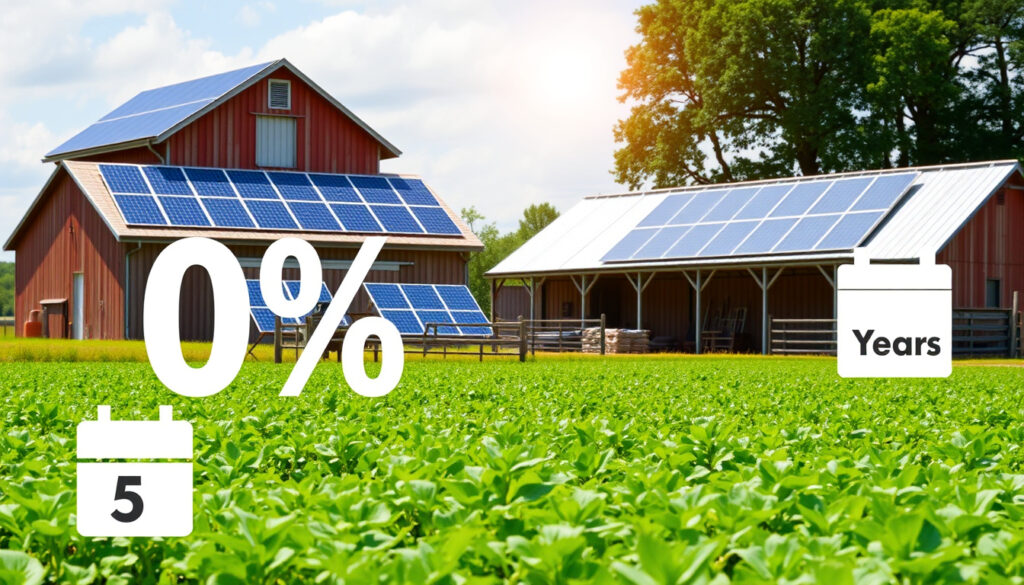
ASB Farm Solar Loans: 0% Interest for 5 Years – Full Guide
For New Zealand farmers, powering a dairy shed or irrigation pump with solar has always made sense on paper. But the upfront cost remains a real hurdle. ASB’s new Smart Solar Loan changes the equation — zero interest for five years on up to $150,000, designed specifically for rural properties. Here’s exactly how it works, who qualifies, and how it stacks up against other options.
Interest-free period: 5 years (0% p.a.) ·
Maximum loan amount: NZD $150,000 ·
Eligible customers: Rural customers with farm property ·
Solar panel lifespan: 25–30 years ·
Home solar loan rate: 1.00% p.a. for 3 years (up to $80,000)
Quick snapshot
- 0% p.a. interest for the first 5 years (ASB Bank)
- Up to $150,000 for solar and battery systems (ASB Bank media release)
- Eligible only for existing or new ASB Rural customers (ASB Bank)
- Minimum equity or LVR requirement for the farm loan
- Whether other NZ banks will launch matching 0% offers
- Specific criteria for combining the loan with government grants
- Loan launched at National Fieldays on 11 June 2025 (ASB Bank media release)
- Offer available until 15 December 2025 for new customers (ASB Bank media release)
- EECA demonstration fund projects must be installed by 30 June 2026 (EECA)
- After 5 years, Floating Base Rate + margin applies (ASB Bank)
- EECA co-funding for battery systems still available (EECA)
- Other banks may respond with competitive offers (ASB Bank)
The table below condenses the six numbers that matter most for a farmer weighing this loan.
| Attribute | Value |
|---|---|
| Interest rate (farm) | 0% p.a. fixed for 5 years |
| Maximum loan | $150,000 |
| Security required | Rural farm property |
| Interest rate (home) | 1.00% p.a. for 3 years (up to $80,000) |
| Solar panel lifespan | 25–30 years |
| Loan announcement | June 2025 |
Can I get an interest-free loan for a solar system in New Zealand?
Yes — ASB’s Smart Solar Loan for farmers is the only zero‑interest, large‑ticket solar loan currently on the market. It targets rural customers who generate the majority of their income from primary production on the farm.
What are the eligibility requirements for ASB’s 0% loan?
- You must be an existing or new ASB Rural customer (ASB Bank).
- Your rural farm property is used as security (ASB Bank).
- The main source of revenue must come from primary production on the farm (ASB Bank).
- Installation must be carried out by a qualified professional (ASB Bank).
- The loan is available only until 15 December 2025 for new customers and may be withdrawn at any time (ASB Bank media release).
What this means: ASB is using its own criteria to limit risk — the property itself backs the loan, and the bank retains discretion even if you meet the stated requirements (ASB Bank).
How to apply for an ASB Smart Solar Loan
Start by contacting ASB business banking. You’ll need to provide details of the solar system (including battery if applicable) and the installer you plan to use. The bank will assess your security and complete a standard loan application. Because the offer has a fixed‑term 0% period, processing times may be faster than for regular rural loans.
What type of loan is best for solar?
For on‑farm solar, the best loan minimizes interest outlay and aligns with the long payback period of the system. ASB’s 0% rural loan is hard to beat on interest cost, but other banks and government co‑funding can play a role.
ASB Smart Solar Loan vs. EECA co‑funding
The following table compares ASB’s farm offer with the government’s Solar on Farms Demonstration Fund (EECA). Together they create a powerful stack — you can use the grant to reduce the upfront cost and the loan to cover the remainder interest‑free.
Three options, one pattern: ASB’s loan provides full financing at zero cost for five years, while EECA offers partial grants that require data sharing and a battery.
| Feature | ASB Smart Solar Loan (Farm) | ASB Home Solar Loan | EECA Solar on Farms Fund |
|---|---|---|---|
| Interest rate | 0% p.a. for 5 years | 1.00% p.a. for 3 years | Grant (not loan) |
| Max amount | $150,000 | $80,000 | Up to $100,000 per farm |
| Eligibility | Rural customer, farm security | Homeowner | Farmers with battery system |
| Installation deadline | Flexible (offer ends Dec 2025) | Flexible | 30 June 2026 |
| Data sharing required | No | No | Yes — real‑time energy data |
The trade-off: EECA covers up to 40% of battery/inverter costs and 20% of other solar array costs (EECA), but requires you to share performance data. ASB’s loan has no such strings, but you’ll need enough property equity and a qualified installer. The pattern is clear: you can stack both programs to minimize upfront cash outlay while keeping the loan interest-free.
Kiwibank and Westpac solar loan options
Both Kiwibank and Westpac offer green loan products, but as of mid‑2025 neither has published a 0% rural solar loan at ASB’s scale. Farmers considering alternatives should compare variable rates, establishment fees, and whether the loan can be secured against the farm.
A 0% interest loan for five years saves a farmer borrowing $150,000 roughly $30,000 in interest at typical rural lending rates. That’s the difference between a positive cash‑flow year and a tight one.
What are the 20% and 33% rules for solar panels?
These rules are industry guidelines, not hard lending criteria. ASB does not publish them in its loan terms (ASB Bank).
How the 20% rule applies to solar system sizing
Some industry sources suggest a 20% cap relating a solar system’s cost to the property’s value — beyond that, the system may trigger different tax treatment. ASB’s loan security requirements effectively limit borrowing to the equity you hold in the farm, but no official “20% rule” is enforced by the bank.
Understanding the 33% rule for solar panel efficiency
The 33% figure often appears in net‑metering discussions: it limits exported solar power to roughly one‑third of total capacity. For on‑farm systems, where most of the power is consumed on‑site (milking, irrigation, coolers), export limits rarely bind. Neither ASB nor EECA references this rule in their farm solar programs. The implication: if you hear about these rules from a solar installer, ask whether they affect your specific farm’s grid connection. They are unlikely to affect loan eligibility.
What are the available farm grants for solar panel installation?
New Zealand’s main grant program for on‑farm solar is run by EECA. It’s designed to accelerate adoption by covering a substantial portion of hardware costs.
Government grants and subsidies for solar in New Zealand
- Solar on Farms Demonstration Fund — administered by EECA, covers up to 40% of inverter and battery system costs (capped at $450 per kWh of nominal battery capacity) and up to 20% of other solar array costs (capped at $410 per kWp), with a maximum grant of $100,000 per farm (EECA).
- Regional councils sometimes offer rebates for solar or battery storage — check with your local council.
How to combine grants with ASB’s 0% loan
There is no rule preventing you from using both. You can apply for the EECA grant to reduce the upfront system cost, then take out an ASB Smart Solar Loan for the remaining amount. The interest‑free period means you can repay the loan entirely before any interest kicks in — provided your grant covers a meaningful share of the system. ASB’s loan terms are silent on stacking with grants (ASB Bank).
What are the biggest disadvantages of solar panels and how long do they last?
Common reasons people remove solar panels
Most removals happen because of roof repairs, home renovations, or moving to a new property. In the farm context, panels may be relocated if sheds are rebuilt or if the energy demand shifts to a different part of the operation. One less obvious issue: inverter failures typically occur every 10–15 years, and replacements cost thousands of dollars.
Solar panel lifespan and degradation
Standard photovoltaic panels last 25–30 years with gradual efficiency loss — roughly 0.5% per year (ASB Bank references the 25–30 year lifespan). That means a system installed today would still be producing at 85–90% capacity in 2045. The main downside is weather dependency: on cloudy days output drops, so farms need either battery storage or grid backup. With ASB’s loan covering battery systems, that risk is manageable.
If you break the 5‑year fixed‑rate term, an early repayment adjustment may apply (ASB Bank). Farmers who might sell the farm within five years should factor this in — the interest saving evaporates quickly if the loan is repaid early.
Timeline: ASB farm solar loans
- 2024 — ASB introduces a 1% home solar loan (up to $80,000 for 3 years).
- 11 June 2025 — ASB launches the 0% Smart Solar Loan for farmers at National Fieldays (ASB Bank media release).
- 15 December 2025 — Offer for new rural customers expires (existing customers may still access it after this date at the bank’s discretion) (ASB Bank media release).
- 30 June 2026 — EECA demonstration‑fund installations must be completed (EECA).
- 30 June 2027 — ASB’s promotional 0% rate offer is officially stated as available until this date (may be withdrawn earlier) (ASB Bank).
The pattern: both ASB and EECA are using time‑limited incentives to accelerate on‑farm solar adoption. The window for the best combined deal (0% loan + grant) closes in late 2025/early 2026, so farmers need to move quickly.
Confirmed facts vs. what’s unclear
Confirmed facts
- ASB offers 0% interest for 5 years up to $150,000 to rural customers (ASB Bank)
- Loan requires farm property as security (ASB Bank)
- Solar installation must be by a qualified professional (ASB Bank)
- EECA grant covers up to 40% battery/inverter costs (EECA)
- Loan offer available until at least 30 June 2027 (ASB Bank)
What’s unclear
- Exact minimum equity or LVR requirement for the farm loan
- Whether other NZ banks will launch matching 0% offers
- Specific criteria for combining the loan with government grants
- What happens if farm ownership changes during the 5‑year term
What the experts say
“With a sunny 5 years interest‑free on up to $150,000 for solar and battery systems, the market‑leading product will help rural customers self‑generate power and lower energy costs.”
— ASB spokesperson (ASB Bank media release)
“The Solar on Farms Demonstration Fund is designed to help New Zealand farmers understand how solar and battery systems can work on their properties, while co‑funding the upfront cost.”
— EECA (New Zealand’s energy efficiency authority) (EECA)
The takeaway for New Zealand farmers
ASB’s 0% Smart Solar Loan is a genuine outlier — no other major bank in New Zealand has offered a zero‑interest product of this size for farm solar. Combine it with the EECA demonstration fund, and you can reduce upfront costs by 20–40% while borrowing the rest interest‑free for five years. For the farmer with good equity in their land and a clear energy plan, the decision is straightforward: apply before the December 2025 deadline, or risk losing the best on‑farm solar finance deal the market has seen. Farmers who hesitate may find themselves paying 6–8% interest on the same investment next year.
asb.co.nz, solarscout.co.nz, asb.co.nz, eeca.govt.nz, sunshinesolar.co.nz, solarscout.co.nz, sunshinesolar.co.nz, aasolar.co.nz, energypoint.nz
Frequently asked questions
What is the minimum equity requirement for the ASB farm solar loan?
ASB has not published a specific LVR (loan‑to‑value ratio) for this product. The bank states the loan is at its discretion, even when eligibility criteria are met (ASB Bank). Expect to need meaningful equity in the farm property.
Can I use the loan for battery storage as well as solar panels?
Yes — ASB’s Smart Solar Loan explicitly covers both solar and battery systems (ASB Bank media release).
How do I apply for the ASB Smart Solar Loan?
Contact ASB business banking directly. You’ll need to provide details of the solar system, the installer, and your farm’s financial information. The bank will assess the application and property security.
What happens after the 5-year interest-free period ends?
After the fixed 5‑year term, the loan reverts to ASB’s Floating Base Rate plus an applicable margin (ASB Bank). You can request a new fixed rate at that time.
Are there any application fees or early repayment penalties?
ASB notes that an early repayment adjustment may apply if you break the fixed‑rate term early (ASB Bank). There may also be standard establishment fees; check with your ASB rural manager.
Can I combine the ASB loan with government grants for solar?
Yes — there is no restriction preventing you from using both. In fact, the EECA Solar on Farms Demonstration Fund is designed to complement commercial financing. Use the grant to reduce the upfront cost, then the ASB loan for the remainder.
Does ASB offer the same loan for home solar systems?
No — the 0% rural loan is specifically for farm customers. ASB does offer a 1.00% p.a. home solar loan for up to $80,000 over 3 years, which is a different product (ASB Bank).
More related posts
 Fiordland Heavy Rain Watch: Status, Warnings & Safety Tips
 Blenheim Auckland Flight Diversion: Passenger Rights Explained
 ASB Bank Interest Rate Changes 2026: Current Rates & Forecast
 TVNZ News Live Now: Stream 1News and Watch Live Online
 Apple and Cinnamon Muffins: Complete Guide to Perfect Baking
 How to Save Money Tips: 30-Day Rule, 50/30/20 & More
 Main Street Cafe & Restaurant Menu: Prices, PDF & Reviews
 The Sands Browns Bay: Retirement Living & Care Guide