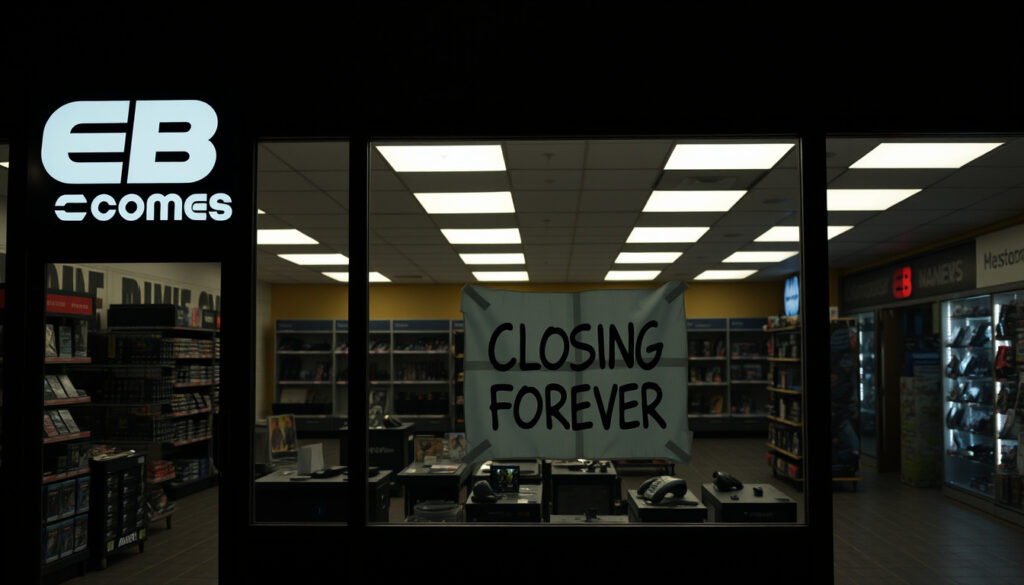
EB Games St Lukes Closing: Final Day, Reasons & What’s Next
There’s a particular ache in watching a game store ring up its last sale — and at Auckland’s St Lukes Mall, shoppers are feeling it in real time. The EB Games outlet is closing for good on 24 January 2026, part of a nationwide shutdown that will see all 38 New Zealand stores close by the end of the month, according to RNZ (NZ public broadcaster).
Final day of trade (St Lukes): 24 January 2026 · Crowds reported on: 15 January 2026 · Parent company: GameStop Corp. · Founded: 1992
Quick snapshot
- St Lukes closes on 24 January 2026 (1News (NZ national news outlet))
- All 38 NZ stores close by 31 January 2026 (RNZ (NZ public broadcaster))
- Shoppers waited about three hours for collectibles (RNZ report from the store)
- How many stores were still trading after the 22 January wave (1News shutdown report)
- Whether the EB Games name returns to New Zealand after the exit
- What fills the St Lukes floor space after handover
- Closure reported from 14 January 2026 (RNZ report)
- Sale began 15 January at 1pm NZDT (1News coverage)
- More than 20 stores closed on 22 January (1News shutdown report)
- Remaining NZ stores close by 31 January 2026 (1News shutdown report)
- Distribution centre closes 28 February 2026 (RNZ report)
- The St Lukes site returns to the mall’s retail mix
One retail name, one final date, one wave of closures — the key facts sit in a tighter frame than most shoppers realise.
| Fact | Detail |
|---|---|
| Store name | EB Games St Lukes |
| Address | Morningside Dr, Auckland, New Zealand |
| Final day | 24 January 2026 (1News shutdown report) |
| Parent company | GameStop Corp. (RNZ report) |
| Founded | 1992 |
| Crowd date reported | 15 January 2026 (RNZ report from the store) |
Why are EB Games closing down?
The short answer is that EB Games New Zealand ran out of runway inside GameStop’s global strategy. The parent company announced the exit in mid-January 2026, and the entire local network — 38 stores — is shutting down by 31 January, according to RNZ (NZ public broadcaster).
Industry competition from digital downloads
- Digital storefronts carry no rent, no shelf stock and no clearance racks.
- Physical game sales have been shrinking beside digital libraries for more than a decade.
- The St Lukes sale shows how much of the remaining demand was for leftover stock, not new releases.
St Lukes Mall makes the shift visible. A store that once needed aisles of titles now competes with a library that lives on a hard drive, and the closing sale made the consequences literal: 50% off everything, with retro items priced from $3, according to 1News (NZ national news outlet).
The same digital shift that emptied the shelves is what made the clearance sale so emotional: for a few weeks, shoppers could buy the physical past at a price that made the trip worthwhile.
GameStop’s corporate strategy
NZ stores closing: 38 · First-wave closures: more than 20 on 22 Jan · Distribution centre: closes 28 Feb 2026
GameStop has been shrinking its physical network for years, and the New Zealand operation became part of that arithmetic in January 2026. The company announced that all 38 stores would close by 31 January and the distribution centre by 28 February, RNZ reported. St Lukes was set for a later farewell than the first wave of stores — 24 January 2026, according to 1News (NZ national news outlet).
Impact of COVID-19 on retail
The pandemic didn’t create digital game buying, but it normalised it. Downloading a new release became the default habit for many players during lockdowns.
The result for mall game retail was a slow fade — until the parent company chose a hard exit. The strongest evidence at St Lukes is not a chart; it is the queue of about 500 people who turned up on 15 January once the discounts hit, as RNZ (NZ public broadcaster) reported from the store.
The pattern is straightforward: when a store’s economics depend on a shrinking format, the parent company eventually sets an end date. For EB Games NZ, that date landed in January 2026.
Where is EB Games shutting down?
The shutdown is nationwide, and it is happening in waves. 1News reported more than 20 stores closing on 22 January, with the remainder — including St Lukes — following by 31 January (1News (NZ national news outlet)).
EB Games St Lukes closure
- Final day of trade: 24 January 2026 (1News shutdown report)
- About 500 people queued outside the store on 15 January (RNZ report)
- Shoppers waited about three hours for collectibles (Inside Retail NZ (retail industry outlet))
St Lukes was not part of the first wave. The store stayed open past 22 January, and its closing sale turned the mall into a destination for collectors chasing discounted stock. RNZ described the local scene as gamers snapping up final deals (RNZ (NZ public broadcaster)).
Closure dates have caused confusion. EB Games’ nationwide timeline said stores would close by 31 January 2026; the St Lukes store’s own final trading day has been reported as 24 January 2026.
Other New Zealand store closures
- All 38 NZ stores close by 31 January 2026 (RNZ report)
- More than 20 stores closed permanently on 22 January (1News shutdown report)
- The NZ distribution centre closes on 28 February 2026 (RNZ report)
The first wave swept through malls and shopping strips across the country, cutting a wide path through the chain’s local presence. Inside Retail NZ reported that shoppers at St Lukes and other stores waited at least three hours to reach the counter, with collectibles, Pokémon cards, Lego sets and gaming accessories leading the rush (Inside Retail NZ (retail industry outlet)).
Global closures
When a chain exits a whole market, it rarely stops at the border. The NZ playbook is visible: announcement first, sale next, stores in waves, distribution last.
GameStop’s store network is far smaller than it was a decade ago, and the NZ closure shows how the chain now withdraws from a market it no longer wants to serve. 1News reported the wave-based structure of the shutdown, with the first batch of more than 20 stores closing on 22 January and the rest following by the end of the month (1News (NZ national news outlet)).
The implication: when a chain closes an entire national market, every mall storefront left behind becomes a marker of how quickly retail change can arrive. St Lukes was simply the most visible point on that map.
The pattern: a nationwide exit that started with an announcement and ended with a clearance sale, compressing years of retail decline into two weeks of visible change.
Is EB Games now called GameStop?
No — and this is where the brand gets confusing. EB Games and GameStop are the same corporate entity, and EB Games has been part of GameStop since the 2005 acquisition (1News (NZ national news outlet)). The local sign stayed EB Games because that was the name New Zealand shoppers knew.
History of EB Games and GameStop merger
- GameStop acquired EB Games in 2005.
- The “EB” traces back to Electronics Boutique, the chain’s original retail name.
- GameStop’s umbrella covered stores in North America, Australia, Ireland and New Zealand.
The names are not separate companies; they are two signs for the same owner. In New Zealand, the EB Games name survived under GameStop ownership right up to the final sales, which is why the St Lukes storefront looked familiar even as the parent company planned the exit (RNZ (NZ public broadcaster)).
Current branding in different countries
- Australia and New Zealand kept the EB Games sign.
- The United States and Canada traded under GameStop.
- Ireland’s stores carried the GameStop name, not EB Games.
The merged company kept the stronger local name in each market, which is why 1News reported the closures as EB Games stores closing, not GameStop conversions (1News (NZ national news outlet)). New Zealand never got the GameStop rebrand, and now it won’t need one.
Why the names differ
EB Games and GameStop are not rivals or siblings. They are one company wearing different local signs, which is why a store in Auckland could shut down while the same owner’s stores in North America kept trading.
That distinction answers the question that follows every closure announcement: is St Lukes turning into a GameStop? No. The 38 NZ stores are closing, not converting.
Who owns EB Games?
GameStop Corp., the US-listed specialty retailer, owns EB Games and the New Zealand stores trading under the name (1News (NZ national news outlet)). When the closure announcement landed, it arrived from the corporate level — the same company behind GameStop stores in North America and Ireland.
GameStop as parent company
- EB Games is part of GameStop Corp. (RNZ report)
- All 38 NZ closures were announced as one company decision.
- The NZ distribution centre belonged to the same owned network.
For customers, the ownership structure only became obvious at the end. The St Lukes store was not an independent shop; its fate was tied to a parent company’s view of the New Zealand market.
CEO of GameStop and EB Games
GameStop CEO since 2023: Ryan Cohen · Brand owner: GameStop Corp. · Local operator: EB Games NZ
Ryan Cohen, who has led GameStop since 2023, oversees the company behind EB Games NZ. The decision to close the local network was made at that corporate level, not by a separate local executive team.
Ownership history
- The business that became EB Games NZ dates to 1992.
- GameStop acquired the brand in 2005.
- The parent company exited the market two decades later.
The 1992 founding gave the brand a long local history — for a generation of Auckland shoppers, the EB Games sign was a permanent part of the mall. Those roots did not change the arithmetic when GameStop reviewed 38 stores and a distribution centre.
What this means: ownership was invisible until it wasn’t. A parent company hundreds of kilometres away made the call, and the St Lukes store became part of a global exit rather than a local failure.
The catch: the EB Games brand in New Zealand was always a local sign for a global operation, and that sign is now coming down for the last time.
Are there any Gamestops left in Ireland?
The short answer: not many. GameStop has closed most of its Irish stores in phases, and Ireland never used the EB Games name. The question keeps appearing because both brands belong to the same parent company — the structure behind the NZ closures reported by RNZ (NZ public broadcaster).
GameStop’s presence in Ireland
- Irish stores traded as GameStop, not EB Games.
- Most Irish locations have already closed.
- Ireland’s remaining footprint is a fraction of its former peak.
The forces that reduced GameStop’s Irish network are the same ones that ended the New Zealand chain: digital sales, mall rents and a parent company focused on its core North American market.
Comparison with EB Games
- Ireland: GameStop signs, largely closed down.
- Australia and New Zealand: EB Games signs; New Zealand closing in full.
- North America: GameStop signs, the chain’s core market.
The map explains the confusion: two countries used one name, most other markets used the other, and the owner is the same throughout, as RNZ confirmed in its coverage of the closure (RNZ (NZ public broadcaster)).
Why this matters for St Lukes
A question about Ireland is really a question about the whole brand family. The St Lukes closure is not the start of a global collapse; it is the end of one company’s patience with one national market.
That distinction matters because GameStop’s network still exists elsewhere. What ended in New Zealand was the EB Games name’s run in this country, not the company itself.
The catch: brand names outlive the companies behind them. EB Games means something specific in Auckland, just as GameStop does in Dublin — even when the same corporate hand is making the decisions.
Closure timeline: from announcement to final day
Two weeks separate the announcement from the St Lukes farewell, with the clearance sales compressing months of retail change into days.
- — The chain announces all 38 NZ stores will close; RNZ reports the decision (RNZ report).
- — The nationwide sale begins at 50% off; St Lukes queues peak around 500 people (1News coverage; RNZ report).
- — More than 20 stores close permanently (1News shutdown report).
- — St Lukes trades its final day (1News shutdown report).
- — The NZ distribution centre closes (RNZ report).
The compression is the point: a retail exit that might once have taken years is being executed in weeks. For shoppers, that speed created the urgency of the final sales.
What’s confirmed and what’s unclear
Fast-moving closures produce a clear split between what is settled and what is still open. Here is that balance sheet.
Confirmed facts
- EB Games St Lukes closes on 24 January 2026 (1News shutdown report).
- All 38 NZ stores close by 31 January 2026 (RNZ report).
- The closing sale offered 50% off everything, with retro items from $3 (1News coverage).
- The NZ distribution centre closes on 28 February 2026 (RNZ report).
What’s unclear
- How many stores remained open after the 22 January wave.
- Whether the EB Games name will return to New Zealand in any form.
- Which other Auckland locations could be affected as the wind-down continues (1News reported the wave structure).
- Whether remaining stock at St Lukes lasts until the final day.
The confirmed items give shoppers a fixed date and a fixed discount. The open items are about inventory and the long-term shape of game retail in Auckland — not about whether the St Lukes store reopens.
Voices from the final weeks
Three perspectives caught the mood of the shutdown: the broadcaster, the retailer’s own announcement, and the crowd in line.
“Heaving with crowds” is how RNZ described the St Lukes scene on 15 January, with gamers snatching final deals before the shelves emptied.
— RNZ (NZ public broadcaster)
EB Games NZ’s farewell to St Lukes was brief: final day of trade, 24 January 2026. A closing notice that turned an ordinary mall store into a destination.
— EB Games NZ via Instagram, reported by 1News (NZ national news outlet)
Shoppers described the scene 30 minutes before doors opened: the line already long, the shelves still full, and a three-hour wait already accepted.
— Shopper reports via Inside Retail NZ (retail industry outlet)
When a store this familiar closes, the real story isn’t the discount — it’s what the empty floor space says about how games are bought now. The EB Games name will disappear from New Zealand retail, and the St Lukes site will become a quiet marker of that change. For anyone who grew up browsing the racks on Morningside Drive, the choice is simple: make one more trip before 24 January, or watch the final chapter of mall gaming retail close from outside the shutters.
Related reading
support.jbl.com, localmint.com, nzherald.co.nz, ebgames.com.au, pcgamer.com, cheapies.nz, westfield.co.nz
Frequently asked questions
Does EB Games exist anymore?
Yes — but not in New Zealand after January 2026. All 38 NZ stores close by 31 January, while the EB Games brand remains in Australia, according to RNZ’s closure report.
Why are EB Games so overpriced?
Prices at EB Games often looked steep next to digital storefronts because a physical chain carries rent, staff and freight costs in every price tag. The closing sale reversed the usual logic: 50% off everything, with some retro items at $3, according to 1News.
Where is the biggest EB Games store?
There’s no official size ranking for EB Games locations, and the question is now mostly moot for New Zealand shoppers. The St Lukes store drew queues of about 500 people in its final weeks, RNZ reported.
What do EB Games stand for?
The “EB” comes from Electronics Boutique, the retail chain that became EB Games in Australia and New Zealand. GameStop, which owns the brand, kept its own name in North American stores and in Ireland.
Who is the CEO of EB Games?
EB Games operates as part of GameStop, so the CEO of the parent company is the CEO of the brand. Ryan Cohen has led GameStop since 2023, and the New Zealand exit was announced under his leadership (see 1News shutdown report).
More related posts
 Christmas Crack Recipe NZ: Salada Toffee With Dark Chocolate
 Car Insurance Quote NZ – Compare Prices, Providers & Costs
 ANZ Home Loan Rates Increase 2026: Latest Changes & Current Rates
 How to Draw a Flower – Step-by-Step Beginner Guide
 Radio New Zealand News: Live Updates, Streaming & Top Stories
 Christchurch Things to Do: Itineraries, Free Activities
 How to Fold a Fitted Sheet: Easiest Method & Hotel Tricks
 How Much Plastic Is in the Ocean? 2026 Stats & Facts